
Mind map
Immunoassays
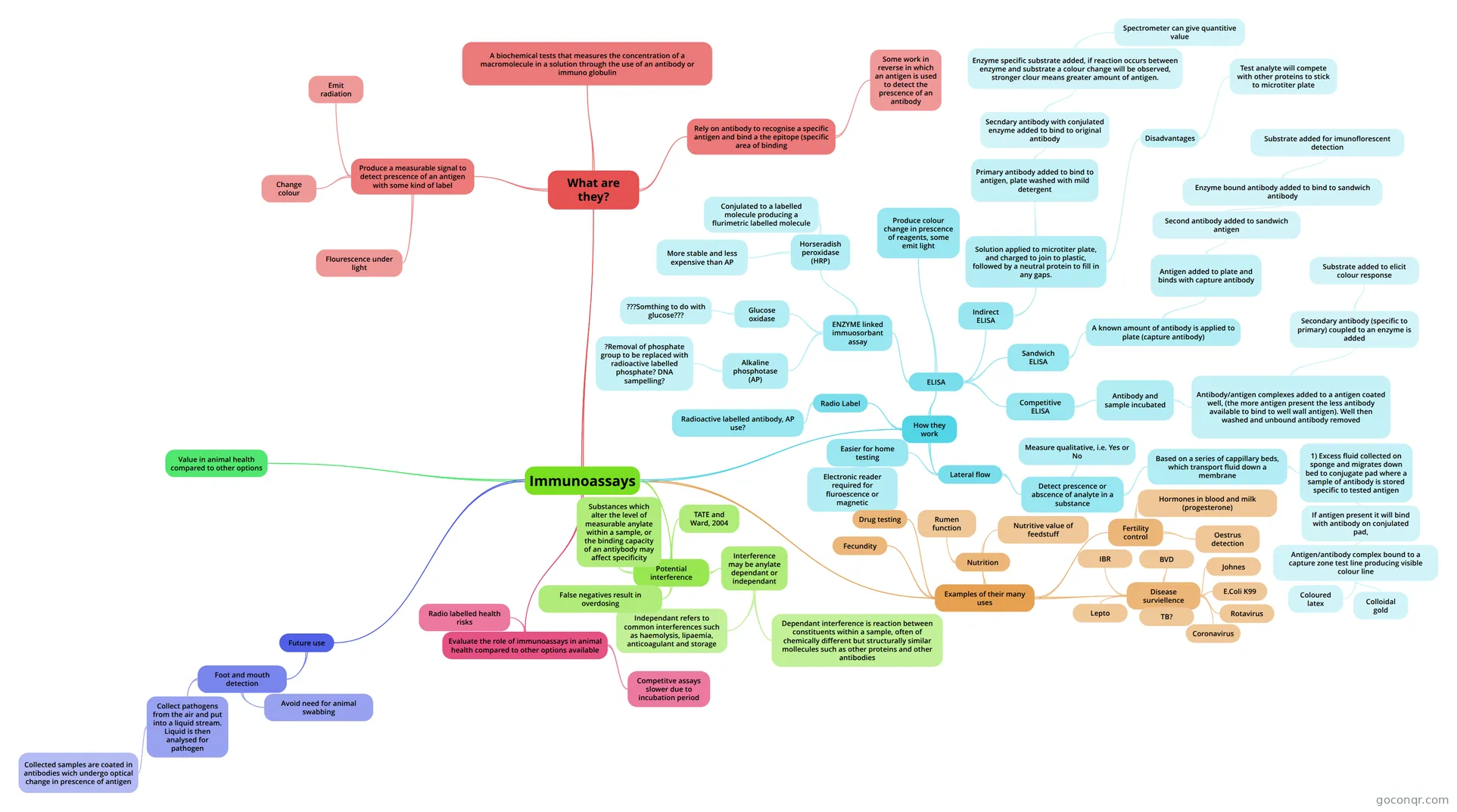
Mind map: Immunoassays in animal health
Map content
Immunoassays
Evaluate the role of immunoassays in animal health compared to other options available
- Competitve assays slower due to incubation period
- Radio labelled health risks
How they work
- ELISA
- ENZYME linked immuosorbant assay
- Horseradish peroxidase (HRP)
- Conjulated to a labelled molecule producing a flurimetric labelled molecule
- More stable and less expensive than AP
- Alkaline phosphotase (AP)
- ?Removal of phosphate group to be replaced with radioactive labelled phosphate? DNA sampelling?
- Glucose oxidase
- ???Somthing to do with glucose???
- Horseradish peroxidase (HRP)
- Produce colour change in prescence of reagents, some emit light
- Indirect ELISA
- Solution applied to microtiter plate, and charged to join to plastic, followed by a neutral protein to fill in any gaps.
- Primary antibody added to bind to antigen, plate washed with mild detergent
- Secndary antibody with conjulated enzyme added to bind to original antibody
- Enzyme specific substrate added, if reaction occurs between enzyme and substrate a colour change will be observed, stronger clour means greater amount of antigen.
- Spectrometer can give quantitive value
- Enzyme specific substrate added, if reaction occurs between enzyme and substrate a colour change will be observed, stronger clour means greater amount of antigen.
- Secndary antibody with conjulated enzyme added to bind to original antibody
- Disadvantages
- Test analyte will compete with other proteins to stick to microtiter plate
- Primary antibody added to bind to antigen, plate washed with mild detergent
- Solution applied to microtiter plate, and charged to join to plastic, followed by a neutral protein to fill in any gaps.
- Sandwich ELISA
- A known amount of antibody is applied to plate (capture antibody)
- Antigen added to plate and binds with capture antibody
- Second antibody added to sandwich antigen
- Enzyme bound antibody added to bind to sandwich antibody
- Substrate added for imunoflorescent detection
- Enzyme bound antibody added to bind to sandwich antibody
- Second antibody added to sandwich antigen
- Antigen added to plate and binds with capture antibody
- A known amount of antibody is applied to plate (capture antibody)
- Competitive ELISA
- Antibody and sample incubated
- Antibody/antigen complexes added to a antigen coated well, (the more antigen present the less antibody available to bind to well wall antigen). Well then washed and unbound antibody removed
- Secondary antibody (specific to primary) coupled to an enzyme is added
- Substrate added to elicit colour response
- Secondary antibody (specific to primary) coupled to an enzyme is added
- Antibody/antigen complexes added to a antigen coated well, (the more antigen present the less antibody available to bind to well wall antigen). Well then washed and unbound antibody removed
- Antibody and sample incubated
- ENZYME linked immuosorbant assay
- Lateral flow
- Detect prescence or abscence of analyte in a substance
- Measure qualitative, i.e. Yes or No
- Based on a series of cappillary beds, which transport fluid down a membrane
- 1) Excess fluid collected on sponge and migrates down bed to conjugate pad where a sample of antibody is stored specific to tested antigen
- If antigen present it will bind with antibody on conjulated pad,
- Antigen/antibody complex bound to a capture zone test line producing visible colour line
- Coloured latex
- Colloidal gold
- Antigen/antibody complex bound to a capture zone test line producing visible colour line
- If antigen present it will bind with antibody on conjulated pad,
- 1) Excess fluid collected on sponge and migrates down bed to conjugate pad where a sample of antibody is stored specific to tested antigen
- Easier for home testing
- Electronic reader required for fluroescence or magnetic
- Detect prescence or abscence of analyte in a substance
- Radio Label
- Radioactive labelled antibody, AP use?
- ELISA
Examples of their many uses
- Fecundity
- Drug testing
- Fertility control
- Hormones in blood and milk (progesterone)
- Oestrus detection
- Disease surviellence
- IBR
- BVD
- Johnes
- Lepto
- TB?
- Rotavirus
- Coronavirus
- E.Coli K99
- Nutrition
- Nutritive value of feedstuff
- Rumen function
Future use
- Foot and mouth detection
- Collect pathogens from the air and put into a liquid stream. Liquid is then analysed for pathogen
- Collected samples are coated in antibodies wich undergo optical change in prescence of antigen
- Avoid need for animal swabbing
- Collect pathogens from the air and put into a liquid stream. Liquid is then analysed for pathogen
- Foot and mouth detection
Value in animal health compared to other options
What are they?
- A biochemical tests that measures the concentration of a macromolecule in a solution through the use of an antibody or immuno globulin
- Rely on antibody to recognise a specific antigen and bind a the epitope (specific area of binding
- Some work in reverse in which an antigen is used to detect the prescence of an antibody
- Produce a measurable signal to detect prescence of an antigen with some kind of label
- Emit radiation
- Change colour
- Flourescence under light
Potential interference
- TATE and Ward, 2004
- Substances which alter the level of measurable anylate within a sample, or the binding capacity of an antiybody may affect specificity
- Interference may be anylate dependant or independant
- Independant refers to common interferences such as haemolysis, lipaemia, anticoagulant and storage
- Dependant interference is reaction between constituents within a sample, often of chemically different but structurally similar mollecules such as other proteins and other antibodies
- False negatives result in overdosing
Information
- Description
- Degree FAHAW Mind Map on Immunoassays, created by jamesryeomans on 18/05/2013.
- Created by
- jamesryeomans
- Views
- 96
- Tags
- Rating