
Mind map
CHF
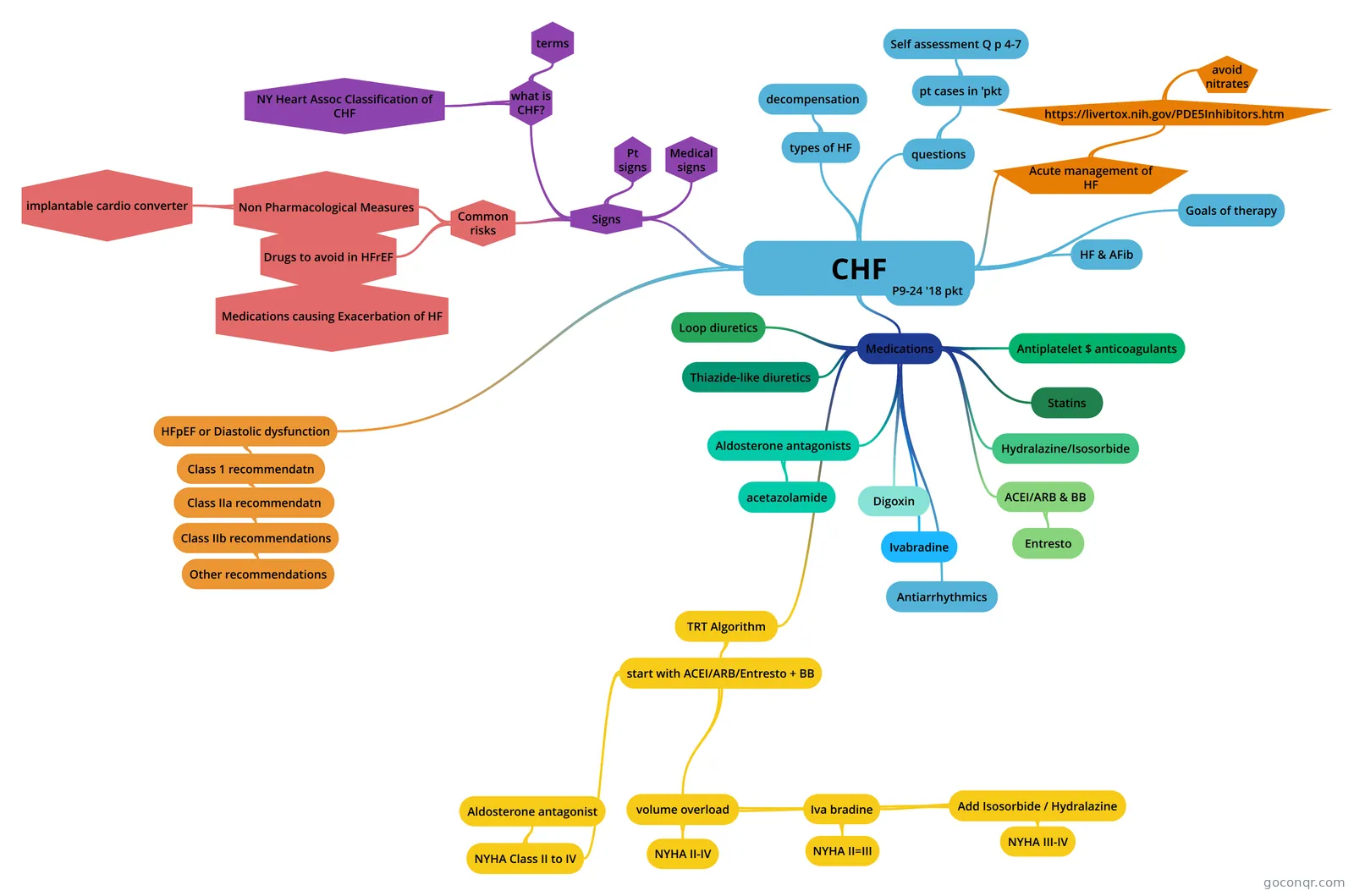
Mind map: CHF
Map content
CHF
Signs
- what is CHF?
- inadequate pumping of blood by the heart
- NY Heart Assoc Classification of CHF
- NYHA classes class 1 asymptomatic, no limitationsclass II winded with exercise asymptomatic at rest, slight limitationsclass III trouble with regular exercise, do have symptoms with exercise but asymptomatic at rest, marked limitationsclass IV most severe , symptoms of HF at rest, cannot carry out physical activity so class IV has symptoms at rest that's the diffall rest asymptomatic at rest Stages are also marked as A A at risk for HF , uncontrolled but no structural damage B structural damage but no symptoms C Structural damage with symptoms now(NYHA classes I to III, also IV) D refractory HF - need special interventions( is NYHA IV)
- terms
- SVR = afterload carvedilol see under BB will also decrease SVR thus decreases BP more than metoprolol succ
- Pt signs
- These are non lab value signs you can get in pt hx: fatigue/shortness of breath, dyspnea, cough edema in legs very commonfluid retention in abdomen(ascites) exercise intolerance- this how the NYHA classes are det' sudden weight over a few days if CHF is exacerbated
- Medical signs
- elevations in Pro-BNP or BNP is common in CHF exacerbations BNP: Brain natriuretic peptide is a hormone secreted by cardiomyocytes in the ventricles in response to stretching caused by increased ventricular blood volume. BNP is named as such because it was originally identified in extracts of porcine brain.
- Use echo-cardiogram to determine ejection fraction (normal is=/> 55%) but in CHF : ejection fraction of left ventricle is suppressed EF is <40% in HF
- Diuretics may be needed to get rid of fluids
- narrowing of arteries atherosclerosis and HPT are major contributors which affect ability of heart to pump
- P may have atrial fib / tachy
- Common risks
- HPT, CAD, MI, valvular heart dx DM Obesity, Smoking, Meds that increase HF risk: a) Thiazolidinediones- Pioglitazone b)NSAIDS c)Lyrica , Gabapentin d)Ca channel blockers
- Non Pharmacological Measures
- lose wt, guided exercise, less alcohol, control DM, watch diet, control HPT * alcohol can be the cause of cardiomyopathy- in this case stop alcohol periodNa intake limited to at least under 3g per day for stages C/DIf still having fluid excess: can restrict fluid intake to 2L per day for stage D
- Watch electrolytes to avoid arrhythmia esp watch K Watch Thyroid function as hypothyroidism can be masked by HF while hyperthyroidism can worsen systolic symptoms Also keep ahead with vaccinations annual flu shot Pneumonia shot q 5 yr
- implantable cardio converter
- recommended for SCD prevention in HFrEF but life expectancy has to be >1 yr and pt must be at least 40 days post-MI(class 1 indication). This applies to patients with a) LVEF < 35% and NYHA class II or III symptoms on chronic optimal therapy b) LVEF <30% from previous MI and NYHA Class I symptoms
- Drugs to avoid in HFrEF
- a)NSAIDS : large dose may cause pt to decompensate bc cause water retention, worsening of HF b)Corticosteroids : cause volume retention so can worsen HF and cause decompensation c) Hormonal therapy but Levothyroxine is ok if TSH is good around 2.6 since hypothyroidism and Hyperthyroidism is bad for HFd) Nutritional supplements which stimulate sympathetic system work in opposition to BB in HF (BB aims to block the sympathetic hormones)
- )class I and III antiarrhythmics are not for HFrEF , exception can use dofetilide and amiodarone e)non dihydropyridine CCB (Verapamil, Diltiazem) should be avoided in HFrEF pt Why? can cause edema Also they can decrease HR and have negative inotropic effects so should be avoided in HF (Class III recommendation)
- Medications causing Exacerbation of HF
- Better 2018 list : what causes HF or worsens HF:NSAIDS; p 23 ,a) incl COX 2 inhibitorsb) worsens HF bc Na/water retentionc) diuretic response is blunted d) increase morbidity, mortality
- Corticosteroids: p 23, a) Na and water retention
- Class 1 and III antiarrhythmic agent however can use amiodarone, dofetilide a)neg arrhythmic action b) Pro arrhythmic effects c)amiodarone and dofetilide safe in HF d)Not multaq dronaderone CI in symptomatic HF with recent hospitalization for class IV
- CCB except amlodipine and felodipine a) use of negative inotropic activity is discouraged in ACC/AHA guidelines and these have -ve inotropy b)promote neurohormonal activation c)amlodipine and felodipine safe in HF and can be added when additional BP reduction is needed- watch for edema
- Minoxidil: a) promotes Na and water retention b) stimulates renin-angiotensin-aldosterone system
- thiazolidinediones glitazones like Actosalso promote Na and water retention like NSAIDS, Minoxidil too
- Metformin increases lactic acidosis (black box warning)
- Amphetamines eg Ritalin a) alpha and beta agonist activity b) Causes tachycardia c) pro-arrhythmia effects
- Cilostazol inhibits Phosphodiesterase type 3
- Itraconazole negative inotropy
- Lyrica Inhibits Ca channel exacerbates HF lower extremity edema in legs
- Nutritional supplements no regulation ...could interact , increase risk of bleeds
- Hormonal: may increase risk of adverse CV events
- what is CHF?
Medications
- Loop diuretics
- Inhibit Na reabsorption(20-25%) in in ascending loop Furosemide- used most often but bioavaliabilty is bad 10-67% especially with gut edema - po furosemide may be poorly absorbed. this is when we may try others below or do iv 20-40mg qd/bid(max 600)Torsemide 80-100% oral bioavailability 10-20mg qd (max 200)Bumetanide also 80-100% oral bioavailability , 0.5-1 mg qd/bid (max 10)Ethacrynic Acid((Edacrin)- not used much. Advantage is it does not have a sulfur group like the others so may be used in pt with severe S allergy - but drug is not so available Bioavailability= 100% p12 Dose 25-50 mg qd/bid (max 200)all have 6-8h duration except torsemide is longer 12-16 h All have different po bioavailability so watch when switching between them. Only torsemide is once daily longer duration others qd or bid
- Loop diuretics can change electrolytes dramatically- like K,Mg,Ca, Na so monitor electrolytes FOr CV dx: aim for >/= 4 for K and >/= 2 for Mg to avoid arryhtmiasLoop diuretics are preferred b/c keep working with poor renal functionFluid is removed but watch for dehydration- so kidneys will not be perfused so monitor CrCl. Diuretics can cause acute injury to kidney with overdiuresis. SCr goes up as pt gets more dehydrated
- lowers BP so watch orthostasis don't dose too late as frequent urination - worse with elderly Place: for fluid retention Short term will decrease jug venous distension, decrease pulm congestion, and peripheral edema Intermittent: decreased daily symptoms, increase exercise tolerance Long term no benefit to mortality ********
- Diuretics should be combines with ACEI, BB, ARA. Loop van be combined with diff diuretic for synergy to dose look at pt wt and diuresis as needed With loop diuretics start at low dose then double the dose and titrate to get about 1 kg wt loss/day - more as inptLong term: adjust so pt is euvolemic.
- Thiazide-like diuretics
- Thiazides inhibit Na reabsorption(10-15%) in distal loop HCTZ 25mg qd/bid max 100mg duration 6-12hMetolazone 2.5mg qd (max 20mg) duration 12-24hChlorthalidone12.5- 25mg qd max 100mg lasts 24-72 h duration thus qdChlorothiazide 250-500mg qd or bid max 2000mg duration 6-12h Most often used to promote fluid loss Better for pt with reduced kidney function cf to HCTZ Dosing once or twice per week with loop diuretic Need to monitor electrolytes and kidney function- especially if used with loop diuretics and K sparing diuretics
- Diuretics: A.Short-term benefits(takes days): a) decreased jugular venous distension b) decreased pulmonary congestion c)decreased peripheral edema B.Intermediate-term benefits(takes weeks or months): a)decreased daily symptoms b) improved cardiac function c)increased exercise tolerance C. Long-term benefits (months to years) no effect on mortality
- Diuretics: a)generally not used as monotherapy b)initiate for volume overload and adjust so pt loses 1-2 lb each day - loop diuretics are the ones used for this . Thiazide like diuretics don't work as well but metolazone (thiazide like) can be added to loop diuretics. c)Chronic therapy adjusted to maintain euvolemia d)monitor electrolytes esp loop _ metolazone (thiazide) e)start with low dose and may double and titrate
- Aldosterone antagonists
- Aldosterone Receptor antagonist (ARA) Spironolactonefor NYHC III to IVSE gynecomastia- can painstart with 12.5mg daily or 25mg qd Dosing is renally adjusted p3 and also depends on K level.If after 1 month of initial dose if K not >5 and crcl >50 ml/min , can dose at 25mg qd or 25mg bidHF compelling indication. Should be used in Class II to IV of New York HF classification system so the moment there are symptomswith ejection fraction < 40%Also, given after MI if pt has symptoms/signs of HF or DM hx plus LVEF<40%See HPT for more infoAlso need to monitor BP as spironolactone can drop BP quickly
- Eplerenone (Inspra) for NYHC II can switch to Eplerenone if pt has painful gynecomastia with spironolactone start at 25mg daily but dose depends on K level and crcl p3 for renal adjIf after 1 month of 25mg qd, can go to 50mg qd if crcl >50ml/min and K not>5
- dosing of both drugs depends on crcl and K level Why K level? these drugs are K sparing Stop use if K> 5 and remember these pts are on ACEI which are K sparing too. Check K levels if dose of ACEI is changedWhy crcl: they work on aldosterone- see p4 Do not use if crcl <30ml/min renally dose if crcl 30-49ml/min if crcl =30-40 eplerenone 25mg qod and if after 1 month K not>5 and crcl=30-49ml/min can go back to 25mg qd EplerenoneSpironolactone:if crcl=30-40 dose at 12.5mg qd and if crcl =30-49ml/min after 1 month can go up to 25mg qdSCr should be less than 2.5 for men and 2 in women. or crcl> 30ml/min. K<5Need to check SCr in first 2-3 days then at 7 days then monthly x3 then q3 months
- Aldosterone, the main mineralocorticoid hormone, is a steroid hormone produced by the zona glomerulosa of the adrenal cortex in the adrenal gland. It is essential for sodium conservation in the kidney, salivary glands, sweat glands and colon. It plays a central role in the regulation of the plasma sodium, the extracellular potassium and arterial blood pressure. It does so mainly by acting on the mineralocorticoid receptors in the distal tubules and collecting ducts of the nephron. It influences the reabsorption of sodium and excretion of potassium of the kidney, thereby indirectly influencing water retention or loss, blood pressure and blood volume. When dysregulated, aldosterone is pathogenic and contributes to the development and progression of cardiovascular and renal disease
- When would you start an aldosterone antagonist: this is a 4th drug class to use: HF pt will already be on BB, ACEI/ARB, diuretic now want to add this 4th drug but when can you? a)LVEF < 35% in class II-IV (if it's class II they should have been in admitted for CV dx before + have high BNP indicating HF) b) also recommended after acute MI + signs / symptoms of HF or hx of DM and EF<40% start this 4th drug
- acetazolamide
- 250mg bid - cardiologist order for CHF Acetazolamide moa: AcetaZOLAMIDE, a non-bacteriostatic sulfonamide, inhibits carbonic anhydrase from catalyzing the reversible hydration of carbon dioxide and dehydration of carbonic acid. In the eye, carbonic anhydrase inhibition reduces aqueous humor production resulting to a decrease in intraocular pressure. It also delays abnormal, paroxysmal excessive discharge from central nervous system neurons and affects promotion of diuresis and urinary alkalinization [4]
- Digoxin
- no mortality benefits but does reduce hospitalizations and does improve exercise tolerance What is the place of digoxin in HF? Newer evidence/studies show ACEI and BB benefits so these are used first in HF but if after max doses of these- pt still shows signs of HF and LVEF<40% still can use Digoxin. Digoxin will drop HR and once that happens cannot titrate a BB so this is why must be sure to add ACEI and BB first then add Digoxin. Be careful with hypokalemia risk especially if also on loop or thiazide-like diuretics :Low K can increase SE / toxicity with diuretics. See atrial fibrillation for more info
- MOA a)decrease in sympathetic outflow b)decrease Na re-absorption at kidneys c)mild increase cardiac contractility
- Digoxin dosing 0.125 mg qd initially Aim for serum level of < 1 ng/ml Dose depends on age/crcl/low K/ low Mg - low K ,Mg can increase toxicity It is 95% renally excreted so need to monitor SCr
- So for Digoxin pt monitor serum levels and SCr daily
- ACEI/ARB & BB
- used in CHF a lot. ACEI and BB work differently in HF so need both drugs in HF unless C/I. Both needed if EF <40% ie HFrEF but for BB watch if pt is decompensated.HF pt needs both ACEI and BB bc they treat HF in different ways. Use optimal doses of both.they do improve mortalitySee HPT for more info
- BB: used in HF a lot bc it improves cardiac function. MOA: blocks effect of NE and sympathomimetics on heart /vasculature thus decreases ventricular arythmias(SCD) decreases cardiac hypertrophy, and cell death in heart, decreases vasoconstriction, HR Carvedilol also will produce alpha 1 blockade thus further decreases SVR (afterload) and reduced BP more than metoprolol for this reason Beta 1 blockade allows the heart to not over work and saves lives this way(used to learn BB not good in HF- but that is only in decompensated pt)BB can be used in HF unless CI or if pt is decompensated. Use BB is LVEF<40% ie HFrEF, unless CI Class I indicationBenefit when added to ACEI:Improves mortality 35% RR cf to placeboimproves EFdecreases hospitalizations =25% RR cf to placebo
- Which 3 BB are used in HF guidelines? Bisoprolol, Carvedilol and metoprolol succinate are recommended in HFrEF Good in HF - bc greater mortality reductionWhen to add to ACEI?1)when euvolemic- if pt is not euvolemic and they are fluid overloaded always add diuretic and BB(not BB alone in fluid overloaded pt)2)when HF is stable3)should be considered even with reactive airway dx or asymptomatic bradycardia4)don't dc abruptly in HF bc ppt clinical symptoms Dosing: start low, double every 2 weeks to target dose in 8-12 weeks but improvement may take months** metoprolol tartrate is not in HF guidelines- only succinate isCarvedilol : 25mg bid ok dose for <85kg>85 kg dose is 50 mg bid. start with 3.125mg bidCarvedilol CR: start with 10mg qd target 80mg qdBisoprolol: start with 1.25mg qd target dose 10mg qdMetoprolol succ 12.5mg qd target 200mg qdWith BB: monitor BP and HR if you start at a higher dose it can cause bradycardiadon't want HR in 40's !! so watchMonitoring:a) watch BP, HR and for hypotension or bradycardia monitoring in 1-2 weeks 1% have bradycardia, dizziness, hypotension thus lower dose by 50% b/c BB help with greater mortality reduction, if there is low BP as S/E try to lower ACEI dose first instead of d/c the BBb)edema S/E thus monitor in 1-2 weeks 2% have this thus increase diuretic dosec) fatigue/weakness may need to dec dose but it resolves usually on its own
- ACEI very compelling evidence that these save lives(mortality dec by 25-50% risk reduction) + decreased hospitalizations( 30 % risk reduction)MOA: (in CHF good so use in any pt with EF<40% unless CI)1)Block Angiotensin II productionwhat is the result of less A II?a) decrease sympathetic stimulation b)decrease production of aldosterone and vasopressinc) decrease vasoconstriction(preload and afterload)2)increase bradykinin bc decreased their metabolismso seea)increase vasodilatory prostaglandinsb) may reduce myocardial remodeling
- ACE I dosing , SE etc Start 2 low dose and double every 1-4 weeks to target. High doses did not affect mortality but did lower risk of death or hospitalization in general or hospitalization from HF issues. May take several weeks to see improvement.Need to check how they respond to these drugs at low dose first bec they a)increase SCr -may increase 30% transiently which is ok. Very rarely see ARF is dehydrated.Avoid overdiuresis. ( caution if SCr>3). Check SCr for 1-2 weeks after starting. b) decrease BP so check for for hypotension caution if SBP<80c) K caution if baseline>5 mEq/L - check within 3 days after initiating and for 1-2 weeks atstart. In studies 2% reported but reality is 20%.d) use with caution in bilateral renal artery stenosisDecrease dose by 50% or Dc if K > 5.5m Eq/LSE in 10% pts a)20% have coughb)1% have Angioedema with ACEI thus avoid use with Angioedema from ACEI Can switch to ARB but 1%-2.5% cross allergy Also avoid ACEI in pregnancy
- ARB MOA: selectively block binding of Angiotension II to angiotensin I receptor. ARB are not superior to ACEI for HFrEFIt is an alternative to ACEI eg if pt has a cough, angioedema with ACEI( class I)everything else like for ACEI p14ARB:Candesartan 4-8mg qd target 32mgLosartan start @ 25-50mg qd Target 150mg qdValsartan 20-40mg bid target 160mg bidACEI:Only captopril and enalapril are not qd . Captopril max = 50mg tid= targetEnalapril = 20mg bid (max) , Target=10 mg bid Lisinopril, Perindopril, Ramipril, Trandolapril are all qd
- BB MOA in HF: a)blocks the effect of NE and other sympathetic neurotransmitters on the heart and vascular system i) decreases ventricular arrhythmias (sudden cardiac death) ii) decreases cardiac hypertrophy and cardiac cell death iii) decreases vasoconstriction and HR b) Carvedilol also provides alpha 1 blockade so it further decreases SVR and provides greater BP reduction than metoprolol succinate so Carvedilol is actually recommended for HF
- Entresto
- Sacubitril + Valsartan (Sacubitril is a prodrug and needs to be converted to work) Entresto also called ARNI (due to MOA) Indications:Indicated for HF ptie use ACEI , ARB or Entresto bc of renin angiotensin system inhibition. Recommended by 2017 ACC/AHA/HF Society for HF guidelines. Its a class I recommendation if used in conjunction with BB, ARA in chronic HFrEF (to reduce morbidity/mortality)Another class I recommendation: In NYHA Class II & III who have HFrEF symptoms - you can replace ACEI or ARB with Entresto to further reduce morbidity/mortality. 2nd indication- if BNP is low can use Entresto MOA: Sacubitril: blocks natriuretic enzyme neprilysin which normally breaks down peptides. So by blocking neprilysin, these peptides levels go up and net effect is relaxing of bv + decreased Na and fluid Valsartan = ARB Angiotensin I Receptor Blocker and inhibits AII dependent aldosterone release thereby reducing BV tightening and reducing Na and fluid excess
- IMPT: a) if transitioning from ACEI to Entresto need 36 window period - if not get increased risk of angioedema b) if pregnant pt- cant be on ARB so stop Entresto c)if naive to ACEI use 24/26mg tab bid if switching from ACEI, use 49/51 mg bid d) monitoring i)angioedema, hypotension ii)monitor SCr , K 1-2 weeks after initiating/increasing dose esp with DM,Azotemia, K tabs, decreased BP already
- A brain natriuretic peptide (BNP) test measures the amount of the BNP hormone in your blood. BNP is made by your heart and shows how well your heart is working. Normally, only a low amount of BNP is found in your blood. But if your heart has to work harder than usual over a long period of time, such as from heart failure, the heart releases more BNP, increasing the blood level of BNP. The BNP level may drop when treatment for heart failure is working.
- in normal function BNP is low. IN HF heart is working harder and BNP levels will be higher. Can help diagnose HF.
- Statins
- important for atherosclerosis but not recommended for HF diagnosis
- Antiplatelet $ anticoagulants
- assess for need for antiplatelet therapy
- In atrial fibrillation as a symptom in HF : need to add anticoagulation ( any a/c okay) This is only if its persistent/paroxysmal/permanent AF with additional risk of stroke No a/c recommended if no AF or no risk of stroke/ stroke Hx or cardiac embolism
- Hydralazine/Isosorbide
- These are added to ACEI or BB to decrease mortality/morbidity or if the pt has hx of HF and cannot use ACEI or BB - hydralazine and isosorbide are options Also use in Black pt with class III to IV HF (on NYHA system )
- MOA Hydrallazine is an arterial vasodilator thus reduces afterload and it increases effect of nitrates thru antioxidant mechanism Isosorbide dinitrate is a venous vasodilator and reduces preload stimulates nitric acid signals in endothelium
- Hydrallazine dosing 75-300 mg qd 3-4 divided doses S/E lupus Isosorbide dinitrate 60-120mg qd in 3-4 divided doses too Bidil (combo hydrallazine 37.5mg/isosorbide 20mg) 2 tabs tid MD
- TRT Algorithm
- algorithm see p 22 so for non black pt: ACEI/ARB/ARNI +BB if volume overload- add loop diuretic If class II-IV HF can add aldosterone antagonist
- for Black pt: Avoid ACEI/ARB/Entresto Go go hydralazine/Isosorbide and add loop diuretic for fluid overload and then add aldosterone antagonist for class II to IV NYHA
- start with ACEI/ARB/Entresto + BB
- volume overload
- For NYHA Class II-IV HFrEF: add loop diuretic or maximise loop diuretic dose for Stage II to IV with HF signs of overload
- Add Isosorbide / Hydralazine
- If intolerant to ACEI/ARB/ARNI or If NYHA stage III - IV in African American pt and persistently symptomatic need Hydralazine/ Isosorbide
- Iva bradine
- class II a recommendation for NYHA Class II - III if symptomatic with HR>70 bpm
- NYHA II=III
- NYHA III-IV
- NYHA II-IV
- NYHA Class II to IV
- NYHA Class II-IV HFrEF Add aldosterone antagonist if K <5Crcl >30ml/min
- Aldosterone antagonist
- volume overload
- Ivabradine
- Iva-bradine for SA node action approved 2015 MOA selective inhibition of If current in sinoatrial node providing HR reduction Class IIa recommendation when they updated HF guidelines: to reduce hospitalizations if pt is on max doses of BB but still having sinus rhythm SR with HR>/= 70 bpm at rest. This is for HF pt with NYHA class II or III with symptoms and with HFrEF ie LVEF< 35% Use to decrease endpoint CV death or hospitalisation for HF (18%RR) decrease HF 26% RR
- Dosing of Iva-bradine: start at 5mg bid (max 7.5mg bid) BB decrease mortality and this is proven so before switching to this drug, need max doses of BB if tolerated or CI to BB use before assessing at rest to consider this drug. (if max doses of BB used and HR> 70bpm at rest then consider it...) Increasing do depends on HR after 2 weeks: 50-60 bpm no change > 60 bpm increase by 2.5mg bid <50 bpm decrease by 2.5mg bid
- SE and monitoring: 3% had phopshenes (transient rings or spots of light bradycardia 6-10% & AF 5-8% so check after 2 weeks and periodically
- Antiarrhythmics
- Antiarrhythmics have a neutral effect on mortality...so preferred antiarrhythmics are dofetilide for AF/ atrial flutter or amiodarone
- Loop diuretics
Acute management of HF
- Identify the cause and fix it (infection/MI/ arrhythmia)
- Add loop diuretic for fluid overload pt/fluid retention=class I Short term benefit: dec jug vein pressure, decreased pulmonary congestion, decreased peripheral edema Intermediate benefit:dec daily symptoms, increased exercise toleranceLong term benefit: no change in mortalitymay need more aggressive dosing for pt who are already on loop diuretics or have poor renal function
- Oxygen administer if PO2 <90
- Urgent or Significant HPT: Nitroprusside =vasodilator Warning on severe hypotension so need to watch BP closely Risk of CN toxicity so watch- use short term only If pt BP responds to diuretic alone- and BP is normal to moderate- initiate nitroglycerine
- If pt has systolic dysfunction (low ejection fraction- usually considered <40%) and severe symptoms with shock or possible shock : start inotrope a) Dobutamine i) can raise BP instead of lowering it ii)Correct K and Mg levels to reduce risk of arrhythmias b) Milrinone i) more effective if pt was on BB as Milrinone acts via phospho-diesterase inhibition vs dobutamine which works via Beta receptor activation ii)monitor BP for hypotension and monitor for arrhythmias iii) arrhythmia risk so correct electrolytes iv)reduce dose with poor renal function c) if unsure of ejection fraction and possible signs of shock: consider i)consider inotrope (dobutamine, milrinone) ii)consider NE or Epinephrine
- Phosphodiesterase inhibitor A phosphodiesterase inhibitor is a drug that blocks one or more of the five subtypes of the enzyme phosphodiesterase (PDE), thereby preventing the inactivation of the intracellular second messengers cyclic adenosine monophosphate (cAMP) and cyclic guanosine monophosphate (cGMP) by the respective PDE subtype(s).
- Dobutamine is a direct-acting agent whose primary activity results from stimulation of the β1-adrenoceptors of the heart, increasing contractility and cardiac output. Since it does not act on dopamine receptors to induce the release of norepinephrine (another α1agonist), dobutamine is less prone to induce hypertension than is dopamine. Dobutamine is predominantly a β1-adrenergic agonist, with weak β2 activity, and α1 selective activity, although it is used clinically in cases of cardiogenic shock for its β1 inotropic effect in increasing heart contractility and cardi
- https://livertox.nih.gov/PDE5Inhibitors.htm
- avoid nitrates
questions
- 1. 50 yo Kim HF EF 20% Ans increase carvedilol to optimise therapy K >5 so don't increase ACEI dont add spironolactone Don't add Digoxin as we need to optimize trt first
- pt cases in 'pkt
- Q1 p9 need to know recommended doses for HF: 1. LS 48y female 69kgBP 112/70, HR 68bpmalcohol induced cardiomyopathy LVEF<20 , sympomatic(fatigue/dyspnea, no edema)meds ACEI, diuretic, BB, aldosterone antag,digoxin (level .7)optionsa) carvedilol incr to 25mg bidb)inc lisinopril to 80mg qdc)inc spirono to 50mg qdd) inc dig to 0.25 qdLabs: Na,K, bicarb, Ca, Phos, Mg, me: no alcoholDiuretic, BB neededwon't increase carvedilolol bc BP is low (not a), wont increase dig bc therapeutic 0.5-0.9 (not d)Choice bet b and c. Need more fluid out for lung symptoms- go with increase spironolactoneanswer:A) Carvedilol start at 3.25 bid max 25mg bid (p 15 says even with resp issues, and asymptomatic bradycardia can still use BB ..higher doses mean more reduction in mortality) she is only at 12.5mg bidB)ACEI start at 2.5-5mg qd with lisinopril target 20mg qd max= 40mg qd but prefer to reduce ACEI and increase BB if BP is getting lower. (pt is at max dose 40mg qd) no change needed hereC)spirono start at 12.5mg qd and depends on crcl MD 25mg qd she is that max dose 25mg qd already no need to increase to 50mg qdD)no need as level is goodActual answer:A bc BB will reduce mortality just monitor HR , BP her HR is 68 not bad
- Q2 pt case p 9 : 62 yo man ,CHD, PAD , MI 3 yrs ago, CKD- SCr 2.8 mg/dl, Hypothyroidism BP 120/70, HR 72bpm K 4.1 TSH 2.6 Drugs : Asp 81mg qd Simv 40mg qhs Enalapril 5mg bid, Meto succ 50mg qd Fur 80mg bid Cilos 100mg qd, Sertaline 100mg qd, Levothyroxine 100mcg qd, Tylenol Me: main problem is kidney..SCr> 2.5 therefore won't want to add full dose sprinolactone so C is wrong(for renal dose 12.5mg qd or qod dosing is needed) D is wrong bc you have to optimize diuretics, BB and ACEI first then try digoxin if pt has symptoms and A is wrong bc carvedilol just will lower BP more than others bc of alpha 1 action so no need for change in BB Ans: A to optimize ACEI dose
- Q3 p21: continues from Q2 p9 Which drug would you dc due to HFrEF? a)Tylenol b) Sertraline c) Cilostazol d)Levothyroxine Me : avoid hormonal trt going with D correct answer : Cilostazol bc its a phospodiesterase inhibitor PDE and can increase Ventricular arrhythmias and death in HF. so C = correct
- Self assessment Q p 4-7
- p4 Q1 58 yo woman with HTN, CHD,MI 4 mo ago, dyslipidemai, LVEF <35% , BP 138/80 HR 58 Class III NYHA not worsening signs cf to baseline for dyspnea so stable Meds: a) Meto 150mg qd b)asp 81 c)ator 40 A.Do we conitinue B.Start dig Cstart spiro 25mg qd Dstart ACEI 5mg lisino Me: answer D bc need maximal ACEI+BB+diuretics Answer D: reason for HF Class III is MI. A is incorrect bc need BB and ACEI optimal B is incorrect bc before Digoxin need optimal BB, ACEI C spironolactone is after optimal doses too So D add ACEI
- q2 p5 answer p 67 JO 64 yo fem, labs ok, NYHA class II LVEF 30, Euvolemic, BP 130/88, HR 78 Meds a) Enal 10mg qd b)Lasix 40mg bid c)K 20mEq bid Me: top 3 for HF should be optimal ie ACEI, BB. Can go to 20mg bid with ACEI but bigger issue is BB is missing so goingwith C correct ans - COptions: A continue as isB inc ACE to 20mg bid not necessary bc 10mgbid is target ACEI enalapril unless BP high C start carvedilol answer bc will reduce mortality/morbidityD start dig no bc other initial trt options are not optimal
- p 5 Q3 JM 65 y fem, poor adherence so SOB, dec exercise tolerance, LVEF >65% , HFpHF bc diastolic dysfunction, BP 128/78, HR 98bpm Meds: ER Nifedipine 90mg qd, HCTZ 25mg qd, Me: need diuretic for fluid overload class 1 recommendation. diuretics help control symptoms like SOB, exercise intolerance...but must show symptoms Use BB, ACEI, for BP class IIa Next step is to add ARA (class IIb) to above For tachy: can use BB or non DHP CCB ( like V &D ) for breathless need nitrate go with A?? b/c need V or D not Nifedipine for tachy answer=A: pt has HFpEF caused by ventricular relaxation prefer BB or non DHP CCB which slows HR and allows ventricles to fill eg Diltiazem so stop Nifedipine which can cause reflex tachy and potentiate diastolic dysfunction bec it slows ventricular filling Diuretics should be used cautiously as in HFpEF pt is fluid dependent (preload) to fill ventricles to max. so don't want to get rid of fluid unnecessarily as pt has no sign of congestion (not B) Digoxin is not used in HFpEF (rule out C) ACEI are ised to lower BP if needed only after HR is lowered tho'
types of HF
- Left ventricular heart failure called systolic and 2nd type is HFpEF There are two types of left-sided heart failure. Drug treatments are different for the two types.Heart failure with reduced ejection fraction (HFrEF), also called systolic failure: The left ventricle loses its ability to contract normally. The heart can't pump with enough force to push enough blood into circulation. With HFrEF : EF<40%CHD is cause 2/3 of time and other causes= thyroid dx , HTN, Obesity, tachy etc for HFrEFHeart failure with preserved ejection fraction (HFpEF), also called diastolic failure (or diastolic dysfunction): The left ventricle loses its ability to relax normally (because the muscle has become stiff). The heart can't properly fill with blood during the resting period between each beat. HFpEF is mostly caused by HTN(60-90%)
- HFpEF preserved EF: if EF> 50%or borderline 41-49% EF About 30% of the HF pt fall into this grp.EF can be as high as 65% in HFpEFthese pts have normal wall motion but the heart ventricle does not relax enough to fill all the wayIf BP is not controlled can land up with HFpEF ..60-90% of the time. so goal is to control BP, control HR and reduce preload cautiously and manage ischemia . don't want to reduce preload too quickly as it can cause decompensation
- HFpEF guidelines latest (2017) a)in class 1 : i)recommend SBP and DBP should be well controlled. Why? HTN causes HFpEF often HTN impairs relaxing of heart muscle and promoted cardiac hypertrophy ii)use diuretics for symptoms (volume overload) These pts present with fluid overload and they assume its systolic HF but if the EF is preserved ie not <40 they are actually HFpEF b)Class II a recommendations see p4
- b)class II a recommendations i) if pt has optimal therapy but still have angina/ symptomatic ischemia - it is reasonable to do coronary revascularization which is coronary artery bypass graft CABG "cabbage" or angioplasty techniques ii) to control BP in Class II a pt: use ACEI/ARB and BB iii) Need to manage Afib as wellLuckily these are used in systolic HF as well where EF <40% c)class IIb recommendations see p5
- Class IIb recommendations Consider ARB to decrease hospitalizations for HFpEF pts
- decompensation
- Acute decompensated heart failure (ADHF) is a sudden worsening of the signs and symptoms of heart failure, which typically includes difficulty breathing (dyspnea), leg or feet swelling, and fatigue. ADHF is a common and potentially serious cause of acute respiratory distress.
HF & AFib
- this is more complex Rate vs Rhythm control: to control Afib in HF - can only use dofetilide and amiodarone (only these 2 are safe in HF with Afib) see same noted in Afib mindmap Others risk for mortalityprefer rate control still but choices limited bc don't want to put these pts on non-dihydropyridine CCB Verapamil / Diltiazem bc C/I in HF, negative inotropic action for Rate control : a)can use BB - metoprolol or carvedilol preferred b)digoxin may a useful adjunct Symptoms could be due to HF or Afib:HF: see SOB, edemaAtrial Fibrillation: see SOB, palpitations
Goals of therapy
- a)modify risks HTN, MI b)Manage structural heart dx c) reduce morbidity/mortality d)prevent Na/water retention e)eliminate HF symptoms f)Block compensatory mechanisms to activate neuro-hormones when CO is low g)slow progression of worsening cardiac function
- Diuretics are needed if need to reduce jugular pressure,pulmonary congestion, peripheral edema
- ACE-I class 1 indication are needed with all HFrEF (EF<40%) current or prior symptoms unless CI because the actually will decrease mortality (25-50% RR)and will decrease hospitalizations ( 30% RR) MOA blocks A II production and increases bradykinins A II pretty much same. Don't affect kinin metabolism though. Candesartan and losartan are qd but Valsartan is bid
- BB are also a Class I indication unless CI IF need to treat VA(SCD), enlargened heart, high HR, high BP use BB (Class 1 for HF) only don't use if unstable or decompensated and if volume is off Benefits pt when added to ACEI will decrease mortality 35% RR will decrease hospitalizations 25% RR improved clinical status MOA blocks NE effect and other sympathetic neurotransmitters to heart/CVS so see decreased ventrilcular arrythmia(SCD), decreased cardio hypertrophy, cardiac cell death, decreased vasoconstriction and decreased HR and Carvedilol will also decrease SVR bc of alpah 1 effect thus decreases BP (more than metoprolol succ)
- Aldosterone Receptor Antagonists (Spironolactone/Eplerenone) Spironolactone:See decrease mortality (30% RR) and decreased hospitalizations for HF (35% RR) + symptoms of HF improve eplerenone: see decreased death from CV and decreased hospitalizations for HF + decreased mortality. In LV dysfunction due to MI it will also decrease mortality and have same benefits as in HFClass 1 recommendation: recommended with NYHA class II-IV with LVEF<35% to reduce morbidity/mortality unless CIbut NYHA class II should at least have high BNP or history of hospitalizations recently since class II is not as severe as classes III-IV2nd recommendation is for NYHA class III-IV HF when LVEF< 40 % and pt has HF or DM Monitor SCr / K within 2-3 days , again at 7 days , nothly for first 3 mo and q3 mo after. If K>5.5 decrease dose by 50% SE gynecomastia
- Digoxin: decreases hospitalizations in HFrEf (ClassIIa indication) but no effect on mortality Only add if pt already on ACEI + BB Why is it used ? to improve symptoms of HF: exercise tolerance, decrease hospitalization careful with DI: with mycin antibiotics, a/zole, Amio, multaq,verapamil and cyclosporine all increase Dig thus can decrease dose by 50 % with Amio and Multaq Keep level under 1 ng/ml (0.5-0.9) or can get VT , toxicity esp with low K/Mg Dont load in HF - not needed MD .125mg/d but monitor SCr
- Hydrallazine / Isosorbide dinitrate even have Bidil combo pill 37.5/20mg dose 2 tid Place in therapy: rec to use with ACEI +BB to reduce morbidity & mortALITY in African American pt with NYHA Class III-IV HFrEF = class 1 indication and class IIa recommendation is to use it when pt can't tolerate ACEI/ARB
- Entresto Sacubitril / Valsartan decreases morbidity, mortality, CV deaths, hospitalizations - all cf to enalapril HF guidelines updated in 2017 by ACC/AHA///HF SOCIETY class 1 recommendation to use with BB and ARA in pt with chronic HFrEF to reduce morbidity/mortality (renin angiotensin aldosterone system is inhibited with ACEI, ARB or Entresto is new option) Also a class I recommendation to use it in NYHA Class II or III HFrEF if can take ACEI/ARB's to further reduce morbidity/mortality can switch to Entresto (need 36 hr washout)
- Iva-bradine for SA node action approved 2015 MOA selective inhibition of If current in sinoatrial node providing HR reduction Class IIa recommendation when they updated HF guidelines:to reduce hospitalizations if pt is on max doses of BB but still having sinus rhythm SR with HR>/= 70 bpm at rest.This is for HF pt with NYHA class II or III with symptoms and with HFrEF ie LVEF< 35%Use to decrease endpoint CV death or hospitalisation for HF (18%RR) decrease HF 26% RR
- Anticoagulation: only needed if pt has AF or stroke risk: In atrial fibrillation as a symptom in HF :need to add anticoagulation (any a/c okay)This is only if its persistent/paroxysmal/permanent AF with additional risk of stroke No a/c recommended if no AF or no risk of stroke/ stroke Hx or cardiac embolism
- Statins not recommended if purely HF
- Antiarrhythmics have a neutral effect on mortality...so preferred antiarrhythmics are dofetilide (tikosyn) for AF/ atrial flutter or amiodarone
- CCB: non DHP like V and D are not recommended (Class III) bc can cause edema and have negative inotropic effects which will be harmful for low EF pt (LVEF<35%) DHP CCB: could use amlodipine for HPT or ischemic heart dx in HF pt . these non DHP CCB's are neutral wrt morbidity/mortality
P9-24 '18 pkt
HFpEF or Diastolic dysfunction
- clinical eveidence for effective agents disappointing
- see q3 self assessment p5
- Class 1 recommendatn
- a) SBP and diastolic BP should be well controlled b) HTN impairs myocardial relaxation and promotes cardiac hypertrophy. 2017 HF guidelines- keep BP < 130 c)Use diuretics for fluid overload
- Class IIa recommendatn
- a)coronary revascularisation with CHD pt with Angina or MI with symptoms even with optimal trt b) AF trt is reasonable to improve symtomatic HF c) use of BB , ACEI and ARB's in HTN is reasonable to control BP
- Class IIb recommendations
- d)Class IIb recommendation : may consider ARA to decrease hospitalization in HFrEF if already on BB, ACEI/ ARB
- Other recommendations
- a) control tachy with BB or non DHP CCB: bc tachy will decrease time for ventricles and coronary arteries to fill with blood(controlling HR improves HF) b) breathlessness can be controlled with nitrates added onto diuretics
Information
- Description
- BCPS Pharmacy Mind Map on CHF, created by Salosh Mood on 24/09/2017.
- Created by
- Salosh Mood
- Views
- 1
- Rating