
Mind map
Game Theory 1
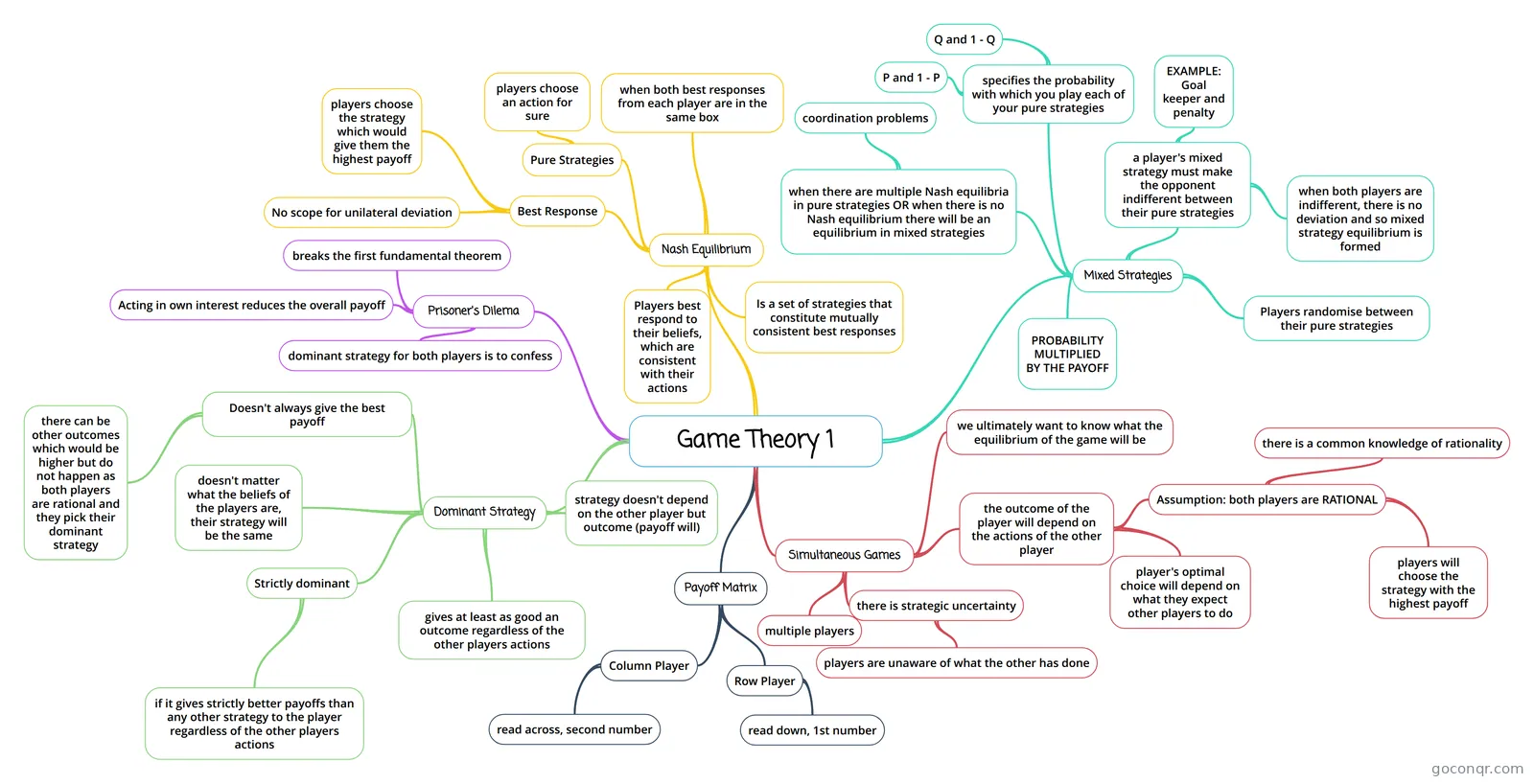
Mind map: Game Theory 1
Map content
Game Theory 1
Simultaneous Games
- there is strategic uncertainty
- players are unaware of what the other has done
- the outcome of the player will depend on the actions of the other player
- player's optimal choice will depend on what they expect other players to do
- Assumption: both players are RATIONAL
- players will choose the strategy with the highest payoff
- there is a common knowledge of rationality
- we ultimately want to know what the equilibrium of the game will be
- multiple players
- there is strategic uncertainty
Dominant Strategy
- strategy doesn't depend on the other player but outcome (payoff will)
- gives at least as good an outcome regardless of the other players actions
- Strictly dominant
- if it gives strictly better payoffs than any other strategy to the player regardless of the other players actions
- doesn't matter what the beliefs of the players are, their strategy will be the same
- Doesn't always give the best payoff
- there can be other outcomes which would be higher but do not happen as both players are rational and they pick their dominant strategy
Payoff Matrix
- Row Player
- read down, 1st number
- Column Player
- read across, second number
- Row Player
Prisoner's Dilema
- dominant strategy for both players is to confess
- Acting in own interest reduces the overall payoff
- breaks the first fundamental theorem
Nash Equilibrium
- Players best respond to their beliefs, which are consistent with their actions
- Best Response
- No scope for unilateral deviation
- players choose the strategy which would give them the highest payoff
- Pure Strategies
- players choose an action for sure
- Is a set of strategies that constitute mutually consistent best responses
- when both best responses from each player are in the same box
Mixed Strategies
- Players randomise between their pure strategies
- when there are multiple Nash equilibria in pure strategies OR when there is no Nash equilibrium there will be an equilibrium in mixed strategies
- coordination problems
- specifies the probability with which you play each of your pure strategies
- P and 1 - P
- Q and 1 - Q
- a player's mixed strategy must make the opponent indifferent between their pure strategies
- EXAMPLE: Goal keeper and penalty
- when both players are indifferent, there is no deviation and so mixed strategy equilibrium is formed
- PROBABILITY MULTIPLIED BY THE PAYOFF
Information
- Description
- Business/Economics Mind Map on Game Theory 1, created by Fiona Smyth on 04/10/2017.
- Created by
- Fiona Smyth
- Views
- 0
- History
-
- Created by Fiona Smyth · Oct 4, 2017
- Copied by Fiona Smyth · Oct 4, 2017
- Rating