
Mind map
Building Information Systems
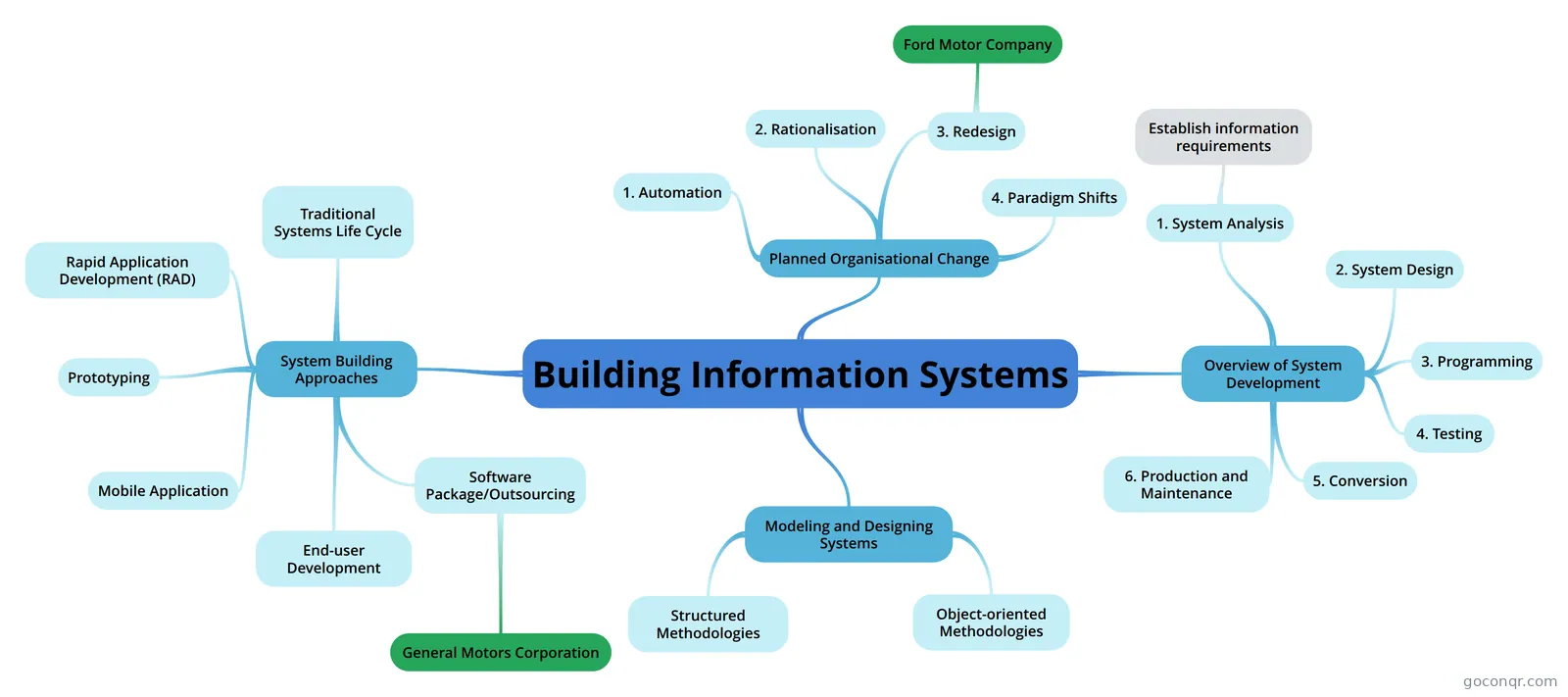
Mind map: Building information systems
Map content
Building Information Systems
Planned Organisational Change
- Building a new information system will involve changes in job, skills, management and organisation as well.
- 1. Automation
- - Increase effectiveness and efficiency - Calculating payroll, instant access to customer's records
- 2. Rationalisation
- Streamlining of standard operating procedures. - Total quality management: make achieving quality an end and responsibility of all people
- 3. Redesign
- Business processes are analysed, simplified and redesigned.
- Business process management: 1. Identify processes for change 2. Analyse existing processess 3. Redesign the new process - reduces time and cost or enhance customer service and value. 4. Implement the new process 5. Continuous measurement - process may deteriorate over time or they may lose effectiveness if the business experiences other changes
- BPM tools helps 1. Identify inefficiencies using software to connect with systems in the company. (AIC, cannadian mutual fund company - Sajus BPM monitoring software to check inconsistencies in its process for updating accounts after transactions. 2. Automates some business process. (American National Insurance Company - Pega BPM to streamline Customer service processes across different business groups. 3. Helps business integrate existing systems to support process improvements
- Ford Motor Company
- - Invoiceless processing. - Reduce accounts payable clerks
- 4. Paradigm Shifts
- Rethinking the nature of the business and organisation - Extensive organisational change
Overview of System Development
- 1. System Analysis
- Analysis of a problem that firm tries to solve with an information system. - Defining problem, identify cause, specifying solution, identify the information requirements - Identify users - Includes feasible study to determine if solution is feasible - financial, technical and organisational standpoint - Written report stating benefits and costs, advantage and disadvantage of each alternatives.
- Establish information requirements
- Can be a challenge. - Need detailed description of the functions - Faulty requirement analysis leads to system failure and high cost of development
- 2. System Design
- Shows how the system will fulfil the objectives of the functions of a system. - overall plan or model - details the specifications that will deliver the functions identified in step 1. - Superior design => ease and efficiency that fulfils requirements within a specific set of technical, organisational, financial and time constraints.
- 3. Programming
- System specifications that were prepared during the designing stage are translated into software program code. - buy/outsource software from external sources
- 4. Testing
- Test to check whether the system produces the right results. (Test plan) - Time consuming 1. Unit testing: testing each program separately 2. System testing: tests the functioning of the IS as a whole. 3. Acceptance testing: final certification that the system is ready to be used in a production setting. Evaluated by users and managers
- 5. Conversion
- Process of changing from the old system to new system. 1. Parallel strategy: old and new system runs tgt until everyone is assured new one is run smoothly. Ad: safest. Dis: expensive, additional resources and staffs needed 2. Direct cutover strategy: replaces entirely. Dis: risky, might incur even more costs if theres problem 3. Pilot study strategy: introduce new system in a limited area/one department, continue in stages if run smoothly 4. Phased Approached strategy: introduce new system in stages, either by function or by units
- Detailed documentation is needed to show how the system works from technical and end users POV during conversion time for future training and operation purposes.
- 6. Production and Maintenance
- Reviewed and check if revisions or modifications are in order. - Maintain to correct errors, meet requirements or improve processing efficiency
- 1. System Analysis
Modeling and Designing Systems
- Structured Methodologies
- - Step by step, building on the previous step - top-down, progressing from the highest, most abstract level to the lowest level of detail - Process orientated, separate data and process
- Tools: - Data flow diagram (DFD) - logical graphic model of information flow, partitioning a system into modules that show manageable levels of detail. - Data dictionary: contain information about individual pieces of data and data groupings within a system - Structure chart
- Object-oriented Methodologies
- Combine data and the specific processes that operate on those data. - Based on the concepts of class and inheritance. - Objects group to class with same features
- Structured Methodologies
System Building Approaches
- Traditional Systems Life Cycle
- - Waterfall method - Large complex system- Divide building a system in multiple stages- Not flexible, complete one stage in order to proceed on to another- Heavy documentation: formal specification and paperwork - Structured, tight controlled
- Prototyping
- Building an experimental system rapidly and inexpensively for users to evaluate. - Iterative process - Actively promotes system changes
- 1. Identify basic requirement 2. Develop initial prototype 3. Testing 4. Revise and enhance
- Advantages: - uncertainty with requirements or design solution - Intense end users involvement - will lIkely meet users' requirement in the end Disadvantages: - Lack of testing and analysing - Might not be able to accommodate huge data or many users
- End-user Development
- Develop information system with little or no formal assistance from technical specialist. - using tools such as: 4th generation language - Build system faster. - Cannot handle the processing of large numbers of transactions or applications with extensive procedural logic and updating requirement - Control over data may be lost - Lack of testing and documentation
- Software Package/Outsourcing
- - Using pre-developed, predesigned software for common procedures - payroll/inventory control - Customisation of features may be available - Adopt to the software package instead of being tailored made
- - outsource to external organisation that specialising in building system. - Cheaper, minimise temporary employees (who might need training) - Offshore outsourcing - cheaper - However, might incur additional cost dealing with cultural differences/Human resources issues
- General Motors Corporation
- - outsourced 90% of IT services - Taking back control of IS - Bringing it back In house - complete IT projects more quickly
- Rapid Application Development (RAD)
- describe the process of creating workable system in a very short period of time. - Joint application design (JAD): brings end users and information specialists tgt in an interactive session to discuss the design. Speed up the process of designing the system
- - Agile development: breaking a large project to smaller project that are completed in a shorter time period, emphasise face to face communication over documentation. - More flexible - Involve end users - Iteration and feedback
- Mobile Application
- Responsive web design: enables website to automatically change the layout and according to screen solutions or devices - Eliminate needs for separate design and development work for each device.
- Traditional Systems Life Cycle
Information
- Description
- INFS1602 Mind Map on Building Information Systems, created by Jessica Naing on 02/11/2017.
- Created by
- Jessica Naing
- Views
- 1
- Rating