
Mind map
Breast Conditions
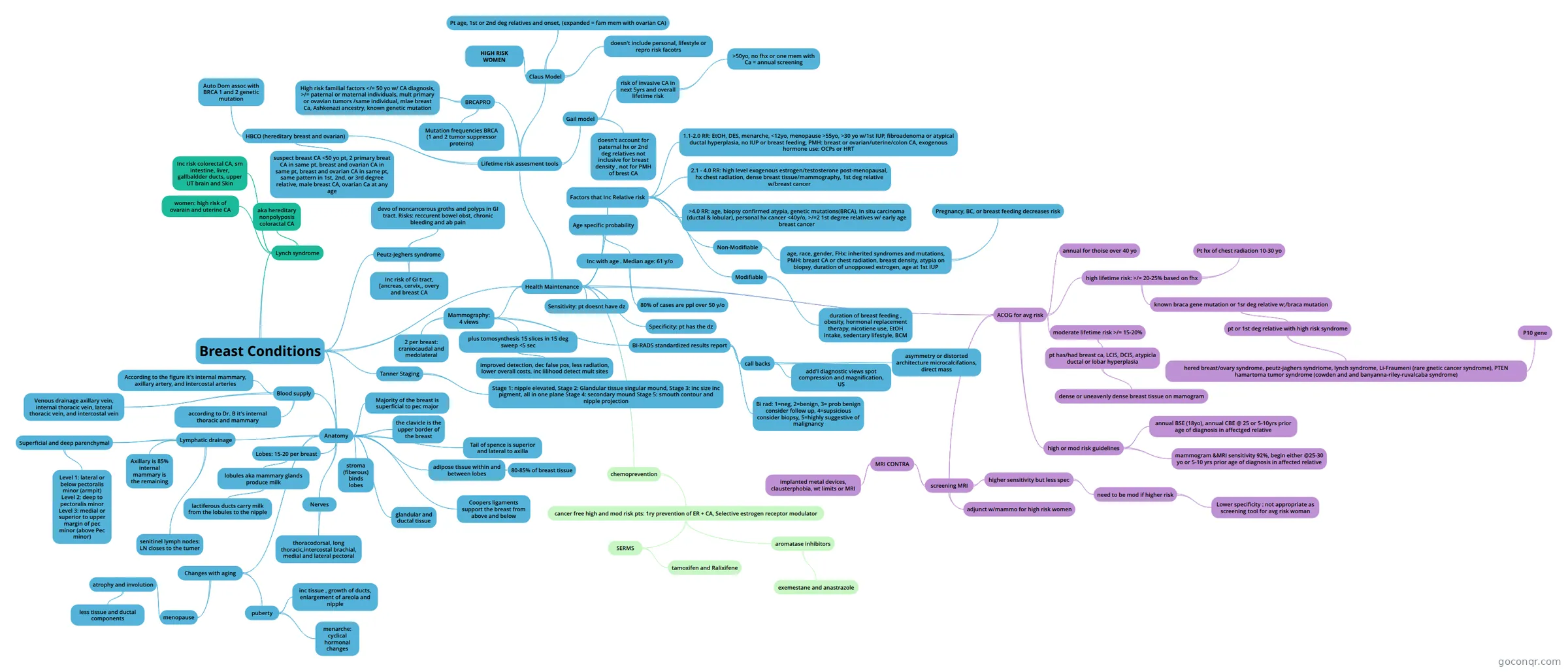
Mind map: Breast conditions
Map content
Breast Conditions
Anatomy
- glandular and ductal tissue
- stroma (fiberous) binds lobes
- adipose tissue within and between lobes
- 80-85% of breast tissue
- Lobes: 15-20 per breast
- lobules aka mammary glands produce milk
- lactiferous ducts carry milk from the lobules to the nipple
- lobules aka mammary glands produce milk
- the clavicle is the upper border of the breast
- Majority of the breast is superficial to pec major
- Tail of spence is superior and lateral to axilla
- Coopers ligaments support the breast from above and below
- Blood supply
- according to Dr. B it's internal thoracic and mammary
- According to the figure it's internal mammary, axillary artery, and intercostal arteries
- Venous drainage axillary vein, internal thoracic vein, lateral thoracic vein, and intercostal vein
- Lymphatic drainage
- Axillary is 85% internal mammary is the remaining
- Superficial and deep parenchymal
- Level 1: lateral or below pectoralis minor (armpit) Level 2: deep to pectoralis minor Level 3: medial or superior to upper margin of pec minor (above Pec minor)
- senitinel lymph nodes: LN closes to the tumer
- Nerves
- thoracodorsal, long thoracic,intercostal brachial, medial and lateral pectoral
- Changes with aging
- puberty
- inc tissue , growth of ducts, enlargement of areola and nipple
- menarche: cyclical hormonal changes
- menopause
- atrophy and involution
- less tissue and ductal components
- atrophy and involution
- puberty
Tanner Staging
- Stage 1: nipple elevated, Stage 2: Glandular tissue singular mound, Stage 3: inc size inc pigment, all in one plane Stage 4: secondary mound Stage 5: smouth contour and nipple projection
Health Maintenance
- Age specific probability
- Inc with age . Median age: 61 y/o
- 80% of cases are ppl over 50 y/o
- Inc with age . Median age: 61 y/o
- Factors that Inc Relative risk
- Modifiable
- duration of breast feeding , obesity, hormonal replacement therapy, nicotiene use, EtOH intake, sedentary lifestyle, BCM
- Non-Modifiable
- age, race, gender, FHx: inherited syndromes and mutations, PMH: breast CA or chest radiation, breast density, atypia on biopsy, duration of unopposed estrogen, age at 1st IUP
- Pregnancy, BC, or breast feeding decreases risk
- age, race, gender, FHx: inherited syndromes and mutations, PMH: breast CA or chest radiation, breast density, atypia on biopsy, duration of unopposed estrogen, age at 1st IUP
- >4.0 RR: age, biopsy confirmed atypia, genetic mutations(BRCA), In situ carcinoma (ductal & lobular), personal hx cancer <40y/o, >/=2 1st degree relatives w/ early age breast cancer
- 2.1 - 4.0 RR: high level exogenous estrogen/testosterone post-menopausal, hx chest radiation, dense breast tissue/mammography, 1st deg relative w/breast cancer
- 1.1-2.0 RR: EtOH, DES, menarche, <12yo, menopause >55yo, >30 yo w/1st IUP, fibroadenoma or atypical ductal hyperplasia, no IUP or breast feeding, PMH: breast or ovarian/uterine/colon CA, exogenous hormone use: OCPs or HRT
- Modifiable
- Lifetime risk assesment tools
- Gail model
- risk of invasive CA in next 5yrs and overall lifetime risk
- >50yo, no fhx or one mem with Ca = annual screening
- doesn't account for paternal hx or 2nd deg relatives not inclusive for breast density , not for PMH of brest CA
- risk of invasive CA in next 5yrs and overall lifetime risk
- Claus Model
- HIGH RISK WOMEN
- Pt age, 1st or 2nd deg relatives and onset, (expanded = fam mem with ovarian CA)
- doesn't include personal, lifestyle or repro risk facotrs
- BRCAPRO
- Mutation frequencies BRCA (1 and 2 tumor suppressor proteins)
- High risk familial factors </= 50 yo w/ CA diagnosis, >/= paternal or maternal individuals, mult primary or ovavian tumors /same individual, mlae breast Ca, Ashkenazi ancestry, known genetic mutation
- HBCO (hereditary breast and ovarian)
- Auto Dom assoc with BRCA 1 and 2 genetic mutation
- suspect breast CA <50 yo pt, 2 primary breat CA in same pt, breast and ovarian CA in same pt, breast and ovarian CA in same pt, same pattern in 1st, 2nd, or 3rd degree relative, male breast CA, ovarian Ca at any age
- Gail model
- Sensitivity: pt doesnt have dz
- Specificity: pt has the dz
- Mammography: 4 views
- 2 per breast: craniocaudal and medolateral
- plus tomosynthesis 15 slices in 15 deg sweep <5 sec
- improved detection, dec false pos, less radiation, lower overall costs, inc lilihood detect mult sites
- BI-RADS standardized results report
- call backs
- add'l diagnostic views spot compression and magnification, US
- asymmetry or distorted architecture microcalcifations, direct mass
- Bi rad: 1=neg, 2=benign, 3= prob benign consider follow up, 4=supsicious consider biopsy, 5=highly suggestive of malignancy
- call backs
- ACOG for avg risk
- annual for thoise over 40 yo
- high lifetime risk: >/= 20-25% based on fhx
- known braca gene mutation or 1sr deg relative w;/braca mutation
- pt or 1st deg relative with high risk syndrome
- hered breast/ovary syndrome, peutz-jaghers syndriome, lynch syndrome, Li-Fraumeni (rare gnetic cancer syndrome), PTEN hamartoma tumor syndrome (cowden and and banyanna-riley-ruvalcaba syndrome)
- P10 gene
- hered breast/ovary syndrome, peutz-jaghers syndriome, lynch syndrome, Li-Fraumeni (rare gnetic cancer syndrome), PTEN hamartoma tumor syndrome (cowden and and banyanna-riley-ruvalcaba syndrome)
- pt or 1st deg relative with high risk syndrome
- Pt hx of chest radiation 10-30 yo
- known braca gene mutation or 1sr deg relative w;/braca mutation
- moderate lifetime risk >/= 15-20%
- pt has/had breast ca, LCIS, DCIS, atypicla ductal or lobar hyperplasia
- dense or uneavenly dense breast tissue on mamogram
- pt has/had breast ca, LCIS, DCIS, atypicla ductal or lobar hyperplasia
- high or mod risk guidelines
- annual BSE (18yo), annual CBE @ 25 or 5-10yrs prior age of diagnosis in affectged relative
- mammogram &MRI sensitivity 92%, begin either @25-30 yo or 5-10 yrs prior age of diagnosis in affected relative
- screening MRI
- adjunct w/mammo for high risk women
- higher sensitivity but less spec
- need to be mod if higher risk
- Lower specificity : not appropriate as screening tool for avg risk woman
- need to be mod if higher risk
- MRI CONTRA
- implanted metal devices, clausterphobia, wt limits or MRI
- chemoprevention
- cancer free high and mod risk pts: 1ry prevention of ER + CA, Selective estrogen receptor modulator
- SERMS
- tamoxifen and Ralixifene
- aromatase inhibitors
- exemestane and anastrazole
- SERMS
- cancer free high and mod risk pts: 1ry prevention of ER + CA, Selective estrogen receptor modulator
- Age specific probability
Peutz-Jeghers syndrome
- devo of noncancerous groths and polyps in GI tract. Risks: reccurent bowel obst, chronic bleeding and ab pain
- Inc risk of GI tract, [ancreas, cervix,, overy and breast CA
Lynch syndrome
- aka hereditary nonpolyposis coloractal CA
- Inc risk colorectal CA, sm intestine, liver, gallbaldder ducts, upper UT brain and Skin
- women: high risk of ovarain and uterine CA
Information
- Description
- Mind Map on Breast Conditions, created by ajriffic . on 11/11/2017.
- Created by
- ajriffic .
- Views
- 0
- Rating