
Mind map
MODERN PHYSICS
Map content
MODERN PHYSICS
- 1. Special Relativity 2. Astrophysics & Cosmology 3. Medical Imaging Techniuqes
ASTROPHYSICS & COSMOLOGY
- Measuring distance
- AU: d sun earth
- astronomical unit (AU) 1AU: distance between Sun and Earth= 1.50×10^11m
- ly: d c t=1 year
- light year: distance travelled by light in vacuum through one year. = (c)(t)=9.46×10^15m.
- pc: d r=1AU 1arcsecond
- parsec is the distance at which a radius of 1 AU substends an angle of 1 arcsecond. => it derived by 1pc=1AU/(tan(1arcsecond)). for small angel: tanθ≈θ. while θ must be in radius. it becomes to 1pc=1AU/(1arcsecond in rad). approximately=2.06×10^5AUOR 3.26ly
- 1 arcsecond: (1/3600)° 1 arcminute: (1/60)°
- d= 1/p, angle of parallax p
- Parallax: apparent shift NS -> B
- apparent shift of nearby stars against the background of distant stars.
- use parallax to measure distance: recording the positions of a stat twice at two different time. parallax angle:???
- Parallax: apparent shift NS -> B
- AU: d sun earth
- Stars Luminosity and surface temperature
- Blackbody: perfect absorber of EM
- refer to Kichoff's law: it can emit all ranges of EM
- relationship with T
- conventionally a hotter object radiated more energy per second
- Stefan law:L=(4πr^2)(σ)(T^4)
- σ: stefan's constant is 5.67×10^-8 [Wm^-2K^-4]
- Wien's law: λmax=(Wien's constant)/T
- peak wavelength (at which radiation has highest intensity) is inversely proportional to absolute temperature. Wien's constant is 3×10^-3[mK].
- graph of intensity-peak wavelength
- L=P radiated
- Louminosity is defined as power radiated. [Js-1] OR [watt]
- Blackbody: perfect absorber of EM
- Cosmology
- is a general study of Universe, its origins and evolutions. Uni contains billions of galaxies surrounded by massive amounts of tiny spread, invisible material called dark matter.
- Emission spectra: c discreteL f elements emit
- consists of discrete lines of frequency characteristic of the elements emitting the radiation.
- not continuous like a rainbow(blackbody radiation).
- f=△E/h
- △E transition energy. it is determined like that as elements emitting light of diff f by absorbing different photon energy given by transition of electron.
- Absorption spectra: c WB crossed DL f elements absorbe
- consists of white light background crossed with dark lines of frequency characteristic of elements absorbing the radiation.
- white background: consists of radiation of all frequencies
- e.g. hot WB go through cooler gas, gas absorbe radiation of certain f.
- Doppler effect[shift] of dark lines
- red shift for recession: wave be stretched λ↑ f↓(v unchanged)
- -> support Bigbang theory
- distance galaxies are receding(red shift). Bigbang theory refers to Uni begins as a concentrated point and then exploded.
- -> support Bigbang theory
- blue shift for approachment: wave be compressed λ↓ f↑
- appli: use spectrum to find out relative speed
- 1. from spectrum obtain △λ for a spectral line. 2. using λo measured on Earth. 3. (△λ)/(λo)=v/c.
- appli: use to find out rotational speed
- (facts: galaxies is receding and rotating) 1.each side of rotating galaxy has diff relative speed(if V1=VG+v, V2=VG-v), hence diff red shift. Edge rotating away from us has relatively higher speed than edge towards us . 2.appli (△λ)/(λo)=v/c to obtain V1,V2. △λ:comparing diff in spectrum of a spectral line. λo: recorded on Earth before. 4. differences between two relative speed be used to determine rotational speed ((V1-V2)/2 ).
- red shift for recession: wave be stretched λ↑ f↓(v unchanged)
- Cosmological principle: (assumption on Uni) viewed at vLS: H&I, laws bold
- assumption on University viewed at large enough scale: 1. uni is Homogenous(uniform matter distribution). 2. uni is Isotropical(no differences of view in all directions). 3. Laws of physics is universal(bold).
- (补充) 1.=> density of uni/galaxies are constant which means structure of galaxies are the same.? 2. => no centre, edge of Uni.
- Doppler effect: △λ/ f relative motion
- change in wavelength OR frequency of observed wave due to relative motion between observer and source.
- v/c= △λ/λo= △f/fo
- Lives of stars
- Hertzsprung-Russell diagram: absolute magnitudes ∝ spectral class [O->M], scale ↓ from origin
- absolute magnitudes of star size verse spectral class. dwarft, giant refer to magnitude.
- Classification: depends on star I & T
- classification of stars by Brightness(intensity) and Temperature.
- Magnitude: measure of I
- magnitude of star is a measure of brightness(intensity) of it.
- describe as bright, dim.
- Apparent magnitude: I appears from Earth
- is the intensity of stars appears from Earth.
- Absolute magnitude: apparent magnitude of stars 10 parsecs from Earth [-10, +15]
- 1.it ranges from -10 up to +15: stars intensity falls(less bright). 2.log scale relationship??
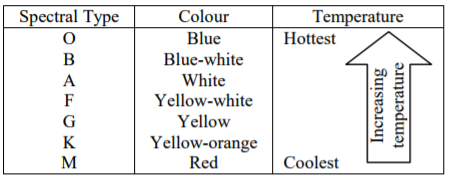
- Temperature: be determined by CL by CST [2500, 40000]
- the surface temperature of star can be determined by color of loight it emits by Classification of spectral type.
- describe as cold, hot.
- juicing CST
- 1.Hot bodies?? emit a range of EM radiation of a range of f,λ, there is always a peak Intensity(->P/A=E/(At)=hf/(At)) at one particular f,λ. 2. as T↑ I↑ f↑,λ↓. 3. hottest star, minimum λ, emits blue end of visible spectrum. refer to O Type. coolest star, maximum λ, emits red end. refer to M Type.
- Hertzsprung-Russell diagram: absolute magnitudes ∝ spectral class [O->M], scale ↓ from origin
- The Bigbang Model of Universe: m ISS -> exploded & creation -> NIE
- 1. at some time, all mass in the Universe was located in a infinitly small singlarity. 2. then, it exploded, then cooled, made Hydrogen, made stars, made us. 3. the universe is non-infinite expanding. (non-infinite size, perhaps non-infinite small size)
- Evidence
- Red-shift of spectral lines
- 1.take the spectum of galaxy at two points. 2.spectral lines are red shift. 3.[???????]. 4.all move away from us. universe is expanding. 5.balloon expanding model. space itself expanded, carrying the galaxies with it.
- CMB radiation
- cosmic microwave background. 1.in theory, if the universe has a bigbang with hot T, it must be cooling now. so somehow scientist perdicted T≈2.725K. 2.experiment by Penzias Twilson. all light in μm have T≈2.725K continuous and completed in λ. strongly supports the theory.
- Olbern's Paradox: expanding non-infinite Universe
- Red-shift of spectral lines
- [recession speed related to distance] Hubble's law: v∝d. v=(Ho)(d)
- relative recession speed = (constant)(relative distance from Earth). in kms-1, Mpc. Ho: Hubble's constant.
- t=v/d=1/Ho=Age of Uni
- t:Hubble's time. this is the time taken for any galaxy to reach its present position, starting at Bigbang. it is the age of Universe. [so awaresome: if we know Ho we can guess the age of universe. Age≈13.7Gyears]
- [observed correlation supports dark energy]
- the energy supports the Universe to expand in an increasing rate. it acts opposite to gravity/mass.
- LIfe cycle of stars
- Measuring distance
MEDICAL IMAGING TECHNIQUES
Images and files in the map
Information
- Description
- OCR A OCRA PHYSICS Mind Map on MODERN PHYSICS, created by C D on 20/02/2018.
- Created by
- C D
- Views
- 5
- Rating