
Mind map
Unit 2 : Regulatory Structure
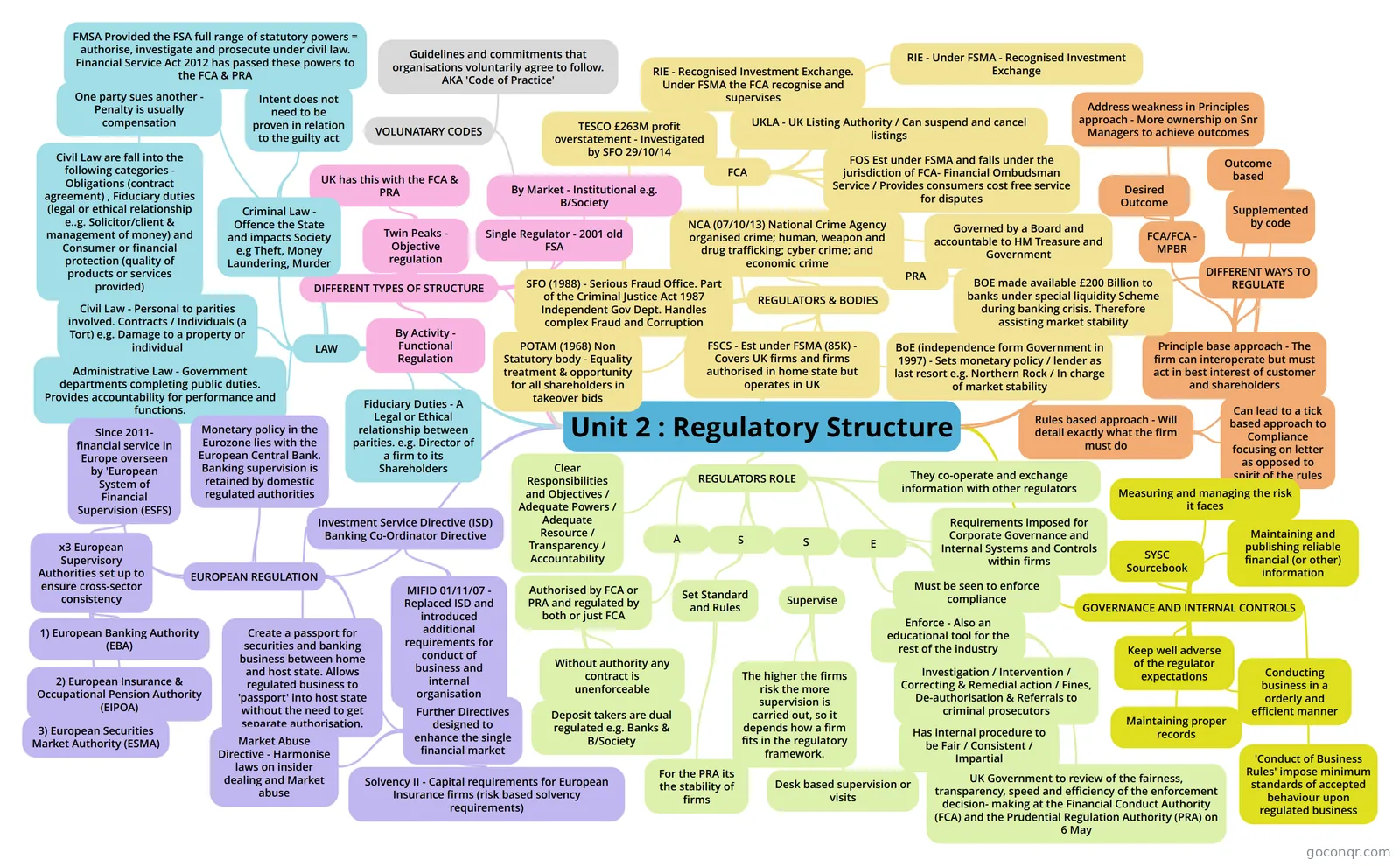
Mind map: Unit 2 regulatory structure
Map content
Unit 2 : Regulatory Structure
REGULATORS & BODIES
- FCA
- UKLA - UK Listing Authority / Can suspend and cancel listings
- FOS Est under FSMA and falls under the jurisdiction of FCA- Financial Ombudsman Service / Provides consumers cost free service for disputes
- RIE - Under FSMA - Recognised Investment Exchange
- RIE - Recognised Investment Exchange. Under FSMA the FCA recognise and supervises
- Governed by a Board and accountable to HM Treasure and Government
- BoE (independence form Government in 1997) - Sets monetary policy / lender as last resort e.g. Northern Rock / In charge of market stability
- PRA
- BOE made available £200 Billion to banks under special liquidity Scheme during banking crisis. Therefore assisting market stability
- FSCS - Est under FSMA (85K) - Covers UK firms and firms authorised in home state but operates in UK
- POTAM (1968) Non Statutory body - Equality treatment & opportunity for all shareholders in takeover bids
- SFO (1988) - Serious Fraud Office. Part of the Criminal Justice Act 1987 Independent Gov Dept. Handles complex Fraud and Corruption
- TESCO £263M profit overstatement - Investigated by SFO 29/10/14
- NCA (07/10/13) National Crime Agency organised crime; human, weapon and drug trafficking; cyber crime; and economic crime
- FCA
VOLUNATARY CODES
- Guidelines and commitments that organisations voluntarily agree to follow. AKA 'Code of Practice'
REGULATORS ROLE
- A
- Authorised by FCA or PRA and regulated by both or just FCA
- Without authority any contract is unenforceable
- Deposit takers are dual regulated e.g. Banks & B/Society
- Authorised by FCA or PRA and regulated by both or just FCA
- S
- Set Standard and Rules
- For the PRA its the stability of firms
- Set Standard and Rules
- S
- Supervise
- The higher the firms risk the more supervision is carried out, so it depends how a firm fits in the regulatory framework.
- Desk based supervision or visits
- Supervise
- E
- Enforce - Also an educational tool for the rest of the industry
- Investigation / Intervention / Correcting & Remedial action / Fines, De-authorisation & Referrals to criminal prosecutors
- Has internal procedure to be Fair / Consistent / Impartial
- UK Government to review of the fairness, transparency, speed and efficiency of the enforcement decision- making at the Financial Conduct Authority (FCA) and the Prudential Regulation Authority (PRA) on 6 May
- Investigation / Intervention / Correcting & Remedial action / Fines, De-authorisation & Referrals to criminal prosecutors
- Must be seen to enforce compliance
- Enforce - Also an educational tool for the rest of the industry
- They co-operate and exchange information with other regulators
- Requirements imposed for Corporate Governance and Internal Systems and Controls within firms
- Clear Responsibilities and Objectives / Adequate Powers / Adequate Resource / Transparency / Accountability
- A
DIFFERENT TYPES OF STRUCTURE
- Twin Peaks - Objective regulation
- UK has this with the FCA & PRA
- By Activity - Functional Regulation
- Single Regulator - 2001 old FSA
- By Market - Institutional e.g. B/Society
- Twin Peaks - Objective regulation
LAW
- Criminal Law - Offence the State and impacts Society e.g Theft, Money Laundering, Murder
- Intent does not need to be proven in relation to the guilty act
- Civil Law - Personal to parities involved. Contracts / Individuals (a Tort) e.g. Damage to a property or individual
- One party sues another - Penalty is usually compensation
- Civil Law are fall into the following categories - Obligations (contract agreement) , Fiduciary duties (legal or ethical relationship e..g. Solicitor/client & management of money) and Consumer or financial protection (quality of products or services provided)
- Administrative Law - Government departments completing public duties. Provides accountability for performance and functions.
- Fiduciary Duties - A Legal or Ethical relationship between parities. e.g. Director of a firm to its Shareholders
- FMSA Provided the FSA full range of statutory powers = authorise, investigate and prosecute under civil law. Financial Service Act 2012 has passed these powers to the FCA & PRA
- Criminal Law - Offence the State and impacts Society e.g Theft, Money Laundering, Murder
DIFFERENT WAYS TO REGULATE
- Rules based approach - Will detail exactly what the firm must do
- Can lead to a tick based approach to Compliance focusing on letter as opposed to spirit of the rules
- Principle base approach - The firm can interoperate but must act in best interest of customer and shareholders
- Supplemented by code
- FCA/FCA - MPBR
- Address weakness in Principles approach - More ownership on Snr Managers to achieve outcomes
- Desired Outcome
- Outcome based
- Rules based approach - Will detail exactly what the firm must do
EUROPEAN REGULATION
- Monetary policy in the Eurozone lies with the European Central Bank. Banking supervision is retained by domestic regulated authorities
- Since 2011- financial service in Europe overseen by 'European System of Financial Supervision (ESFS)
- x3 European Supervisory Authorities set up to ensure cross-sector consistency
- 1) European Banking Authority (EBA)
- 2) European Insurance & Occupational Pension Authority (EIPOA)
- 3) European Securities Market Authority (ESMA)
- x3 European Supervisory Authorities set up to ensure cross-sector consistency
- Further Directives designed to enhance the single financial market
- Market Abuse Directive - Harmonise laws on insider dealing and Market abuse
- MIFID 01/11/07 - Replaced ISD and introduced additional requirements for conduct of business and internal organisation
- Investment Service Directive (ISD) Banking Co-Ordinator Directive
- Create a passport for securities and banking business between home and host state. Allows regulated business to 'passport' into host state without the need to get separate authorisation.
- Investment Service Directive (ISD) Banking Co-Ordinator Directive
- Solvency II - Capital requirements for European Insurance firms (risk based solvency requirements)
GOVERNANCE AND INTERNAL CONTROLS
- Measuring and managing the risk it faces
- Conducting business in a orderly and efficient manner
- Maintaining proper records
- Maintaining and publishing reliable financial (or other) information
- Keep well adverse of the regulator expectations
- SYSC Sourcebook
- 'Conduct of Business Rules' impose minimum standards of accepted behaviour upon regulated business
Information
- Description
- Mind Map on Unit 2 : Regulatory Structure, created by martin.stacey on 29/10/2014.
- Created by
- martin.stacey
- Views
- 29
- Rating