
Mind map
Colloid solutions: a clinical update
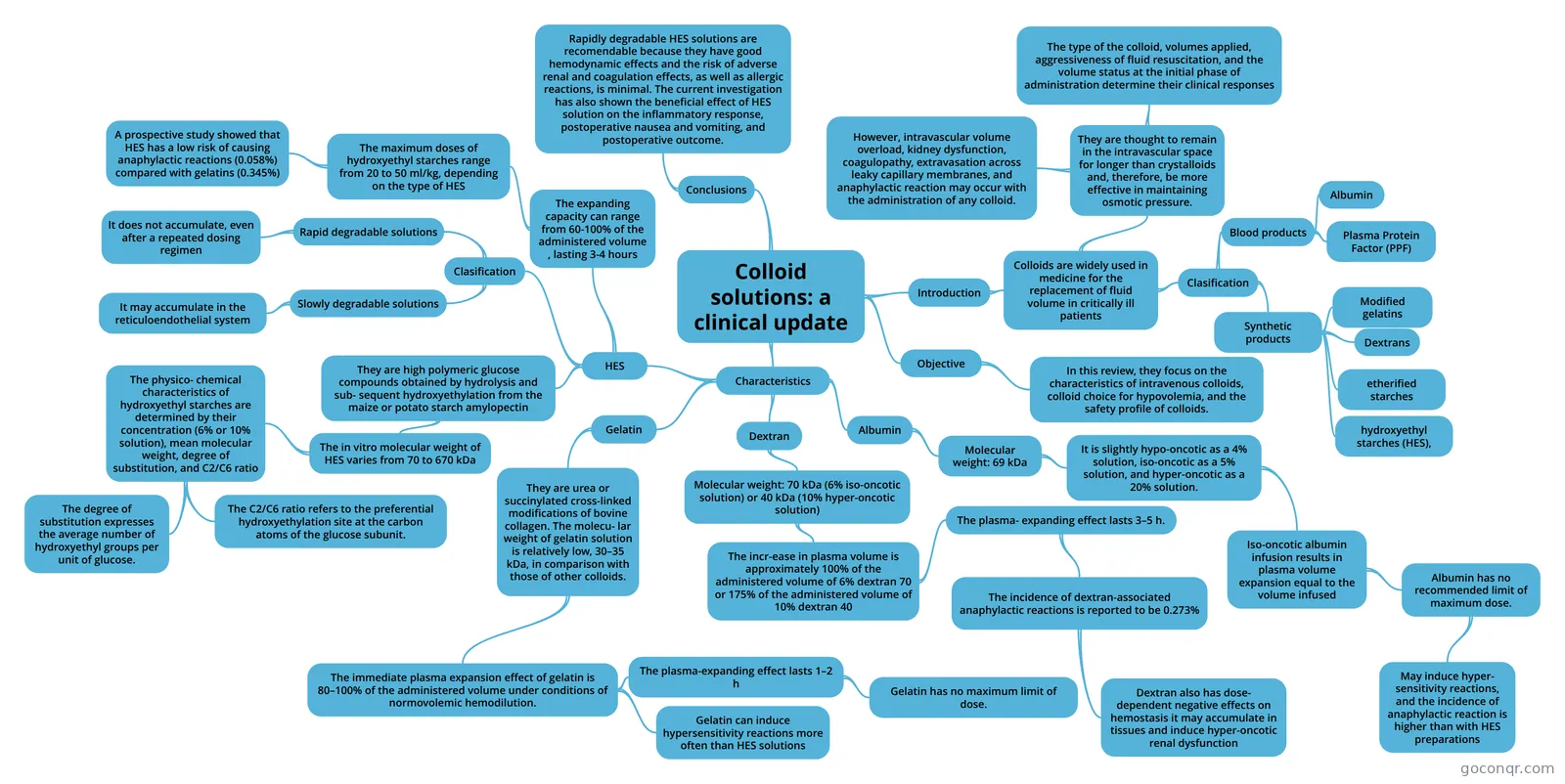
Mind map: Colloid solutions: a clinical update
Map content
Colloid solutions: a clinical update
Introduction
- Colloids are widely used in medicine for the replacement of fluid volume in critically ill patients
- Clasification
- Blood products
- Albumin
- Plasma Protein Factor (PPF)
- Synthetic products
- Modified gelatins
- Dextrans
- etherified starches
- hydroxyethyl starches (HES),
- Blood products
- They are thought to remain in the intravascular space for longer than crystalloids and, therefore, be more effective in maintaining osmotic pressure.
- The type of the colloid, volumes applied, aggressiveness of fluid resuscitation, and the volume status at the initial phase of administration determine their clinical responses
- However, intravascular volume overload, kidney dysfunction, coagulopathy, extravasation across leaky capillary membranes, and anaphylactic reaction may occur with the administration of any colloid.
- Clasification
- Colloids are widely used in medicine for the replacement of fluid volume in critically ill patients
Objective
- In this review, they focus on the characteristics of intravenous colloids, colloid choice for hypovolemia, and the safety profile of colloids.
Characteristics
- Albumin
- Molecular weight: 69 kDa
- It is slightly hypo-oncotic as a 4% solution, iso-oncotic as a 5% solution, and hyper-oncotic as a 20% solution.
- Iso-oncotic albumin infusion results in plasma volume expansion equal to the volume infused
- Albumin has no recommended limit of maximum dose.
- May induce hyper- sensitivity reactions, and the incidence of anaphylactic reaction is higher than with HES preparations
- Albumin has no recommended limit of maximum dose.
- Iso-oncotic albumin infusion results in plasma volume expansion equal to the volume infused
- It is slightly hypo-oncotic as a 4% solution, iso-oncotic as a 5% solution, and hyper-oncotic as a 20% solution.
- Molecular weight: 69 kDa
- Dextran
- Molecular weight: 70 kDa (6% iso-oncotic solution) or 40 kDa (10% hyper-oncotic solution)
- The incr-ease in plasma volume is approximately 100% of the administered volume of 6% dextran 70 or 175% of the administered volume of 10% dextran 40
- The plasma- expanding effect lasts 3–5 h.
- The incidence of dextran-associated anaphylactic reactions is reported to be 0.273%
- Dextran also has dose- dependent negative effects on hemostasis it may accumulate in tissues and induce hyper-oncotic renal dysfunction
- The incidence of dextran-associated anaphylactic reactions is reported to be 0.273%
- The plasma- expanding effect lasts 3–5 h.
- The incr-ease in plasma volume is approximately 100% of the administered volume of 6% dextran 70 or 175% of the administered volume of 10% dextran 40
- Molecular weight: 70 kDa (6% iso-oncotic solution) or 40 kDa (10% hyper-oncotic solution)
- Gelatin
- They are urea or succinylated cross-linked modifications of bovine collagen. The molecu- lar weight of gelatin solution is relatively low, 30–35 kDa, in comparison with those of other colloids.
- The immediate plasma expansion effect of gelatin is 80–100% of the administered volume under conditions of normovolemic hemodilution.
- The plasma-expanding effect lasts 1–2 h
- Gelatin has no maximum limit of dose.
- Gelatin can induce hypersensitivity reactions more often than HES solutions
- The plasma-expanding effect lasts 1–2 h
- The immediate plasma expansion effect of gelatin is 80–100% of the administered volume under conditions of normovolemic hemodilution.
- They are urea or succinylated cross-linked modifications of bovine collagen. The molecu- lar weight of gelatin solution is relatively low, 30–35 kDa, in comparison with those of other colloids.
- HES
- They are high polymeric glucose compounds obtained by hydrolysis and sub- sequent hydroxyethylation from the maize or potato starch amylopectin
- The in vitro molecular weight of HES varies from 70 to 670 kDa
- The physico- chemical characteristics of hydroxyethyl starches are determined by their concentration (6% or 10% solution), mean molecular weight, degree of substitution, and C2/C6 ratio
- The degree of substitution expresses the average number of hydroxyethyl groups per unit of glucose.
- The C2/C6 ratio refers to the preferential hydroxyethylation site at the carbon atoms of the glucose subunit.
- The physico- chemical characteristics of hydroxyethyl starches are determined by their concentration (6% or 10% solution), mean molecular weight, degree of substitution, and C2/C6 ratio
- The in vitro molecular weight of HES varies from 70 to 670 kDa
- Clasification
- Rapid degradable solutions
- It does not accumulate, even after a repeated dosing regimen
- Slowly degradable solutions
- It may accumulate in the reticuloendothelial system
- Rapid degradable solutions
- The expanding capacity can range from 60-100% of the administered volume , lasting 3-4 hours
- The maximum doses of hydroxyethyl starches range from 20 to 50 ml/kg, depending on the type of HES
- A prospective study showed that HES has a low risk of causing anaphylactic reactions (0.058%) compared with gelatins (0.345%)
- The maximum doses of hydroxyethyl starches range from 20 to 50 ml/kg, depending on the type of HES
- They are high polymeric glucose compounds obtained by hydrolysis and sub- sequent hydroxyethylation from the maize or potato starch amylopectin
- Albumin
Conclusions
- Rapidly degradable HES solutions are recomendable because they have good hemodynamic effects and the risk of adverse renal and coagulation effects, as well as allergic reactions, is minimal. The current investigation has also shown the beneficial effect of HES solution on the inflammatory response, postoperative nausea and vomiting, and postoperative outcome.
Information
- Description
- Mind Map on Colloid solutions: a clinical update, created by ana gut on 20/11/2018.
- Created by
- ana gut
- Views
- 0
- Rating
More on Fluid Balance Disorders and IV Fluids