
Mind map
Glucose regulation:
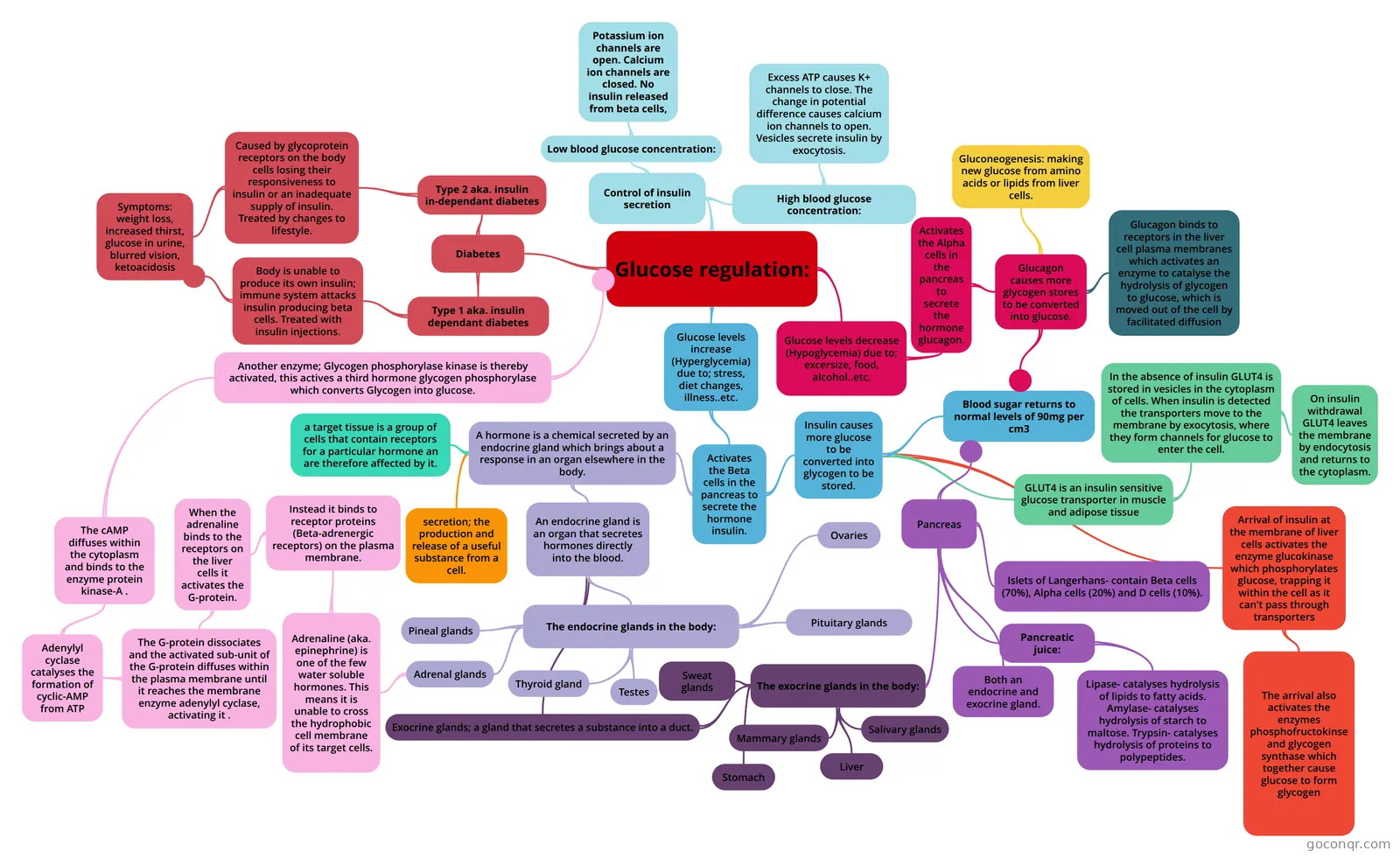
Mind map: Glucose regulation
Map content
Glucose regulation:
Glucose levels increase (Hyperglycemia) due to; stress, diet changes, illness..etc.
- Activates the Beta cells in the pancreas to secrete the hormone insulin.
- Insulin causes more glucose to be converted into glycogen to be stored.
- Blood sugar returns to normal levels of 90mg per cm3
- GLUT4 is an insulin sensitive glucose transporter in muscle and adipose tissue
- In the absence of insulin GLUT4 is stored in vesicles in the cytoplasm of cells. When insulin is detected the transporters move to the membrane by exocytosis, where they form channels for glucose to enter the cell.
- On insulin withdrawal GLUT4 leaves the membrane by endocytosis and returns to the cytoplasm.
- In the absence of insulin GLUT4 is stored in vesicles in the cytoplasm of cells. When insulin is detected the transporters move to the membrane by exocytosis, where they form channels for glucose to enter the cell.
- Arrival of insulin at the membrane of liver cells activates the enzyme glucokinase which phosphorylates glucose, trapping it within the cell as it can't pass through transporters
- The arrival also activates the enzymes phosphofructokinse and glycogen synthase which together cause glucose to form glycogen
- A hormone is a chemical secreted by an endocrine gland which brings about a response in an organ elsewhere in the body.
- An endocrine gland is an organ that secretes hormones directly into the blood.
- The endocrine glands in the body:
- Pituitary glands
- Thyroid gland
- Adrenal glands
- Adrenaline (aka. epinephrine) is one of the few water soluble hormones. This means it is unable to cross the hydrophobic cell membrane of its target cells.
- Instead it binds to receptor proteins (Beta-adrenergic receptors) on the plasma membrane.
- When the adrenaline binds to the receptors on the liver cells it activates the G-protein.
- The G-protein dissociates and the activated sub-unit of the G-protein diffuses within the plasma membrane until it reaches the membrane enzyme adenylyl cyclase, activating it .
- Adenylyl cyclase catalyses the formation of cyclic-AMP from ATP
- The cAMP diffuses within the cytoplasm and binds to the enzyme protein kinase-A .
- Another enzyme; Glycogen phosphorylase kinase is thereby activated, this actives a third hormone glycogen phosphorylase which converts Glycogen into glucose.
- Another enzyme; Glycogen phosphorylase kinase is thereby activated, this actives a third hormone glycogen phosphorylase which converts Glycogen into glucose.
- The cAMP diffuses within the cytoplasm and binds to the enzyme protein kinase-A .
- Adenylyl cyclase catalyses the formation of cyclic-AMP from ATP
- The G-protein dissociates and the activated sub-unit of the G-protein diffuses within the plasma membrane until it reaches the membrane enzyme adenylyl cyclase, activating it .
- When the adrenaline binds to the receptors on the liver cells it activates the G-protein.
- Instead it binds to receptor proteins (Beta-adrenergic receptors) on the plasma membrane.
- Adrenaline (aka. epinephrine) is one of the few water soluble hormones. This means it is unable to cross the hydrophobic cell membrane of its target cells.
- Ovaries
- Testes
- Pineal glands
- Exocrine glands; a gland that secretes a substance into a duct.
- The exocrine glands in the body:
- Sweat glands
- Mammary glands
- Salivary glands
- Stomach
- Liver
- Pancreas
- Both an endocrine and exocrine gland.
- Pancreatic juice:
- Lipase- catalyses hydrolysis of lipids to fatty acids. Amylase- catalyses hydrolysis of starch to maltose. Trypsin- catalyses hydrolysis of proteins to polypeptides.
- Islets of Langerhans- contain Beta cells (70%), Alpha cells (20%) and D cells (10%).
- The exocrine glands in the body:
- The endocrine glands in the body:
- a target tissue is a group of cells that contain receptors for a particular hormone an are therefore affected by it.
- secretion; the production and release of a useful substance from a cell.
- An endocrine gland is an organ that secretes hormones directly into the blood.
- Insulin causes more glucose to be converted into glycogen to be stored.
- Activates the Beta cells in the pancreas to secrete the hormone insulin.
Glucose levels decrease (Hypoglycemia) due to; excersize, food, alcohol..etc.
- Activates the Alpha cells in the pancreas to secrete the hormone glucagon.
- Glucagon causes more glycogen stores to be converted into glucose.
- Glucagon binds to receptors in the liver cell plasma membranes which activates an enzyme to catalyse the hydrolysis of glycogen to glucose, which is moved out of the cell by facilitated diffusion
- Gluconeogenesis: making new glucose from amino acids or lipids from liver cells.
- Glucagon causes more glycogen stores to be converted into glucose.
- Activates the Alpha cells in the pancreas to secrete the hormone glucagon.
Diabetes
- Type 1 aka. insulin dependant diabetes
- Body is unable to produce its own insulin; immune system attacks insulin producing beta cells. Treated with insulin injections.
- Body is unable to produce its own insulin; immune system attacks insulin producing beta cells. Treated with insulin injections.
- Type 2 aka. insulin in-dependant diabetes
- Caused by glycoprotein receptors on the body cells losing their responsiveness to insulin or an inadequate supply of insulin. Treated by changes to lifestyle.
- Symptoms: weight loss, increased thirst, glucose in urine, blurred vision, ketoacidosis
- Caused by glycoprotein receptors on the body cells losing their responsiveness to insulin or an inadequate supply of insulin. Treated by changes to lifestyle.
- Type 1 aka. insulin dependant diabetes
Control of insulin secretion
- High blood glucose concentration:
- Excess ATP causes K+ channels to close. The change in potential difference causes calcium ion channels to open. Vesicles secrete insulin by exocytosis.
- Low blood glucose concentration:
- Potassium ion channels are open. Calcium ion channels are closed. No insulin released from beta cells,
- High blood glucose concentration:
Information
- Description
- Mind Map on Glucose regulation:, created by karafarrar2 on 25/11/2014.
- Created by
- karafarrar2
- Views
- 9
- Rating