
Mind map
P4: Explaining motion
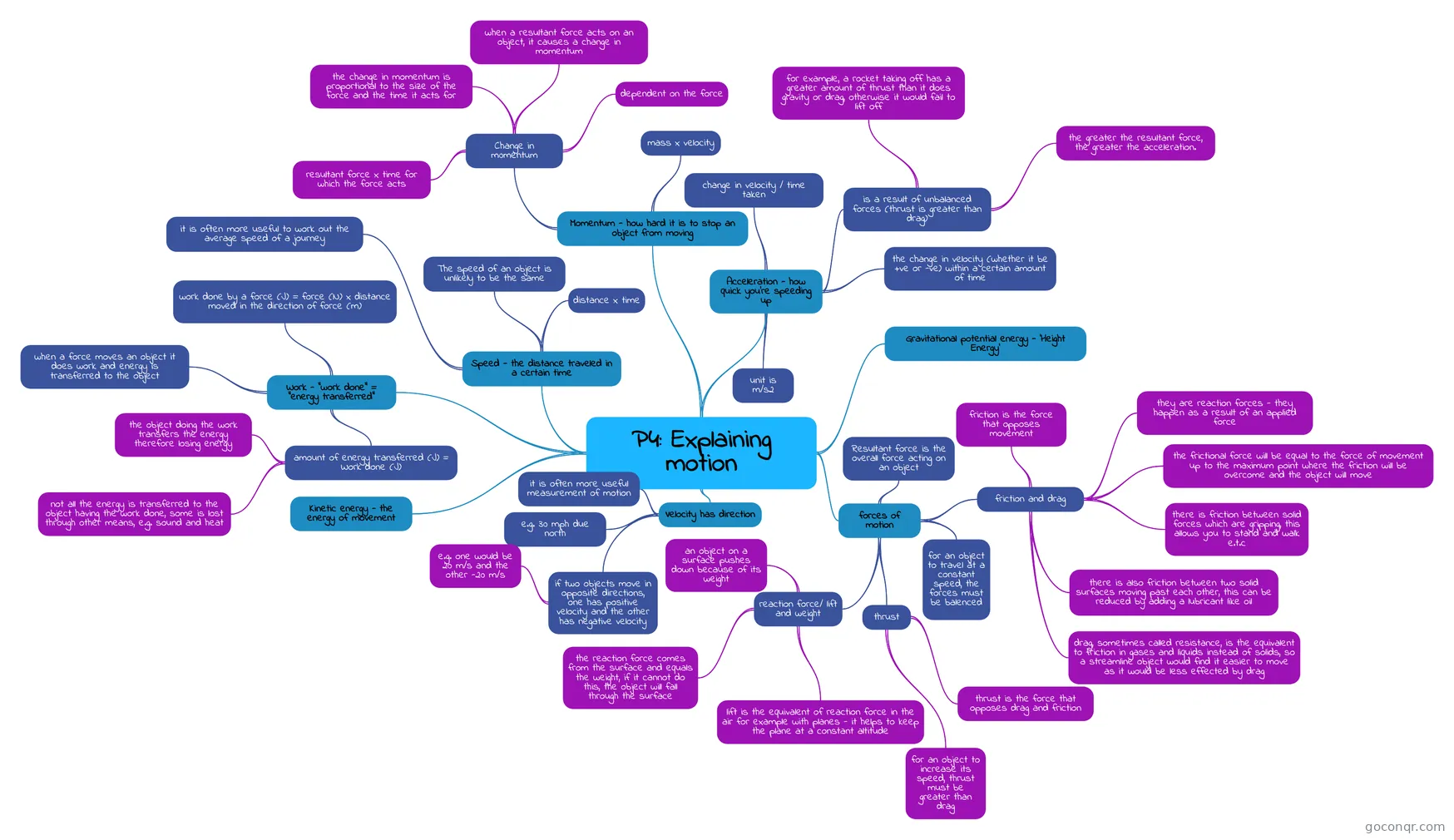
Mind map: Explaining motion
Map content
P4: Explaining motion
Speed - the distance traveled in a certain time
- distance x time
- The speed of an object is unlikely to be the same
- it is often more useful to work out the average speed of a journey
Velocity has direction
- it is often more useful measurement of motion
- e.g. 30 mph due north
- if two objects move in opposite directions, one has positive velocity and the other has negative velocity
- e.g. one would be 20 m/s and the other -20 m/s
Acceleration - how quick you're speeding up
- change in velocity / time taken
- the change in velocity (whether it be +ve or -ve) within a certain amount of time
- unit is m/s2
- is a result of unbalanced forces (thrust is greater than drag)
- for example, a rocket taking off has a greater amount of thrust than it does gravity or drag, otherwise it would fail to lift off
- the greater the resultant force, the greater the acceleration.
forces of motion
- friction and drag
- friction is the force that opposes movement
- they are reaction forces - they happen as a result of an applied force
- the frictional force will be equal to the force of movement up to the maximum point where the friction will be overcome and the object will move
- there is friction between solid forces which are gripping, this allows you to stand and walk e.t.c
- there is also friction between two solid surfaces moving past each other, this can be reduced by adding a lubricant like oil
- drag, sometimes called resistance, is the equivalent to friction in gases and liquids instead of solids, so a streamline object would find it easier to move as it would be less effected by drag
- thrust
- thrust is the force that opposes drag and friction
- for an object to increase its speed, thrust must be greater than drag
- reaction force/ lift and weight
- an object on a surface pushes down because of its weight
- the reaction force comes from the surface and equals the weight, if it cannot do this, the object will fall through the surface
- lift is the equivalent of reaction force in the air for example with planes - it helps to keep the plane at a constant altitude
- for an object to travel at a constant speed, the forces must be balenced
- Resultant force is the overall force acting on an object
- friction and drag
Momentum - how hard it is to stop an object from moving
- mass x velocity
- Change in m0mentum
- dependent on the force
- when a resultant force acts on an object, it causes a change in momentum
- the change in momentum is proportional to the size of the force and the time it acts for
- resultant force x time for which the force acts
Work - "work done" = "energy transferred"
- when a force moves an object it does work and energy is transferred to the object
- amount of energy transferred (J) = Work done (J)
- the object doing the work transfers the energy therefore losing energy
- not all the energy is transferred to the object having the work done, some is lost through other means, e.g. sound and heat
- work done by a force (J) = force (N) x distance moved in the direction of force (m)
Gravitational potential energy - 'Height Energy'
Kinetic energy - the energy of movement
Information
- Description
- GCSE GCSE Stuff Mind Map on P4: Explaining motion, created by thegeekymushroom on 26/11/2014.
- Created by
- thegeekymushroom
- Views
- 426
- Tags
- Rating