
Mind map
Quality Assurance and Improvement Program
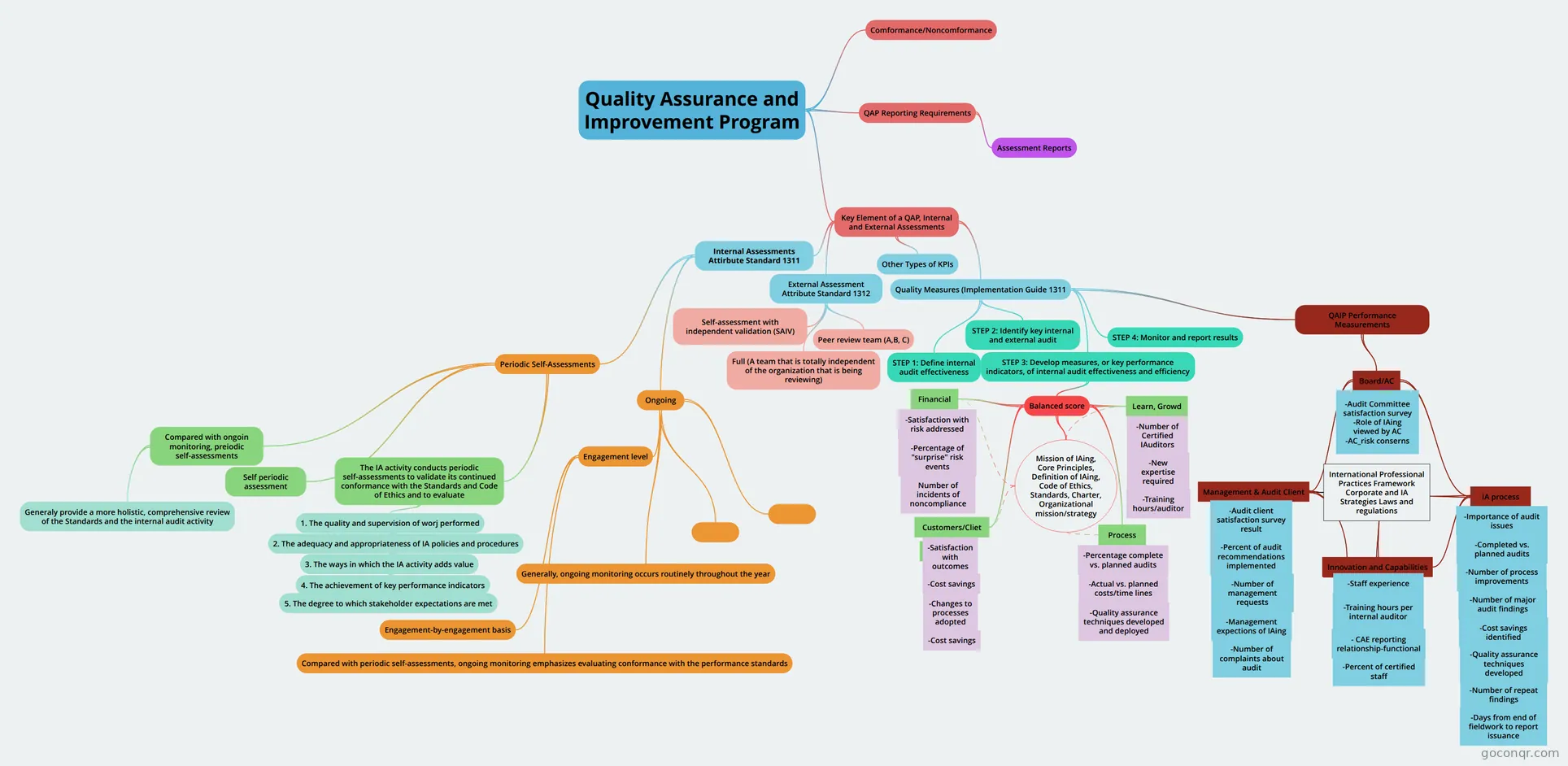
Mind map: Quality assurance and improvement program
Map content
Quality Assurance and Improvement Program
Comformance/Noncomformance
QAP Reporting Requirements
- Assessment Reports
Key Element of a QAP, Internal and External Assessments
- Other Types of KPIs
- Internal Assessments Attirbute Standard 1311
- Periodic Self-Assessments
- Compared with ongoin monitoring, preiodic self-assessments
- Generaly provide a more holistic, comprehensive review of the Standards and the internal audit activity
- Self periodic assessment
- The IA activity conducts periodic self-assessments to validate its continued conformance with the Standards and Code of Ethics and to evaluate
- 1. The quality and supervision of worj performed
- 2. The adequacy and appropriateness of IA policies and procedures
- 3. The ways in which the IA activity adds value
- 4. The achievement of key performance indicators
- 5. The degree to which stakeholder expectations are met
- 4. The achievement of key performance indicators
- 3. The ways in which the IA activity adds value
- 2. The adequacy and appropriateness of IA policies and procedures
- 1. The quality and supervision of worj performed
- Compared with ongoin monitoring, preiodic self-assessments
- Ongoing
- Engagement level
- Engagement-by-engagement basis
- Compared with periodic self-assessments, ongoing monitoring emphasizes evaluating conformance with the performance standards
- Generally, ongoing monitoring occurs routinely throughout the year
- Engagement level
- Periodic Self-Assessments
- External Assessment Attribute Standard 1312
- Self-assessment with independent validation (SAIV)
- Full (A team that is totally independent of the organization that is being reviewing)
- Peer review team (A,B, C)
- Quality Measures (Implementation Guide 1311
- STEP 1: Define internal audit effectiveness
- STEP 2: Identify key internal and external audit
- STEP 3: Develop measures, or key performance indicators, of internal audit effectiveness and efficiency
- Balanced score
- Financial
- -Satisfaction with risk addressed
- -Percentage of "surprise" risk events
- Number of incidents of noncompliance
- -Percentage of "surprise" risk events
- -Satisfaction with risk addressed
- Customers/Cliet
- -Satisfaction with outcomes
- -Cost savings
- -Changes to processes adopted
- -Cost savings
- -Changes to processes adopted
- -Cost savings
- -Satisfaction with outcomes
- Process
- -Percentage complete vs. planned audits
- -Actual vs. planned costs/time lines
- -Quality assurance techniques developed and deployed
- -Actual vs. planned costs/time lines
- -Percentage complete vs. planned audits
- Learn, Growd
- -Number of Certified IAuditors
- -New expertise required
- -Training hours/auditor
- -New expertise required
- -Number of Certified IAuditors
- Mission of IAing, Core Principles, Definition of IAing, Code of Ethics, Standards, Charter, Organizational mission/strategy
- Financial
- Balanced score
- STEP 4: Monitor and report results
- QAIP Performance Measurements
- Board/AC
- -Audit Committee satisfaction survey -Role of IAing viewed by AC -AC_risk conserns
- Management & Audit Client
- International Professional Practices Framework Corporate and IA Strategies Laws and regulations
- -Audit client satisfaction survey result
- -Percent of audit recommendations implemented
- -Number of management requests
- -Management expections of IAing
- -Number of complaints about audit
- -Management expections of IAing
- -Number of management requests
- -Percent of audit recommendations implemented
- IA process
- Innovation and Capabilities
- -Staff experience
- -Training hours per internal auditor
- - CAE reporting relationship-functional
- -Percent of certified staff
- - CAE reporting relationship-functional
- -Training hours per internal auditor
- -Staff experience
- -Importance of audit issues
- -Completed vs. planned audits
- -Number of process improvements
- -Number of major audit findings
- -Cost savings identified
- -Quality assurance techniques developed
- -Number of repeat findings
- -Days from end of fieldwork to report issuance
- -Number of repeat findings
- -Quality assurance techniques developed
- -Cost savings identified
- -Number of major audit findings
- -Number of process improvements
- -Completed vs. planned audits
- Innovation and Capabilities
- Board/AC
Information
- Description
- Mind Map on Quality Assurance and Improvement Program, created by ambuuk bayarbat on 13/06/2019.
- Created by
- ambuuk bayarbat
- Views
- 18
- Rating
More on Managing the Internal Audit Function