
Mind map
Physics Unit 2
Map content
Physics Unit 2
Forces and their effects
- Resultant forces
- Whenever two objects interact the forces they exert are equal and opposite
- hand pushing on table= table pushing back
- Lots of forces acting on one point
- replaced by single force doing everything together
- resultant force
- may cause a change in the state of object
- resultant force
- replaced by single force doing everything together
- Whenever two objects interact the forces they exert are equal and opposite
- Forces and motion
- Acceleration
- a=f/m
- m/s squared
- determined by resultant force (N) and mass (kg)
- the rate of change of velocity per unit of time
- a= v1-v2/t
- final velocity- initial velocity/ seconds taken
- velocity/time graphs
- Velocity = An objects speed in a certain direction
- the steeper the gradient the greater the acceleration
- a downward slope means constant decceleration
- a flat line = constant velocity
- distance = area of graph shape
- m/s
- Acceleration
- Forces and breaking
- when a car travels at a steady speed the driving force is balanced by resistive forces
- therefore the resultant force is 0
- when the breaks are applied
- work done by the friction between the brakes and the wheels reduce the kinetic energy of the vehicle
- the temperature of the breaks increase
- Stopping distances
- a drivers reaction time can be influenced by
- tiredness
- drugs
- alcohol
- a vehicles braking distance can be affected by
- adverse road/weather conditions
- poor condition of the vehicle
- a drivers reaction time can be influenced by
- when a car travels at a steady speed the driving force is balanced by resistive forces
- Forces and terminal velocity
- the faster an object falls the greater the friction
- Three stages of falling
- An object falls b/c gravity and weight. There is no air resistance. There is a resultant force downwards
- It gains speed, air resistance increases, there is a resultant force downwards.
- The objects weight is balanced by the air resistance, no resultant force, the object reaches terminal velocity
- It gains speed, air resistance increases, there is a resultant force downwards.
- An object falls b/c gravity and weight. There is no air resistance. There is a resultant force downwards
- w=m x g
- N=kg x N/kg
- Forces and elasticity
- forces may change the shape of an object
- a force applied to an elastic object will result in the object stretching and storing elastic potential energy
- if an object returns to its original shape elastic potential energy is stored in the object when work is done on it
- f = k x e
- Resultant forces
The Kinetic energy of objects speeding up and slowing down
- Forces and Energy
- work is done when a force causes an object to move through a distance
- Joules
- Energy is transferred when work is done
- W = F x d
- power = work done in a given time
- P = E/t
- the change in gravitational potential energy is what happens when something is raised
- Ep = m x g x h
- kinetic energy = 1/2 x mass x speed
- joules/kg/ meters per second
- work is done when a force causes an object to move through a distance
- Momentum
- Momentum is the tendency of an object to carry on moving in the same direction
- Momentum = mass x velocity
- kg m/s
- momentum is conserved
- if nothing else acts on it the momentum stays the same through collisions and explosions
- Forces and Energy
Currents in electrical circuits
- Static electricity
- When insulating materials are rubbed against each other they become electrically charged
- Negatively charged electrons are rubbed of one material and onto the other
- equal amounts of opposite charge
- this only works for insulators
- Negatively charged electrons are rubbed of one material and onto the other
- when two charged objects are brought together they exert a force on each other
- electrical charges move better through other substances
- e.g. metal
- When insulating materials are rubbed against each other they become electrically charged
- Electrical circuits
- Electric current is a flow of charge
- The size of the electric current is the rate of flow of electric charge
- I = Q/T
- Current = charge/time
- amps = coulombs/ seconds
- I = Q/T
- The size of the electric current is the rate of flow of electric charge
- potential difference is the work done per coulomb of charge that passes between two points in a circuit
- V = W/Q
- potential difference = work done/ charge in coulombs
- V = W/Q
- Current / potential difference graphs show that as current changes so does potential difference
- V= I x R
- Electric current is a flow of charge
- Static electricity
Using Mains Electricity safely and the power of electrical appliances
- Household electricity
- direct current
- current that always passes in the same direction
- batteries, cells
- current that always passes in the same direction
- alternating current
- always changing direction
- mains electricity
- 50 hertz
- 230 V
- Electrical cables
- 2 or 3 inner wires
- copper core
- flexible plastic outer layer
- 2 or 3 inner wires
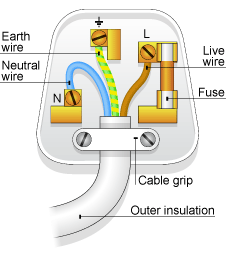
- Structure of a plug
- If there is too much current
- it is stopped by the fuse/ circuit breaker/ live wire
- when there is too much current the fuse will melt and break the circuit
- a residual circuit breaker will detect a difference in the current between the live and neutral wires
- hey are faster than fuses
- it is stopped by the fuse/ circuit breaker/ live wire
- appliances with metal cases are usually earthed
- the earth wire creates a safe route for the current to flow through
- direct current
- Current, charge and power
- When an electrical charge flows through a resistor, the resistor gets hot
- therefore energy is wasted
- filament bulbs waste energy
- therefore energy is wasted
- The rate at which energy is transferred by an appliance is the power
- power = current x potential difference
- P = I x v
- energy transferred = potential difference x coulombs
- E = V x Q
- power = energy/time
- P=E/t
- power = current x potential difference
- When an electrical charge flows through a resistor, the resistor gets hot
- Household electricity
Images and files in the map
Information
- Description
- Mind Map on Physics Unit 2, created by Apoorva Sriram on 13/01/2015.
- Created by
- Apoorva Sriram
- Views
- 31
- Rating