
Mind map
River Landforms
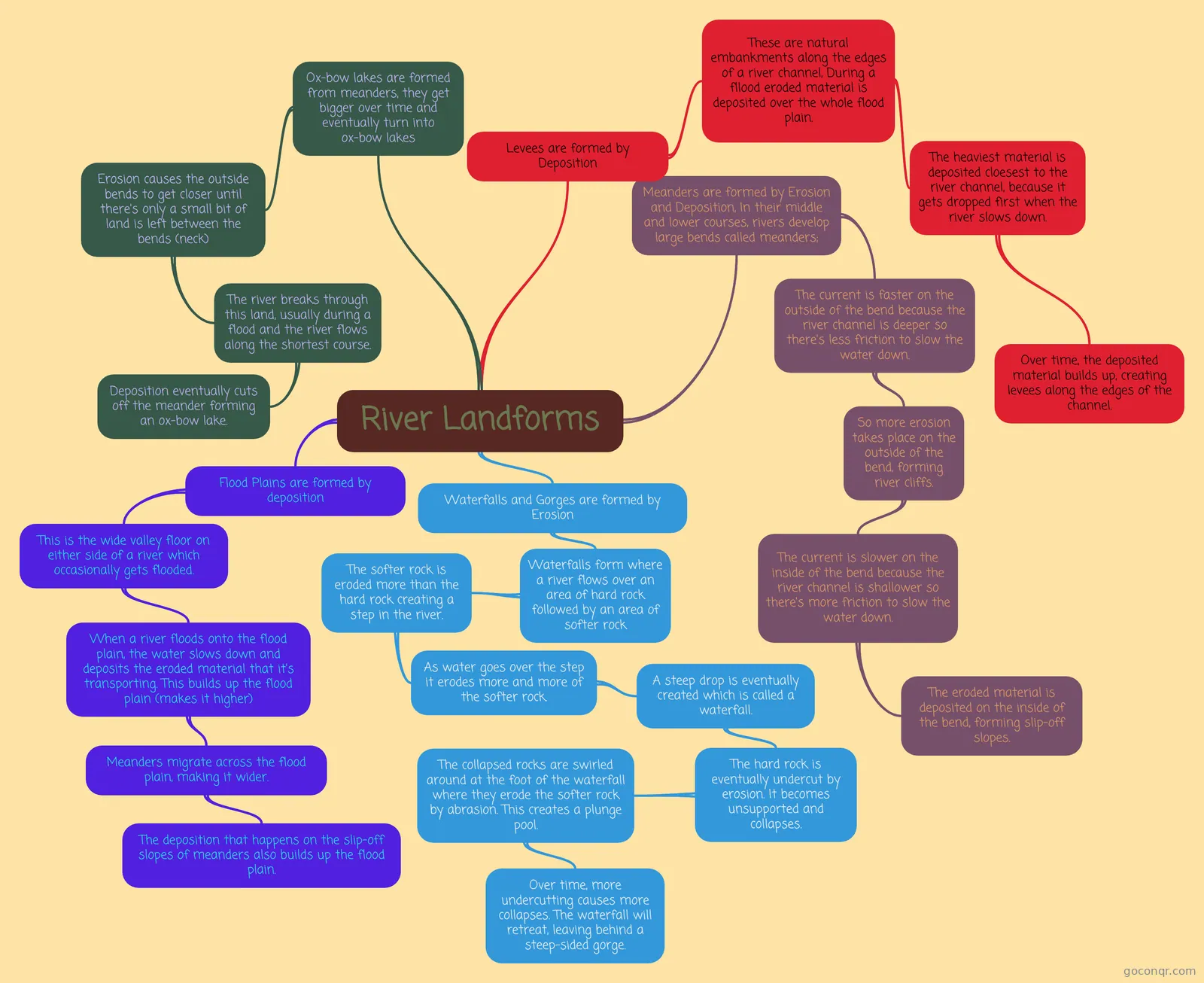
Mind map: River landforms
Map content
River Landforms
Meanders are formed by Erosion and Deposition, In their middle and lower courses, rivers develop large bends called meanders;
- The current is faster on the outside of the bend because the river channel is deeper so there's less friction to slow the water down.
- So more erosion takes place on the outside of the bend, forming river cliffs.
- The current is slower on the inside of the bend because the river channel is shallower so there's more friction to slow the water down.
- The eroded material is deposited on the inside of the bend, forming slip-off slopes.
- The current is slower on the inside of the bend because the river channel is shallower so there's more friction to slow the water down.
- So more erosion takes place on the outside of the bend, forming river cliffs.
- The current is faster on the outside of the bend because the river channel is deeper so there's less friction to slow the water down.
Ox-bow lakes are formed from meanders, they get bigger over time and eventually turn into ox-bow lakes
- Erosion causes the outside bends to get closer until there's only a small bit of land is left between the bends (neck)
- The river breaks through this land, usually during a flood and the river flows along the shortest course.
- Deposition eventually cuts off the meander forming an ox-bow lake.
- The river breaks through this land, usually during a flood and the river flows along the shortest course.
- Erosion causes the outside bends to get closer until there's only a small bit of land is left between the bends (neck)
Waterfalls and Gorges are formed by Erosion
- Waterfalls form where a river flows over an area of hard rock followed by an area of softer rock
- The softer rock is eroded more than the hard rock creating a step in the river.
- As water goes over the step it erodes more and more of the softer rock.
- A steep drop is eventually created which is called a waterfall.
- The hard rock is eventually undercut by erosion. It becomes unsupported and collapses.
- The collapsed rocks are swirled around at the foot of the waterfall where they erode the softer rock by abrasion. This creates a plunge pool.
- Over time, more undercutting causes more collapses. The waterfall will retreat, leaving behind a steep-sided gorge.
- The collapsed rocks are swirled around at the foot of the waterfall where they erode the softer rock by abrasion. This creates a plunge pool.
- The hard rock is eventually undercut by erosion. It becomes unsupported and collapses.
- A steep drop is eventually created which is called a waterfall.
- As water goes over the step it erodes more and more of the softer rock.
- The softer rock is eroded more than the hard rock creating a step in the river.
- Waterfalls form where a river flows over an area of hard rock followed by an area of softer rock
Flood Plains are formed by deposition
- This is the wide valley floor on either side of a river which occasionally gets flooded.
- When a river floods onto the flood plain, the water slows down and deposits the eroded material that it's transporting. This builds up the flood plain (makes it higher)
- Meanders migrate across the flood plain, making it wider.
- The deposition that happens on the slip-off slopes of meanders also builds up the flood plain.
- Meanders migrate across the flood plain, making it wider.
- When a river floods onto the flood plain, the water slows down and deposits the eroded material that it's transporting. This builds up the flood plain (makes it higher)
- This is the wide valley floor on either side of a river which occasionally gets flooded.
Levees are formed by Deposition
- These are natural embankments along the edges of a river channel, During a fllood eroded material is deposited over the whole flood plain.
- The heaviest material is deposited cloesest to the river channel, because it gets dropped first when the river slows down.
- Over time, the deposited material builds up, creating levees along the edges of the channel.
- The heaviest material is deposited cloesest to the river channel, because it gets dropped first when the river slows down.
- These are natural embankments along the edges of a river channel, During a fllood eroded material is deposited over the whole flood plain.
Information
- Description
- Mind Map on River Landforms, created by Keshena Edwards on 23/03/2015.
- Created by
- Keshena Edwards
- Views
- 0
- Rating