
Mind map
Invasive Species
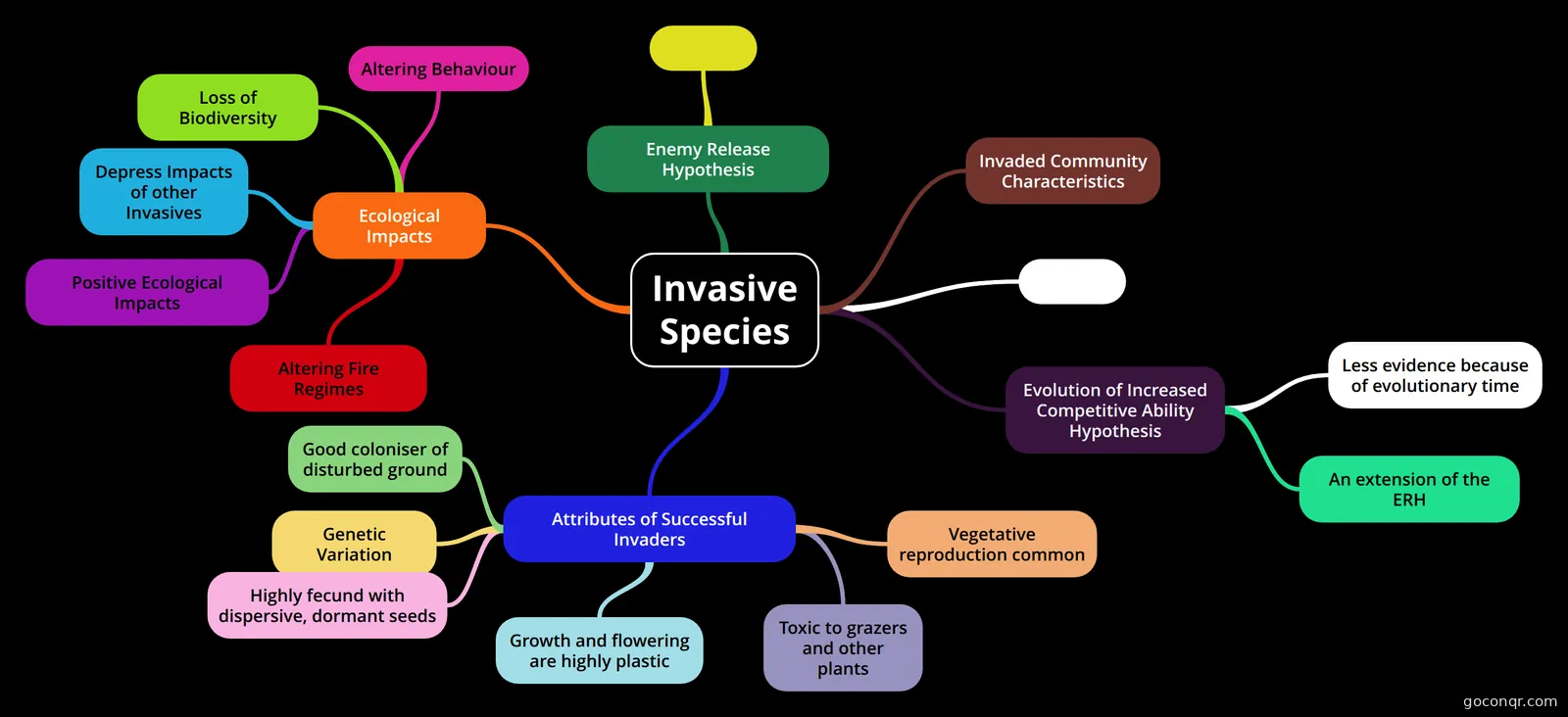
Mind map: Invasive species
Map content
Invasive Species
Ecological Impacts
- Loss of Biodiversity
- *Brown tree snake (Boiga irregularis) arrived on Guam shortly after WWII - only other native snake was a small worm-like insectivore. In 1960s it increased in numbers. Caused (or at least heavily contributed towards) extinction of approx. 15 native bird species. Also consumes native anole, skinks, geckos, rats and bats. * Rosy wolfsnail (Euglandina rosea) introduced to Hawaii as a biological control of Achantina fulica (african land snail) - did little to help but contributed to extinction of 15 of 20 endemic Achatinella snail species. Same effect in the Society Islands of French Polynesia where 56 of 61 endemic partulid snails were driven to extinction. Coincidentally also ended the artisanal jewelry-making economy.
- Depress Impacts of other Invasives
- *In the 1980s in the Black Sea the generalist planktonic carnivore, ctenophore Mnemiopsis leidyi arrived and correlated with its population boom was the decline of a number of fish species and the collapse of the associated commercial fisheries. Then in 1997 a second alien ctenophore species arrived, Beroe ovata, which eats other ctenophores. By 1999 M. leidyi had declined from 4000g/m2 to 155g/m2 wet weight and the fisheries starting to recover.
- Altering Fire Regimes
- Another way that invasive plants can impact the ecology of an area is by altering the fire regimes. Fire is an important type of disturbance. One major way that invasives can alter the fire regime is by changing fuel properties. In turn this can affect fire regime characteristics such as frequency, intensity, extent, type, and seasonality of fire. A key example of an invasive species having a profound effect on a fire regime is that of Bromus tectorum in western USA. Its invasion has increased fire frequency to the point that native shrub-steppe species cannot recover. This, in turn, negatively affects animals that require this habitat for forage and cover (e.g. sage grouse and black-tailed jackrabbit which are major prey species for golden eagles and prairie falcons.
- Altering Behaviour
- Although behavioral impacts may seem subtle they have the potential to scale up to affect population, community and ecosystem dynamics. *Impatiens glandulifera was introduced to Europe from the Himalayas approx. 100 ya. It is the tallest annual in Europe, has a broad climate and soil tolerance and is spreading rapidly. Has a similar sugar content in its nectar to natives but its rate of nectar production is higher by an order of magnitude (its 0.47mg/hr/flower). Pollinating bumblebees visit it 4x more than the native plant with highest nectar production, marsh woundwort (Chittka and Shurkans, 2001). Where it establishes, visits to native plants are reduced by 50% and 25% seed set. By altering the foraging behaviour of a native pollinator, I. glandulifera is indirectly affecting fecundity of native plants.
- Positive Ecological Impacts
- *Mytilus galloprovinicialis introduced to South Africa west coast from Mediterranean. Outcompeted a number of native species (e.g. endemic Aulacomya ater) and has also affected grazing species (e.g. some limpets). But has also had a positive effect - the African black oystercatcher (Haematopus moquini) is one of Africa's rarest birds but with the rapid spread of M. provinicialis they have more food and so population size has increased and a more successful breeding rate.
- Loss of Biodiversity
Attributes of Successful Invaders
- Important to note that invasions should be looked at on a case by case basis. What was successful in one species may not be a contributing factor in the invasion success of another and so there is no clear definitive list of attributes that make a successful invasive species.
- Good coloniser of disturbed ground
- Genetic Variation
- Growth and flowering are highly plastic
- Highly fecund with dispersive, dormant seeds
- Vegetative reproduction common
- Toxic to grazers and other plants
Invaded Community Characteristics
Enemy Release Hypothesis
Evolution of Increased Competitive Ability Hypothesis
- Plant defense theory suggests that poorly defended, fast growing genotypes should be favoured by reduced herbivory. If nothing is eating you anymore then why waste resources on defence. The longer a species has been established in a new area, the more it should favour growth and we should see defensive traits less. Introduced weeds probably escape herbivory so we should see selection of low defence/fast growth genotypes.
- An extension of the ERH
- Less evidence because of evolutionary time
- Joshi & Tielborger (2012) compared plant size and susceptibility to herbivory in native European and introduced North American Loosestrife populations. When grown in common conditions in Germany, North American plants grew larger but also suffered more herbivory than European origin plants
Information
- Description
- BSc Degree Conservation Biology (Principles of Conservation) Mind Map on Invasive Species, created by Madison Burt on 01/04/2015.
- Created by
- Madison Burt
- Views
- 5
- Rating