
Mind map
MODALS OF DEDUCTIONS
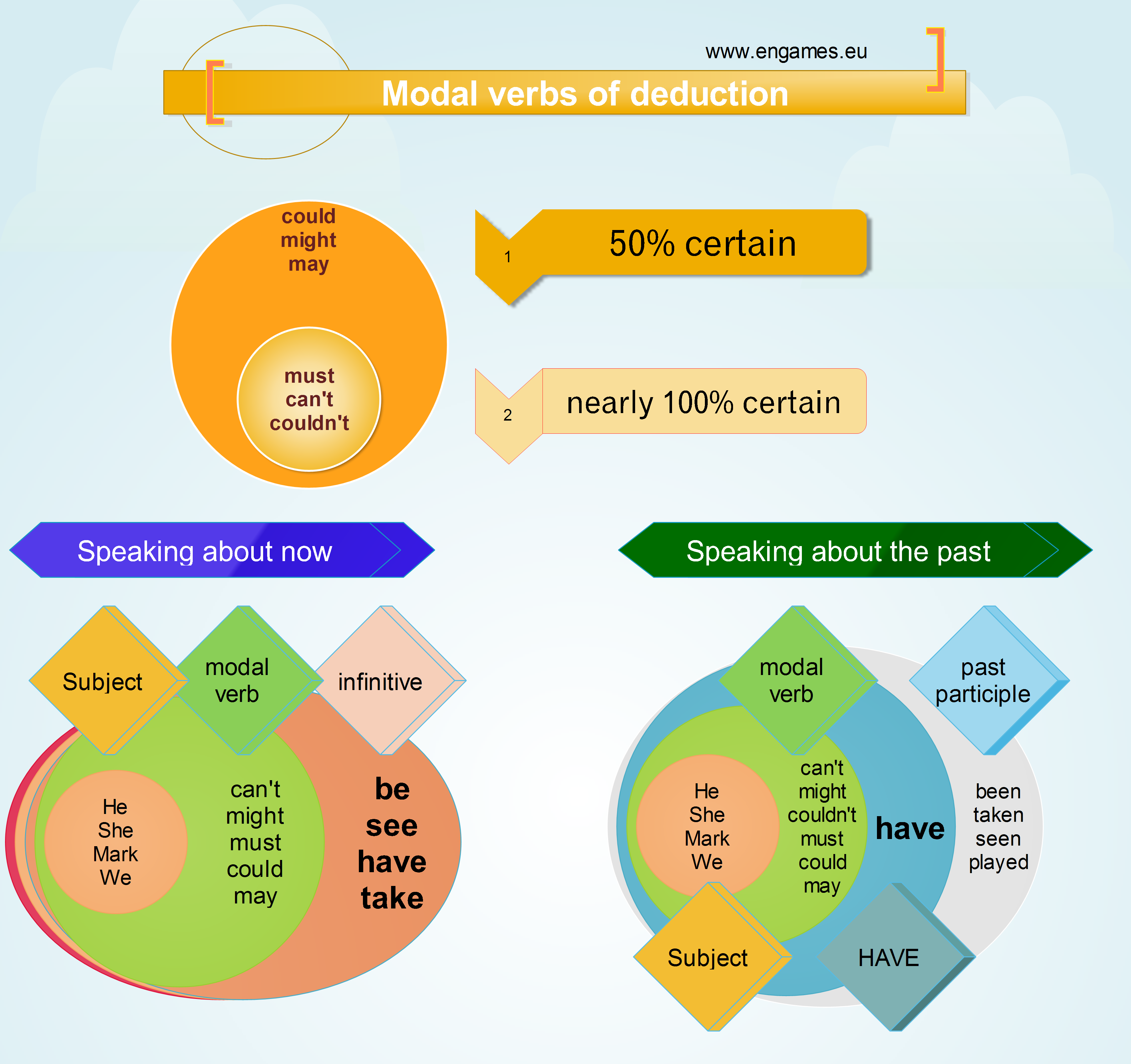
Map content
MODALS OF DEDUCTIONS
Some modal verbs can be used to express probability in the present and past.
Must, can't: expressing present probability
- We use must to express that we feel sure that something is true.
- The team is playing really well today; they must win.
- We use can't to say we are sure that something is impossible.
- She can't be so ill – I saw her playing volleyball yesterday.
- We use must to express that we feel sure that something is true.
We use might, may or could
- To say that we think something is possible but we’re not sure.
- They may be arriving tomorrow. He might be away on holiday at the moment. He could be away on holiday. He might get the job.
- The negative of may is may not. The negative of might is might not
- He might not get the job. I may not pass the exam. I might not go to the match tomorrow.
In Present
in Past
- In the same way that we use modal verbs to say how certain we are about things in the present we can also use them to speculate about the past.
- we are using deduction the form is MODAL + have +past participle
- Must have + past participle
- You must have been very pleased when you received the results of your exams.
- Might have/may have/could have + past participle
- He may have said he was coming but I can’t really remember. I wasn’t listening. I might have been here when I was a child but I can’t really remember.
- Can’t have + past participle
- You can’t have seen him this morning. He was with me all the time. She can’t have liked the show. She hates musicals.
- Must have + past participle
- we are using deduction the form is MODAL + have +past participle
- In the same way that we use modal verbs to say how certain we are about things in the present we can also use them to speculate about the past.
Images and files in the map
Information
- Description
- We use modal verbs to say how sure we are about something.
- Created by
- tedretz
- Views
- 148
- Tags
- Rating