
Mind map
Space work
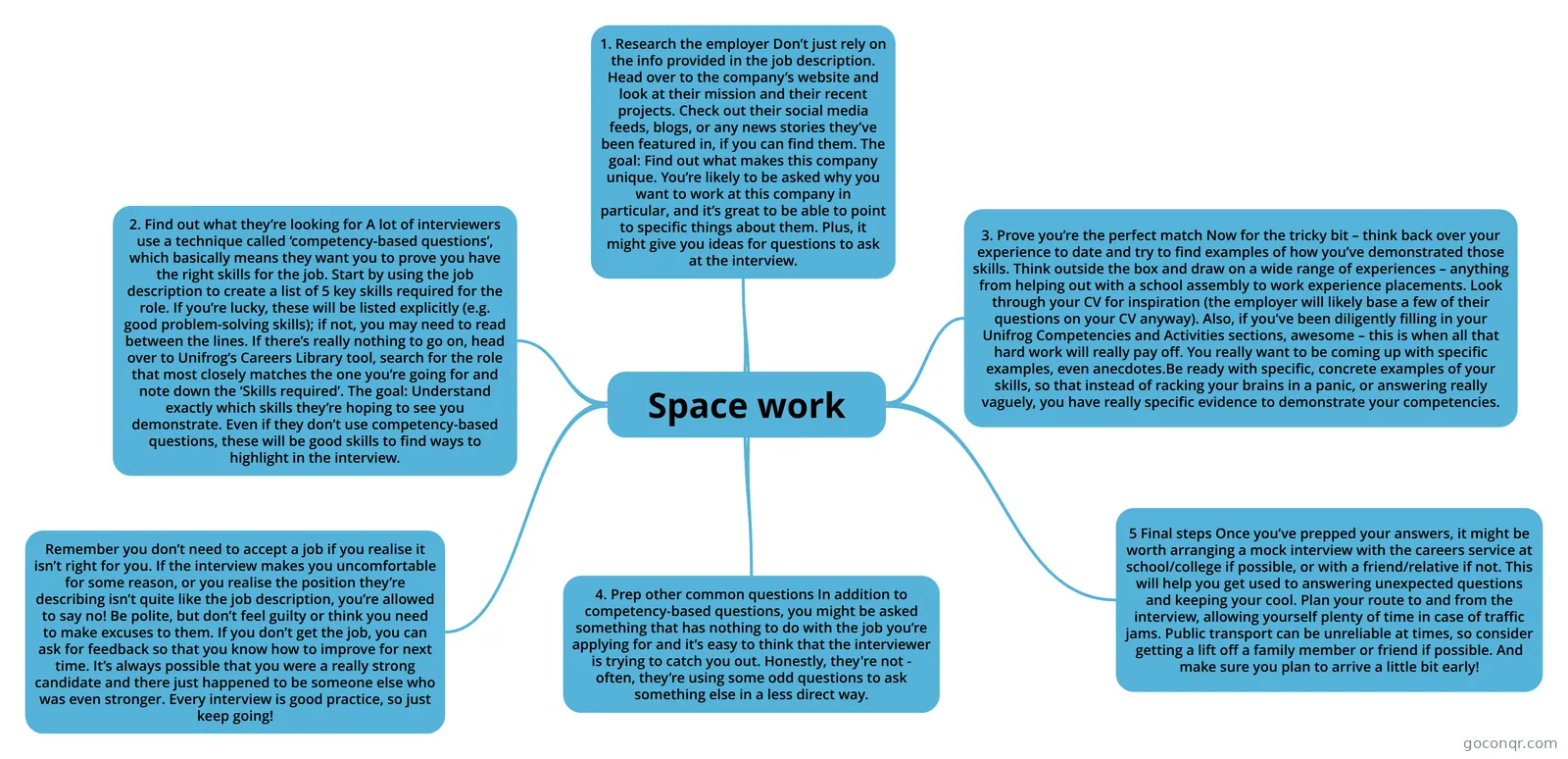
Mind map: space work
Map content
Space work
1. Research the employer Don’t just rely on the info provided in the job description. Head over to the company’s website and look at their mission and their recent projects. Check out their social media feeds, blogs, or any news stories they’ve been featured in, if you can find them. The goal: Find out what makes this company unique. You’re likely to be asked why you want to work at this company in particular, and it’s great to be able to point to specific things about them. Plus, it might give you ideas for questions to ask at the interview.
2. Find out what they’re looking for A lot of interviewers use a technique called ‘competency-based questions’, which basically means they want you to prove you have the right skills for the job. Start by using the job description to create a list of 5 key skills required for the role. If you’re lucky, these will be listed explicitly (e.g. good problem-solving skills); if not, you may need to read between the lines. If there’s really nothing to go on, head over to Unifrog’s Careers Library tool, search for the role that most closely matches the one you’re going for and note down the ‘Skills required’. The goal: Understand exactly which skills they’re hoping to see you demonstrate. Even if they don’t use competency-based questions, these will be good skills to find ways to highlight in the interview.
3. Prove you’re the perfect match Now for the tricky bit – think back over your experience to date and try to find examples of how you’ve demonstrated those skills. Think outside the box and draw on a wide range of experiences – anything from helping out with a school assembly to work experience placements. Look through your CV for inspiration (the employer will likely base a few of their questions on your CV anyway). Also, if you’ve been diligently filling in your Unifrog Competencies and Activities sections, awesome – this is when all that hard work will really pay off. You really want to be coming up with specific examples, even anecdotes.Be ready with specific, concrete examples of your skills, so that instead of racking your brains in a panic, or answering really vaguely, you have really specific evidence to demonstrate your competencies.
4. Prep other common questions In addition to competency-based questions, you might be asked something that has nothing to do with the job you’re applying for and it’s easy to think that the interviewer is trying to catch you out. Honestly, they're not - often, they’re using some odd questions to ask something else in a less direct way.
5 Final steps Once you’ve prepped your answers, it might be worth arranging a mock interview with the careers service at school/college if possible, or with a friend/relative if not. This will help you get used to answering unexpected questions and keeping your cool. Plan your route to and from the interview, allowing yourself plenty of time in case of traffic jams. Public transport can be unreliable at times, so consider getting a lift off a family member or friend if possible. And make sure you plan to arrive a little bit early!
Remember you don’t need to accept a job if you realise it isn’t right for you. If the interview makes you uncomfortable for some reason, or you realise the position they’re describing isn’t quite like the job description, you’re allowed to say no! Be polite, but don’t feel guilty or think you need to make excuses to them. If you don’t get the job, you can ask for feedback so that you know how to improve for next time. It’s always possible that you were a really strong candidate and there just happened to be someone else who was even stronger. Every interview is good practice, so just keep going!
Information
- Description
- Mind Map on Space work, created by Joshua Hancock on 11/02/2021.
- Created by
- Joshua Hancock
- Views
- 0
- Rating
More on Job Search, Resumes and Interviews