
Mind map
NASALS
Map content
NASALS
(2) Place/Point of Articulation
- Bilabial Alveolar Velar
(1) Manner of Articulation
- It refers to how the articulators approach each other to create a seal. It also determines the type and degree of obstacle the airflow encounters at its exit affected by the closure.
Nasals (also called nasal stops, nasal occlusives, or nasal continuants) are types of consonant sounds. These are called nasals because during their articulation the airflow escapes through the nasal cavity as there is a complete closure in the oral cavity.
(3) Voicing/Phonation
- Nasals /m/ /n/ /ŋ/ Place/Point of Articulation bilabial alveolar velar Manner of Articulation nasal nasal nasal Voicing/Phonation voiced (lenis) voiced (lenis) Voiced (lenis)
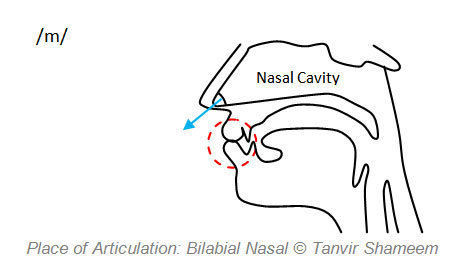
- /m/-Bilabial Nasal
- Place of Articulation: The upper and the lower lips.
- Manner of Articulation: During the articulation of /m/ the two lips are pressed together and a closure is made. The soft palate is lowered; consequently the air then goes up the nasal cavity and passes out through the nose.
- Voicing: During the articulation of /m/ the vocal folds vibrate, hence it is a voiced bilabial nasal sound.
- Distribution: /m/ can occur initially, medially, and finally, for instance: Nasal Initial Medial Final /m/ mat laymen gum
- Voicing: During the articulation of /m/ the vocal folds vibrate, hence it is a voiced bilabial nasal sound.
- Manner of Articulation: During the articulation of /m/ the two lips are pressed together and a closure is made. The soft palate is lowered; consequently the air then goes up the nasal cavity and passes out through the nose.
- Place of Articulation: The upper and the lower lips.
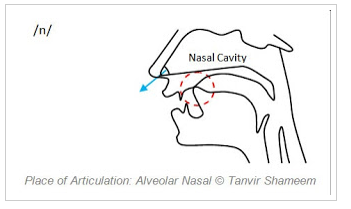
- /n/-Alveolar Nasal
- Place of Articulation: The tip of the tongue and the alveolar ridge.
- Manner of Articulation: During the articulation of /n/the tip of the tongue touches the alveolar ridge and creates a closure. The air is held behind the closure for a while. The soft palate is lowered; consequently the air then goes up the nasal cavity and passes out through the nose.
- Voicing: During the articulation of /n/ the vocal folds vibrate, hence it is a voiced alveolar nasal sound.
- Distribution: /n/ can occur initially, medially, and finally, for instance: Nasal Initial Medial Final /n/ naive sand gun /ŋ/- Velar Nasal
- References * Consonants.” SLT Info. 2013. SLTInfo.20 August 2013 <http://www.sltinfo.com/consonants.html>. * Mannell, Robert.“Articulation of Nasal Stops.” Macquarie University. 2009. Macquarie University.20 August 2013 <http://clas.mq.edu.au/phonetics/phonetics/consonants/nasal_stops.html>.
- Distribution: /n/ can occur initially, medially, and finally, for instance: Nasal Initial Medial Final /n/ naive sand gun /ŋ/- Velar Nasal
- Voicing: During the articulation of /n/ the vocal folds vibrate, hence it is a voiced alveolar nasal sound.
- Manner of Articulation: During the articulation of /n/the tip of the tongue touches the alveolar ridge and creates a closure. The air is held behind the closure for a while. The soft palate is lowered; consequently the air then goes up the nasal cavity and passes out through the nose.
- Place of Articulation: The tip of the tongue and the alveolar ridge.
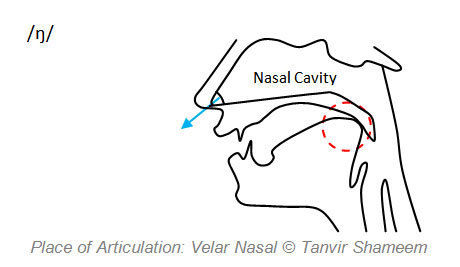
- /ŋ/- Velar Nasal
- Place of Articulation: The back of the tongue and the soft plate.
- Manner of Articulation: During the articulation the back of the tongue comes near the soft palate and creates a closure. The soft palate is lowered; consequently the air then goes up the nasal cavity and passes out through the nose.
- Voicing: During the articulation of /ŋ/ the vocal folds vibrate, hence it is a voiced velar nasal sound.
- Distribution: /n/ can occur medially, and finally, for instance: Nasal Initial Medial Final /ŋ/ - ankle bring
- Voicing: During the articulation of /ŋ/ the vocal folds vibrate, hence it is a voiced velar nasal sound.
- Manner of Articulation: During the articulation the back of the tongue comes near the soft palate and creates a closure. The soft palate is lowered; consequently the air then goes up the nasal cavity and passes out through the nose.
- Place of Articulation: The back of the tongue and the soft plate.
- /m/-Bilabial Nasal
- Nasals /m/ /n/ /ŋ/ Place/Point of Articulation bilabial alveolar velar Manner of Articulation nasal nasal nasal Voicing/Phonation voiced (lenis) voiced (lenis) Voiced (lenis)
Images and files in the map
Information
- Description
- Mind Map on NASALS, created by Washington Velasco on 18/08/2021.
- Created by
- Washington Velasco
- Views
- 0
- Rating