
Mind map
Pleuripotent Stem Cell
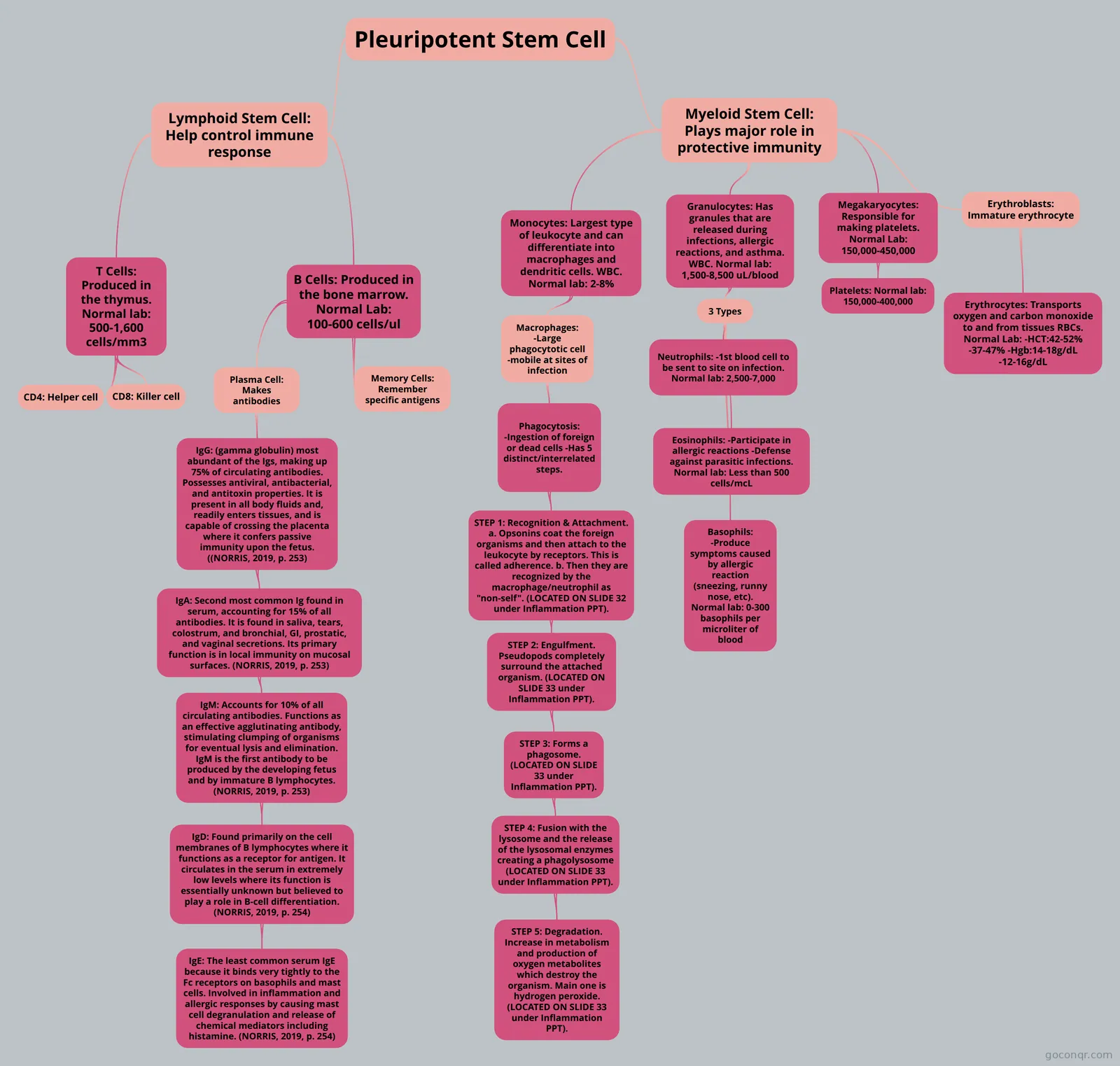
Mind map: Pluripotent stem cell
Map content
Pleuripotent Stem Cell
Lymphoid Stem Cell: Help control immune response
- T Cells: Produced in the thymus. Normal lab: 500-1,600 cells/mm3
- CD4: Helper cell
- CD8: Killer cell
- B Cells: Produced in the bone marrow. Normal Lab: 100-600 cells/ul
- Plasma Cell: Makes antibodies
- IgG: (gamma globulin) most abundant of the Igs, making up 75% of circulating antibodies. Possesses antiviral, antibacterial, and antitoxin properties. It is present in all body fluids and, readily enters tissues, and is capable of crossing the placenta where it confers passive immunity upon the fetus. ((NORRIS, 2019, p. 253)
- IgA: Second most common Ig found in serum, accounting for 15% of all antibodies. It is found in saliva, tears, colostrum, and bronchial, GI, prostatic, and vaginal secretions. Its primary function is in local immunity on mucosal surfaces. (NORRIS, 2019, p. 253)
- IgM: Accounts for 10% of all circulating antibodies. Functions as an effective agglutinating antibody, stimulating clumping of organisms for eventual lysis and elimination. IgM is the first antibody to be produced by the developing fetus and by immature B lymphocytes. (NORRIS, 2019, p. 253)
- IgD: Found primarily on the cell membranes of B lymphocytes where it functions as a receptor for antigen. It circulates in the serum in extremely low levels where its function is essentially unknown but believed to play a role in B-cell differentiation. (NORRIS, 2019, p. 254)
- IgE: The least common serum IgE because it binds very tightly to the Fc receptors on basophils and mast cells. Involved in inflammation and allergic responses by causing mast cell degranulation and release of chemical mediators including histamine. (NORRIS, 2019, p. 254)
- IgD: Found primarily on the cell membranes of B lymphocytes where it functions as a receptor for antigen. It circulates in the serum in extremely low levels where its function is essentially unknown but believed to play a role in B-cell differentiation. (NORRIS, 2019, p. 254)
- IgM: Accounts for 10% of all circulating antibodies. Functions as an effective agglutinating antibody, stimulating clumping of organisms for eventual lysis and elimination. IgM is the first antibody to be produced by the developing fetus and by immature B lymphocytes. (NORRIS, 2019, p. 253)
- IgA: Second most common Ig found in serum, accounting for 15% of all antibodies. It is found in saliva, tears, colostrum, and bronchial, GI, prostatic, and vaginal secretions. Its primary function is in local immunity on mucosal surfaces. (NORRIS, 2019, p. 253)
- IgG: (gamma globulin) most abundant of the Igs, making up 75% of circulating antibodies. Possesses antiviral, antibacterial, and antitoxin properties. It is present in all body fluids and, readily enters tissues, and is capable of crossing the placenta where it confers passive immunity upon the fetus. ((NORRIS, 2019, p. 253)
- Memory Cells: Remember specific antigens
- Plasma Cell: Makes antibodies
- T Cells: Produced in the thymus. Normal lab: 500-1,600 cells/mm3
Myeloid Stem Cell: Plays major role in protective immunity
- Monocytes: Largest type of leukocyte and can differentiate into macrophages and dendritic cells. WBC. Normal lab: 2-8%
- Macrophages: -Large phagocytotic cell -mobile at sites of infection
- Phagocytosis: -Ingestion of foreign or dead cells -Has 5 distinct/interrelated steps.
- STEP 1: Recognition & Attachment. a. Opsonins coat the foreign organisms and then attach to the leukocyte by receptors. This is called adherence. b. Then they are recognized by the macrophage/neutrophil as "non-self". (LOCATED ON SLIDE 32 under Inflammation PPT).
- STEP 2: Engulfment. Pseudopods completely surround the attached organism. (LOCATED ON SLIDE 33 under Inflammation PPT).
- STEP 3: Forms a phagosome. (LOCATED ON SLIDE 33 under Inflammation PPT).
- STEP 4: Fusion with the lysosome and the release of the lysosomal enzymes creating a phagolysosome (LOCATED ON SLIDE 33 under Inflammation PPT).
- STEP 5: Degradation. Increase in metabolism and production of oxygen metabolites which destroy the organism. Main one is hydrogen peroxide. (LOCATED ON SLIDE 33 under Inflammation PPT).
- STEP 4: Fusion with the lysosome and the release of the lysosomal enzymes creating a phagolysosome (LOCATED ON SLIDE 33 under Inflammation PPT).
- STEP 3: Forms a phagosome. (LOCATED ON SLIDE 33 under Inflammation PPT).
- STEP 2: Engulfment. Pseudopods completely surround the attached organism. (LOCATED ON SLIDE 33 under Inflammation PPT).
- STEP 1: Recognition & Attachment. a. Opsonins coat the foreign organisms and then attach to the leukocyte by receptors. This is called adherence. b. Then they are recognized by the macrophage/neutrophil as "non-self". (LOCATED ON SLIDE 32 under Inflammation PPT).
- Phagocytosis: -Ingestion of foreign or dead cells -Has 5 distinct/interrelated steps.
- Macrophages: -Large phagocytotic cell -mobile at sites of infection
- Granulocytes: Has granules that are released during infections, allergic reactions, and asthma. WBC. Normal lab: 1,500-8,500 uL/blood
- 3 Types
- Neutrophils: -1st blood cell to be sent to site on infection. Normal lab: 2,500-7,000
- Eosinophils: -Participate in allergic reactions -Defense against parasitic infections. Normal lab: Less than 500 cells/mcL
- Basophils: -Produce symptoms caused by allergic reaction (sneezing, runny nose, etc). Normal lab: 0-300 basophils per microliter of blood
- 3 Types
- Megakaryocytes: Responsible for making platelets. Normal Lab: 150,000-450,000
- Platelets: Normal lab: 150,000-400,000
- Erythroblasts: Immature erythrocyte
- Erythrocytes: Transports oxygen and carbon monoxide to and from tissues RBCs. Normal Lab: -HCT:42-52% -37-47% -Hgb:14-18g/dL -12-16g/dL
- Monocytes: Largest type of leukocyte and can differentiate into macrophages and dendritic cells. WBC. Normal lab: 2-8%
Information
- Description
- Mind Map on Pleuripotent Stem Cell, created by Madison Tomberg on 23/09/2021.
- Created by
- Madison Tomberg
- Views
- 0
- Rating