
Mind map
How to teach writing?
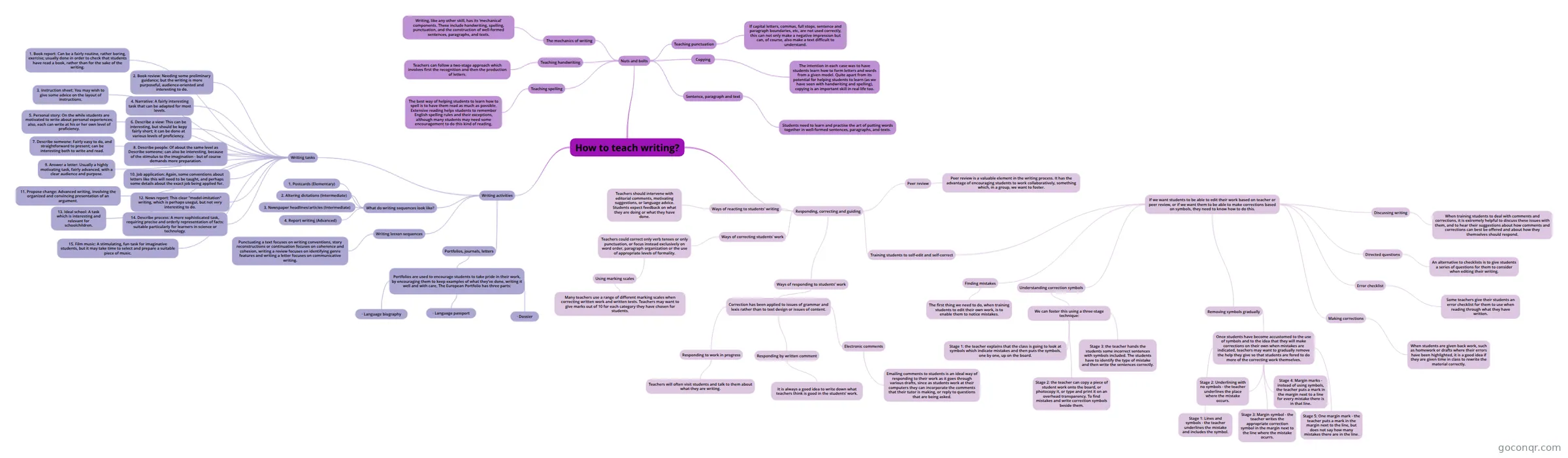
Mind map: How to teach writing?
Map content
How to teach writing?
Nuts and bolts
- The mechanics of writing
- Writing, like any other skill, has its ‘mechanical’ components. These include handwriting, spelling, punctuation, and the construction of well-formed sentences, paragraphs, and texts.
- Teaching handwriting
- Teachers can follow a two-stage approach which involves first the recognition and then the production of letters.
- Teaching spelling
- The best way of helping students to learn how to spell is to have them read as much as possible. Extensive reading helps students to remember English spelling rules and their exceptions, although many students may need some encouragement to do this kind of reading.
- Teaching punctuation
- If capital letters, commas, full stops, sentence and paragraph boundaries, etc, are not used correctly, this can not only make a negative impression but can, of course, also make a text difficult to understand.
- Copying
- The intention in each case was to have students learn how to form letters and words from a given model. Quite apart from its potential for helping students to learn (as we have seen with handwriting and spelling), copying is an important skill in real life too.
- Sentence, paragraph and text
- Students need to learn and practise the art of putting words together in well-formed sentences, paragraphs, and texts.
- The mechanics of writing
Writing activities
- Writing tasks
- 1. Book report: Can be a fairly routine, rather boring, exercise; usually done in order to check that students have read a book, rather than for the sake of the writing.
- 2. Book review: Needing some preliminary guidance; but the writing is more purposeful, audience-oriented and interesting to do.
- 3. Instruction sheet: You may wish to give some advice on the layout of instructions.
- 4. Narrative: A fairly interesting task that can be adapted for most levels.
- 5. Personal story: On the while students are motivated to write about personal experiences; also, each can write at his or her own level of proficiency.
- 6. Describe a view: This can be interesting, but should be kepy fairly short; it can be done at various levels of proficiency.
- 7. Describe someone: Fairly easy to do, and straightforward to present; can be interesting both to write and read.
- 8. Describe people: Of about the same level as Describe someone; can also be interesting, because of the stimulus to the imagination - but of course demands more preparation.
- 9. Answer a letter: Usually a highly motivating task, fairly advanced, with a clear audience and purpose.
- 10. Job application: Again, some conventions about letters like this will need to be taught, and perhaps some details about the exact job being applied for.
- 11. Propose change: Advanced writing, involving the organized and convincing presentation of an argument.
- 12. News report: This clear "model-imitation" writing, which is perhaps usegul, but not very interesting to do.
- 13. Ideal school: A task which is interesting and relevant for schoolchildren.
- 14. Describe process: A more sophisticated task, requiring precise and orderly representation of facts: suitable particularly for learners in science or technology.
- 15. Film music: A stimulating, fun task for imaginative students, but it may take time to select and prepare a suitable piece of music.
- What do writing sequences look like?
- 1. Postcards (Elementary)
- 2. Altering dictations (Intermediate)
- 3. Newspaper headlines/articles (Intermediate)
- 4. Report writing (Advanced)
- Writing lesson sequences
- Punctuating a text focuses on writing conventions, story reconstructions or continuation focuses on coherence and cohesion, writing a review focuses on identifying genre features and writing a letter focuses on communicative writing.
- Portfolios, journals, letters
- Portfolios are used to encourage students to take pride in their work, by encouraging them to keep examples of what they’ve done, writing it well and with care, The European Portfolio has three parts:
- · Language biography
- · Language passport
- · Dossier
- Portfolios are used to encourage students to take pride in their work, by encouraging them to keep examples of what they’ve done, writing it well and with care, The European Portfolio has three parts:
- Writing tasks
Responding, correcting and guiding
- Ways of reacting to students’ writing
- Teachers should intervene with editorial comments, motivating suggestions, or language advice. Students expect feedback on what they are doing or what they have done.
- Ways of correcting students’ work
- Teachers could correct only verb tenses or only punctuation, or focus instead exclusively on word order, paragraph organization or the use of appropriate levels of formality.
- Using marking scales
- Many teachers use a range of different marking scales when correcting written work and written tests. Teachers may want to give marks out of 10 for each category they have chosen for students.
- Using marking scales
- Teachers could correct only verb tenses or only punctuation, or focus instead exclusively on word order, paragraph organization or the use of appropriate levels of formality.
- Ways of responding to students’ work
- Correction has been applied to issues of grammar and lexis rather than to text design or issues of content.
- Responding to work in progress
- Teachers will often visit students and talk to them about what they are writing.
- Responding by written comment
- It is always a good idea to write down what teachers think is good in the students’ work.
- Electronic comments
- Emailing comments to students is an ideal way of responding to their work as it goes through various drafts, since as students work at their computers they can incorporate the comments that their tutor is making, or reply to questions that are being asked.
- Responding to work in progress
- Correction has been applied to issues of grammar and lexis rather than to text design or issues of content.
- Peer review
- Peer review is a valuable element in the writing process. It has the advantage of encouraging students to work collaboratively, something which, in a group, we want to foster.
- Training students to self-edit and self-correct
- If we want students to be able to edit their work based on teacher or peer review, or if we want them to be able to make corrections based on symbols, they need to know how to do this.
- Finding mistakes
- The first thing we need to do, when training students to edit their own work, is to enable them to notice mistakes.
- Understanding correction symbols
- We can foster this using a three-stage technique:
- Stage 1: the teacher explains that the class is going to look at symbols which indicate mistakes and then puts the symbols, one by one, up on the board.
- Stage 2: the teacher can copy a piece of student work onto the board, or photocopy it, or type and print it on an overhead transparency. To find mistakes and write correction symbols beside them.
- Stage 3: the teacher hands the students some incorrect sentences with symbols included. The students have to identify the type of mistake and then write the sentences correctly.
- We can foster this using a three-stage technique:
- Removing symbols gradually
- Once students have become accustomed to the use of symbols and to the idea that they will make corrections on their own when mistakes are indicated, teachers may want to gradually remove the help they give so that students are fored to do more of the correcting work themselves.
- Stage 1: Lines and symbols - the teacher underlines the mistake and includes the symbol.
- Stage 2: Underlining with no symbols - the teacher underlines the place where the mistake occurs.
- Stage 3: Margin symbol - the teacher writes the appropriate correction symbol in the margin next to the line where the mistake ocurrs.
- Stage 4: Margin marks - instead of using symbols, the teacher puts a mark in the margin next to a line for every mistake there is in that line.
- Stage 5: One margin mark - the teacher puts a mark in the margin next to the line, but does not say how many mistakes there are in the line.
- Once students have become accustomed to the use of symbols and to the idea that they will make corrections on their own when mistakes are indicated, teachers may want to gradually remove the help they give so that students are fored to do more of the correcting work themselves.
- Making corrections
- When students are given back work, such as homework or drafts where their errors have been highlighted, it is a good idea if they are given time in class to rewrite the material correctly.
- Error checklist
- Some teachers give their students an error checklist for them to use when reading through what they have written.
- Directed questions
- An alternative to checklists is to give students a series of questions for them to consider when editing their writing.
- Discussing writing
- When training students to deal with comments and corrections, it is extremely helpful to discuss these issues with them, and to hear their suggestions about how comments and corrections can best be offered and about how they themselves should respond.
- Finding mistakes
- If we want students to be able to edit their work based on teacher or peer review, or if we want them to be able to make corrections based on symbols, they need to know how to do this.
- Ways of reacting to students’ writing
Information
- Description
- Mind Map on How to teach writing?, created by Martha Guadalupe Sosa Carreón on 29/11/2021.
- Created by
- Martha Guadalupe Sosa Carreón
- Views
- 12
- Rating