
Mind map
Test Strategy
Map content
Test Strategy
is a plan to define an approach for the software test life cycle (STLC). Guide QA teams to define test coverage and test scope. It helps testers to get a clear picture of the project in any instance.
Automation Quadrants
- Q1 = Unit and component tests are performed throughout the development of your application
- Q2 = Functional test, with a mix of manual and automated tests, these business-oriented tests are more customer-focused.
- Q3 = User acceptance testing (UAT), usability, and exploratory testing all fall into this quadrant
- Q4 = These are technology-oriented performance tests, such as load testing and verification of the data security
Functional vs Non-Functional
- Functional tests are based on customer requirements while non-functional tests are based on customer expectations.
- Functional describes what the product does, while Non-functional describes how the product works.
Functional Testing Patterns
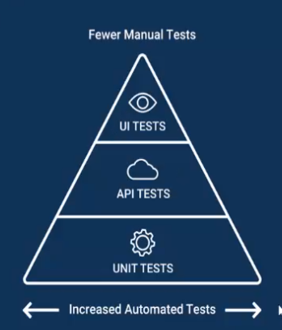
- Unit Test They allow testing the most fundamental elements of the software such as objects, functions, events, among others. Api test, the business logic is tested, the application is tested. UI test They help us identify flaws in the user interface.
- Unit Test They allow testing the most fundamental elements of the software such as objects, functions, events, among others. Api test, the business logic is tested, the application is tested. UI test They help us identify flaws in the user interface.
Antipatterns
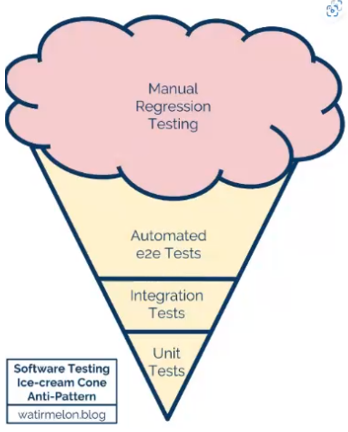
- The ice cream cone, basically everything is in the manual, the regressions are done by the manuals, where bugs also start to be lost, and more appear because the development don't have enough unit tests
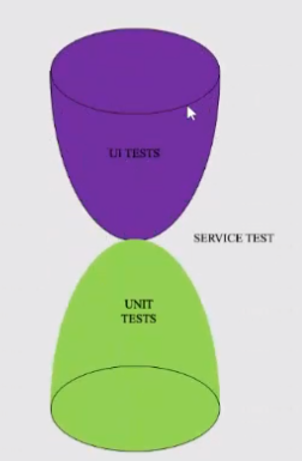
- Hourglass Here we are not testing for API , which generates the antipattern.
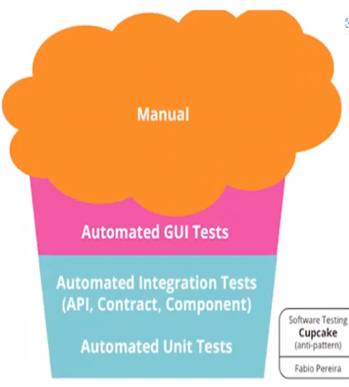
- The cupcake's antipattern is communication, which indicates that there is no communication.
- The ice cream cone, basically everything is in the manual, the regressions are done by the manuals, where bugs also start to be lost, and more appear because the development don't have enough unit tests
E2E
- the primary goal of E2E testing is to simulate an end user's application journey and ensure that all integrated components dependencies, and other integrated pieces work as expected.
- A point of view is to integrate various features. Another point of view is to check if the ui, api and the database were tested
Automation Strategy
- An automated software testing strategy defines key focus areas: objective, test levels, test types, tools, scope, and test environment. It's also where you outline priorities and your overall approach to automation.
Images and files in the map
Information
- Description
- Mind Map on Test Strategy, created by maria huampo on 19/03/2022.
- Created by
- maria huampo
- Views
- 0
- Rating