
Mind map
Measurement Principles
Map content
Measurement Principles
Sensors and measurement
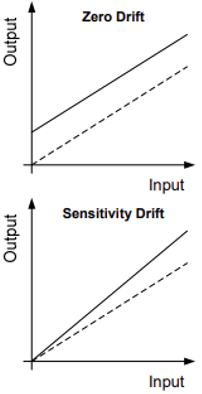
- Sensitivity -- measure of the chnage in output of a sensor for a unit change in input
- Can be obtained from the gradient of a graph of output as a function of input
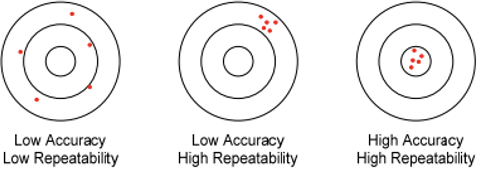
- Accuracy -- a measure of how close the measured value is to the true value
- Repeatability -- a measure of the similarity of output values when the same input is applied repetitively
- Resolution -- the smallest change in output that will produce a detectable change in the output of a sensor at a particular point in its active range
- Potential -- the ability of a charge to do the work of moving another charge by attraction or repulsion
- Potential difference -- the work which must be done against electrical forces to move a unit of charge from one point to another
- Current -- rate of movement of electrical charge
- V = IR
- Series circuit rules:
- Rtotal = R1+R2 +...+Rn
- Vtotal = V1+V2+...+Vn
- V1 = I*R1 etc.
- Current at all parts of the circuit is the same
- Parallel circuit rules:
- Vtotal = V1 = V2 = Vn
- Itotal = I1+I2+...+In
- I1 = V1/R1
- 1/Rtotal = 1/R1+1/R2+...+1/Rn
- Voltage drop across each branch will be the same
- Sensor use in sport tech:
- 1. Temperature measurement
- Conduction -- transfer of heat within a substance or between substances through interaction
- Convection -- heat transfer within fluid by the movement of heated molecules from one place to another
- Radiation -- heat transfer in form of electromagnetic waves (usually infrared)
- 2. Strain gauges
- 3. Piezoelectric sensors
- Piezoelectric material (quartz) generates electric potential when subjected to a force
- 4. Pressure distribution
- 1. Temperature measurement
- Measuring temperature:
- 1. Thermocouples
- 2. Resistance thermometers
- 3. Thermistor
- 4. Radiation pyrometer
- 5. Thermogrsphic camers
- Error in strain gauge measurement:
- 1. Bonding faults
- 2. Hysteresis
- 3. Cross-sensitivity
- 4. Moisture
- 5. Temperature
- Sensitivity -- measure of the chnage in output of a sensor for a unit change in input
Metrology
- SI base units:
- Length (metre)
- Mass (kg)
- Time (seconds)
- Current (ampere)
- Temperature (kelvin)
- Mole
- Candela
- Accuracy -- a qualitive term that describes how close the measurements are to their actual value
- Precision -- the degree to which repeated measurements under the same conditions show the same reuslts
- Atomic clocks -- most accurate time and frequency standards known
- Human reaction time = 0.2s
- Line standards -- length measurmed between the centres of two engraved lines e.g. metre
- End standards -- length measured between ends e.g. gauge blocks
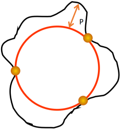
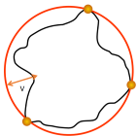
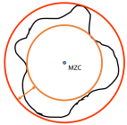
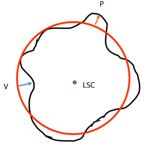
- Roundess -- amount of deviation of a circular feature from a geometrically exact circle
- Measuring roundess:
- 1. Diameter method
- 2. Vee-block method
- 3. Radius method
- Roundess evaluation methods:
- 1. Maximum inscribed circle (MIC)
- 2. Minimum circumscribed circle (MCC)
- 3. Minimum zone circle (MZ)
- 4. Least sqaure circle (LSC)
- Fatigue life -- repeated reversal of stress causes fatigue
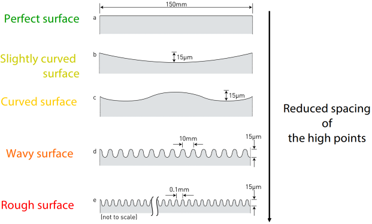
- Bearings -- a perfect surface with no irregularities would not be a good bearing
- Rate of wear is dependent on the surface area of the matieral contact
- Types of surface texture:
- 1. Roughness
- Closely seperaterd irregularities arising from the inherent action of the cutting process
- 2. Waviness
- The irregularities caused by machine vibration an deflections under cutting force
- 3. Errors of form
- The departure from the geometrical shape
- 1. Roughness
- Error -- difference between an induvidual reuslt and the true value of the measured value
- Systematic error -- can be controlled and eliminated
- Random error -- caused by unknown and unpredictable changes in the experiment
- Deformation causes:
- 1. Due to the force exerted to the test piece by the measurement instrument
- 2. The method of support used for the test item
- 3. The method of support of the measurement istrument
- Airy point -- two point support and make the end faces parallel
- Bessel point -- two point support and minimise the change in overall length
- Sine error -- magnification of angular error over distance
- Absolute error -- range of measurements in which true valye of measurement lies
- SI base units:
Human Performance
- Inertia parameters:
- 1. Mass
- 2. Length
- 3. CoM location
- 4. Moment of inertia
- CoM -- position where the entire mass of a body considered to be concentrated
- Moment of inertia (MOI) -- distribution of mass about the axis of rotation
- Model assumptions:
- 1. Rigid segments
- 2. Simple pin/hinge joints
- 3. Uniform segment density
- 4. Standard segment mass/MOI values
- Measuring segmental inertia parameters:
- 1. Direct Measurement
- E.g. tape measure
- 2. Regression Equations
- 3. Mathematical Modelling
- Body modelled as 11 geometric shapes
- Body composition -- measurement of percentage of fat, bone and muscle in the human body
- Measuring body composition:
- 1. Somatotypes
- 2. BMI
- 3. Bioelectrical impedance
- 4. Skinfold measurements
- 5. Bod Pod
- 6. Dual energy X-ray absorptiometry (DXA)
- Scoring of 3 body types
- lean body tissue is more conductive than fat
- Handheld caliper used to measure thickeness of fat stores
- measures air displaced by subject in sealed chamber
- measurement of absorption of X-ray beam
- Power -- the ability of a muscle to produce maximal force over a short period of time
- power = work/change in time = force x velocity
- Endurance -- the ability of a muscle to exert force over an extended period of time
- Power measurement = jump height
- Jump height measurement methods:
- 1. Vertec vertical challenger/wall scale
- 2. Jump mat
- 3. Force plates
- jump to move as many lin markers with hand
- Measures time of flight
- measures resultant force and where it's applied
- Jump height: Impulse momentum method
- change in momentum equals impulse applied to it
- Issues with 1 rep mac (1-RM) strength testing:
- 1. Highly specialised skill
- 2. Time consuming due to warm up
- 3. Injury risk
- Alternative to 1-RM:
- Measure the reps to failure
- sub maximal load and use
- regression equation to predict 1-RM
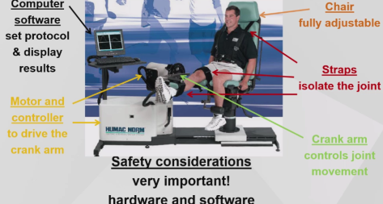
- Isovelocity dynamometers (IVD)
- measures joint torque at a single joint
- E.g. knee extension
- IVD measures torque exerted by the subjet on the crank arm
- ROM = range of movement
- IVD measurement considerations:
- 1. Consistency of effort
- 2. Only net joint torque
- 3. Single joint only
- Isovelocity image:
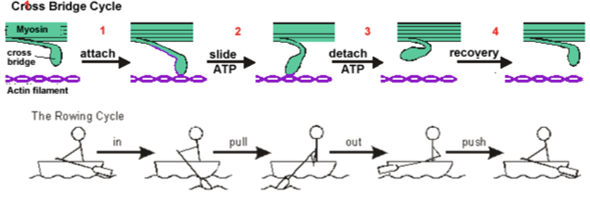
- Cross Bridge Cycle
- 1. Free myosin binds to actin filament to form the cross bridge
- 2. The cross bridge generates force (rate limiting step of contraction)
- 3. The actin-myosin birdge rapidly dissociates
- 4. Free myosin head moves into position to attach to actin
- 3. The actin-myosin birdge rapidly dissociates
- 2. The cross bridge generates force (rate limiting step of contraction)
- Ultrasound allows in vivo images of muscle fibres to be obtained -- fibre length and angle can be measured by digitalising the images
- Fibre types:
- Type 1: Slow oxidative fibres
- Type 2A: Fast oxidative fibres (aerobic)
- Type 2B: Fast glycolytic fibres (anaerobic)
- Fast twitch fibres can generate force quicker than slow twitch
- Motor Unit = motor neurone + all the muscle fibres it innervates
- Measuring neuromuscular function:
- 1. Control signal from brain
- 2. Motor unit firings
- 3. MU electrical signal - MU force output
- 4. Muscle electrical signal - muscle force output
- EMG = Electromyography
- EMG electrodes record the action potentials to give window into neuromuscular system
- Types of EMG electrodes:
- 1. Surface electrodes
- Non-invasive, whole muscle
- 2. Indwelling electrodes
- Invasive, best for deep muscles
- 1. Surface electrodes
- EMG signals are very small
- Amplifier needed
- Variable gain = output signal/input signal
- Aerobic exercise -- exercise that involves oxygen consumption by the body
- Running economy -- energy demand for a given velocity of submaximal running
- Fundamentals of aerobic exercise:
- 1. Heart rate increases
- 2. Oxgyen intake increases
- 3. Lactic acid increases
- 4. Ventilation increases
- 5. Carbon dioxide output increases
- Anaerobic threshold -- exercise intensity at which alctic acid starts to accumalate
- VO2 max -- maximum capacity of an induvidual's body to transport and utilise oxygen during incremental exercise
- mlmin-1kg-1
- Measuring physiological responses to exercise (lab)
- 1. Precision ergometer e.g. treadmill
- 2. Respiratory flow metre
- 3. Gas exchange
- 4. Heart rate/ECG monitoring
- 5. Blood sampling
- Measuring physiological responses to exercise (field)
- 1. Shutter test e.g. bleep
- 2. Rating of percieved exertion
- 3. Heart rate monitors
- 4. Portable analysers
- Inertia parameters:
Images and files in the map
Information
- Description
- Mind Map on Measurement Principles, created by Rhianna Bromwich on 20/04/2022.
- Created by
- Rhianna Bromwich
- Views
- 0
- Rating