
Mind map
LOGISTICS UNIT 1
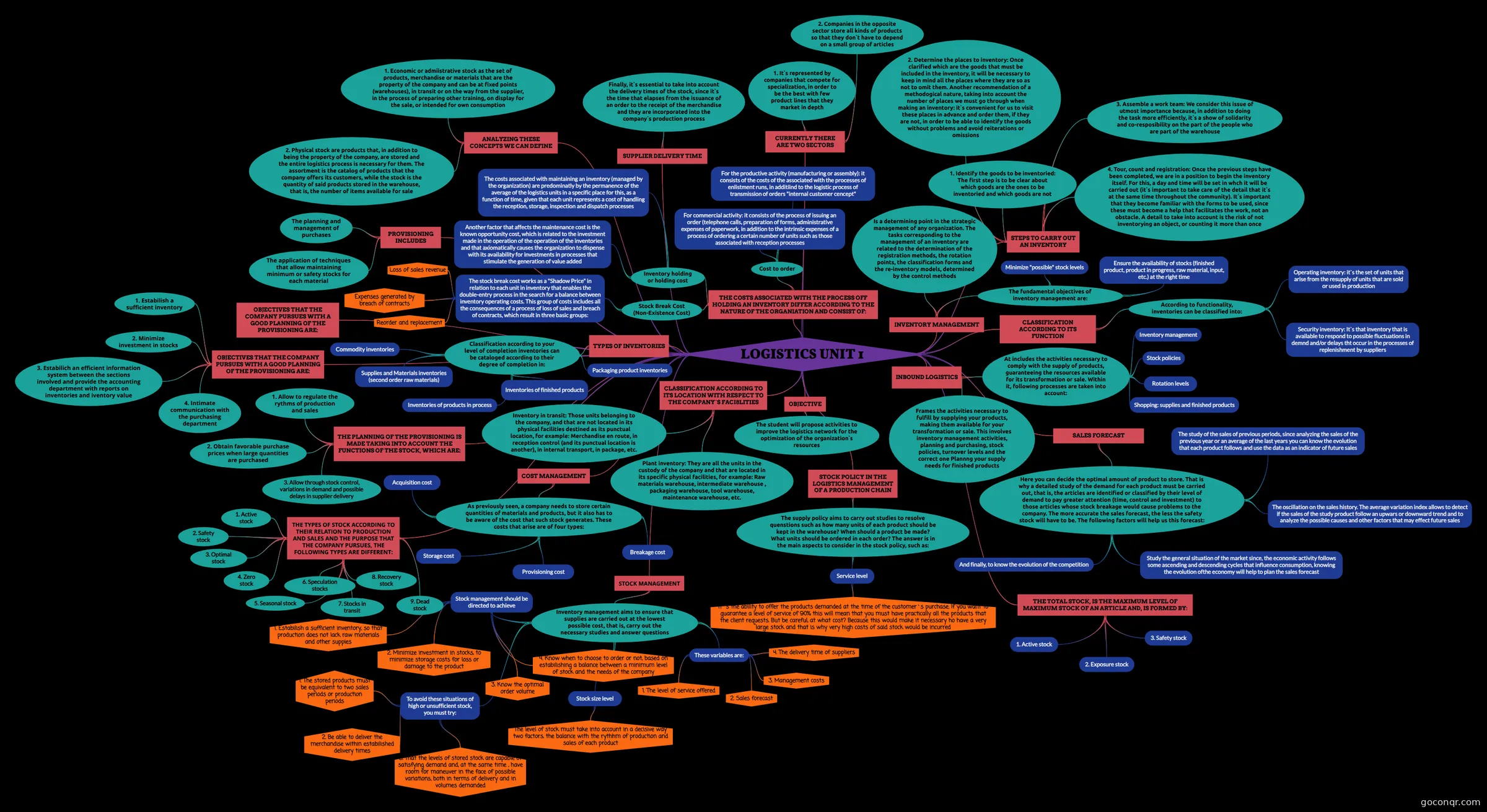
Mind map: Logistics and Inventory Management
Map content
LOGISTICS UNIT 1
OBJECTIVE
- The student will propose activities to improve the logistics network for the optimization of the organization`s resources
INBOUND LOGISTICS
- Frames the activities necessary to fulfill by supplying your products, making them available for your transformation or sale. This involves inventory management activities, planning and purchasing, stock policies, turnover levels and the correct one Plannng your supply needs for finished products
- At includes the activities necessary to comply with the supply of products, guaranteeing the resources available for its transformation or sale. Within it, following processes are taken into account:
- Inventory management
- Stock policies
- Rotation levels
- Shopping: supplies and finished products
INVENTORY MANAGEMENT
- Is a determining point in the strategic management of any organization. The tasks corresponding to the management of an inventory are related to the determination of the registration methods, the rotation points, the classification forms and the re-inventory models, determined by the control methods
- The fundamental objectives of inventory management are:
- Minimize "possible" stock levels
- Ensure the availability of stocks (finished product, product in progress, raw material, input, etc.) at the right time
THE COSTS ASSOCIATED WITH THE PROCESS OFF HOLDING AN INVENTORY DIFFER ACCORDING TO THE NATURE OF THE ORGANIATION AND CONSIST OF:
- Cost to order
- For commercial activity: it consists of the process of issuing an order (telephone calls, preparation of forms, administrative expenses of paperwork, in addition to the intrinsic expenses of a process of ordering a certain number of units such as those associated with reception processes
- For the productive activity (manufacturing or assembly): it consists of the costs of the associated with the processes of enlistment runs, in additiind to the logistic process of transmission of orders "internal customer cencept"
- Inventory holding or holding cost
- The costs associated with maintaining an inventory (managed by the organization) are predominatly by the permanence of the average of the logistics units in a specific place for this, as a function of time, given that each unit represents a cost of handling the reception, storage, inspection and dispatch processes
- Another factor that affects the maintenance cost is the known opportunity cost, which is related to the investment made in the operation of the operation of the inventories and that axiomatically causes the organization to dispense with its availability for investments in processes that stimulate the generation of value added
- Stock Break Cost (Non-Existence Cost)
- The stock break cost works as a "Shadow Price" in relation to each unit in inventory that enables the double-entry process in the search for a balance between inventory operating costs. This group of costs includes all the consequences of a process of loss of sales and breach of contracts, which result in three basic groups:
- Loss of sales revenue
- Expenses generated by breach of contracts
- Reorder and replacement
- The stock break cost works as a "Shadow Price" in relation to each unit in inventory that enables the double-entry process in the search for a balance between inventory operating costs. This group of costs includes all the consequences of a process of loss of sales and breach of contracts, which result in three basic groups:
- Cost to order
TYPES OF INVENTORIES
- Classification according to your level of completion inventories can be cataloged according to their degree of completion in:
- Commodity inventories
- Supplies and Materials inventories (second order raw materials)
- Inventories of products in process
- Inventories of finished products
- Packaging product inventories
- Classification according to your level of completion inventories can be cataloged according to their degree of completion in:
CLASSIFICATION ACCORDING TO ITS LOCATION WITH RESPECT TO THE COMPANY`S FACI8LITIES
- Inventory in transit: Those units belonging to the company, and that are not located in its physical facilities destined as its punctual location, for example: Merchandise en route, in reception control (and its punctual location is another), in internal transport, in package, etc.
- Plant inventory: They are all the units in the custody of the company and that are located in its specific physical facilities, for example: Raw materials warehouse, intermediate warehouse , packaging warehouse, tool warehouse, maintenance warehouse, etc.
CLASSIFICATION ACCORDING TO ITS FUNCTION
- According to functionality, inventories can be classified into:
- Operating inventory: it`s the set of units that arise from the resupply of units that are sold or used in production
- Security inventory: It`s that inventory that is available to respond to possible fluctuations in demnd and/or delays tht occur in the processes of replenishment by suppliers
- According to functionality, inventories can be classified into:
STEPS TO CARRY OUT AN INVENTORY
- 1. Identify the goods to be inventoried: The first step is to be clear about which goods are the ones to be inventoried and which goods are not
- 2. Determine the places to inventory: Once clarified which are the goods that must be included in the inventory, it will be necessary to keep in mind all the places where they are so as not to omit them. Another recommendation of a methodogical nature, taking into account the number of places we must go through when making an inventory: it`s convenient for us to visit these places in advance and order them, if they are not, in order to be able to identify the goods without problems and avoid reiterations or omissions
- 3. Assemble a work team: We consider this issue of utmost importance because, in addition to doing the task more efficiently, it`s a show of solidarity and co-resposibility on the part of the people who are part of the warehouse
- 4. Tour, count and registration: Once the previous steps have been completed, we are in a position to begin the inventory itself. For this, a day and time will be set in whch it will be carried out (it`s important to take care of the detail that it`s at the same time throughout the community). It`s important that they become familiar with the forms to be used, since these must become a help that facilitates the work, not an obstacle. A detail to take into account is the risk of not inventorying an object, or counting it more than once
STOCK POLICY IN THE LOGISTICS MANAGEMENT OF A PRODUCTION CHAIN
- The supply policy aims to carry out studies to resolve quenstions such as how many units of each product should be kept in the warehouse? When should a product be made? What units should be ordered in each order? The answer is in the main aspects to consider in the stock policy, such as:
- Service level
- It`s the ability to offer the products demanded at the time of the customer`s purchase. If you want to guarantee a level of service of 90% this will mean that you must have practically all the products that the client requests. But be careful, at what cost? Because this would make it necessary ho have a very large stock and that is why very high costs of said stock would be incurred
- Service level
- The supply policy aims to carry out studies to resolve quenstions such as how many units of each product should be kept in the warehouse? When should a product be made? What units should be ordered in each order? The answer is in the main aspects to consider in the stock policy, such as:
SALES FORECAST
- Here you can decide the optimal amount of product to store. That is why a detailed study of the demand for each product must be carried out, that is, the articles are identified or classified by their level of demand to pay greater attention (time, control and investment) to those articles whose stock breakage would cause problems to the company. The more accurate the sales forecast, the less the safety stock will have to be. The following factors will help us this forecast:
- The study of the sales of previous periods, since analyzing the sales of the previous year or an average of the last years you can know the evolution that each product follows and use the data as an indicator of future sales
- The oscillation on the sales history. The average variation index allows to detect if the sales of the study product follow an upwars or downward trend and to analyze the possible causes and other factors that may effect future sales
- Study the general situation of the market since, the economic activity follows some ascending and descending cycles that influence consumption, knowing the evolution ofthe economy will help to plan the sales forecast
- And finally, to know the evolution of the competition
- Here you can decide the optimal amount of product to store. That is why a detailed study of the demand for each product must be carried out, that is, the articles are identified or classified by their level of demand to pay greater attention (time, control and investment) to those articles whose stock breakage would cause problems to the company. The more accurate the sales forecast, the less the safety stock will have to be. The following factors will help us this forecast:
COST MANAGEMENT
- As previously seen, a company needs to store certain quantities of materials and products, but it also has to be aware of the cost that such stock generates. These costs that arise are of four types:
- Acquisition cost
- Storage cost
- Provisioning cost
- Breakage cost
- As previously seen, a company needs to store certain quantities of materials and products, but it also has to be aware of the cost that such stock generates. These costs that arise are of four types:
SUPPLIER DELIVERY TIME
- Finally, it`s essential to take into account the delivery times of the stock, since it`s the time that elapses from the issuance of an order to the receipt of the merchandise and they are incorporated into the company`s production process
ANALYZING THESE CONCEPTS WE CAN DEFINE
- 1. Economic or admiistrative stock as the set of products, merchandise or materials that are the property of the company and can be at fixed points (warehouses), in transit or on the way from the supplier, in the process of preparing other training, on display for the sale, or intended for own consumption
- 2. Physical stock are products that, in addition to being the property of the company, are stored and the entire logistics process is necessary for them. The assortment is the catalog of products that the company offers its customers, while the stock is the quantity of said products stored in the warehouse, that is, the number of items available for sale
CURRENTLY THERE ARE TWO SECTORS
- 1. It`s represented by companies that compete for specialization, in order to be the best with few product lines that they market in depth
- 2. Companies in the opposite sector store all kinds of products so that they don`t have to depend on a small group of articles
PROVISIONING INCLUDES
- The planning and management of purchases
- The application of techniques that allow maintaining minimum or safety stocks for each material
THE PLANNING OF THE PROVISIONING IS MADE TAKING INTO ACCOUNT THE FUNCTIONS OF THE STOCK, WHICH ARE:
- 1. Allow to regulate the rythms of production and sales
- 2. Obtain favorable purchase prices when large quantities are purchased
- 3. Allow through stock control, variations in demand and possible delays in supplier delivery
OBJECTIVES THAT THE COMPANY PURSUES WITH A GOOD PLANNING OF THE PROVISIONING ARE:
OBJECTIVES THAT THE COMPANY PURSUES WITH A GOOD PLANNING OF THE PROVISIONING ARE:
- 1. Estabilish a sufficient inventory
- 2. Minimize investment in stocks
- 3. Estabilich an efficient information system between the sections involved and provide the accounting department with reports on inventories and iventory value
- 4. Intimate communication with the purchasing department
THE TYPES OF STOCK ACCORDING TO THEIR RELATION TO PRODUCTION AND SALES AND THE PURPOSE THAT THE COMPANY PURSUES, THE FOLLOWING TYPES ARE DIFFERENT:
- 1. Active stock
- 2. Safety stock
- 3. Optimal stock
- 4. Zero stock
- 5. Seasonal stock
- 6. Speculation stocks
- 7. Stocks in transit
- 8. Recovery stock
- 9. Dead stock
STOCK MANAGEMENT
- Inventory management aims to ensure that supplies are carried out at the lowest possible cost, that is, carry out the necessary studies and answer questions
- Stock management should be directed to achieve
- 1. Estabilish a sufficient inventory, so that production does not lack raw materials and other suppies
- 2. Minimize investment in stocks, to minimize storage costs for loss or damage to the product
- 3. Know the optimal order volume
- 4. Know when to choose to order or not, based on estabilishing a balance between a minimum level of stock and the needs of the company
- These variables are:
- 1. The level of service offered
- 2. Sales forecast
- 3. Management costs
- 4. The delivery time of suppliers
- Stock size level
- The level of stock must take into account in a decisive way two factors, the balance with the rythhm of production and sales of each product
- To avoid these situations of high or unsufficient stock, you must try:
- 1. The stored products must be equivalent to two sales periods or production periods
- 2. Be able to deliver the merchandise within estabilished delivery times
- 3. That the levels of stored stock are capable of satisfying demand and, at the same time , have room for maneuver in the face of possible variations, both in terms of delivery and in volumes demanded
- Stock management should be directed to achieve
- Inventory management aims to ensure that supplies are carried out at the lowest possible cost, that is, carry out the necessary studies and answer questions
THE TOTAL STOCK, IS THE MAXIMUM LEVEL OF MAXIMUM STOCK OF AN ARTICLE AND, IS FORMED BY:
- 1. Active stock
- 2. Exposure stock
- 3. Safety stock
Information
- Description
- Mind Map on LOGISTICS UNIT 1, created by Nicole Marcelino on 15/05/2022.
- Created by
- Nicole Marcelino
- Views
- 23
- Rating