
Mind map
The digestive system
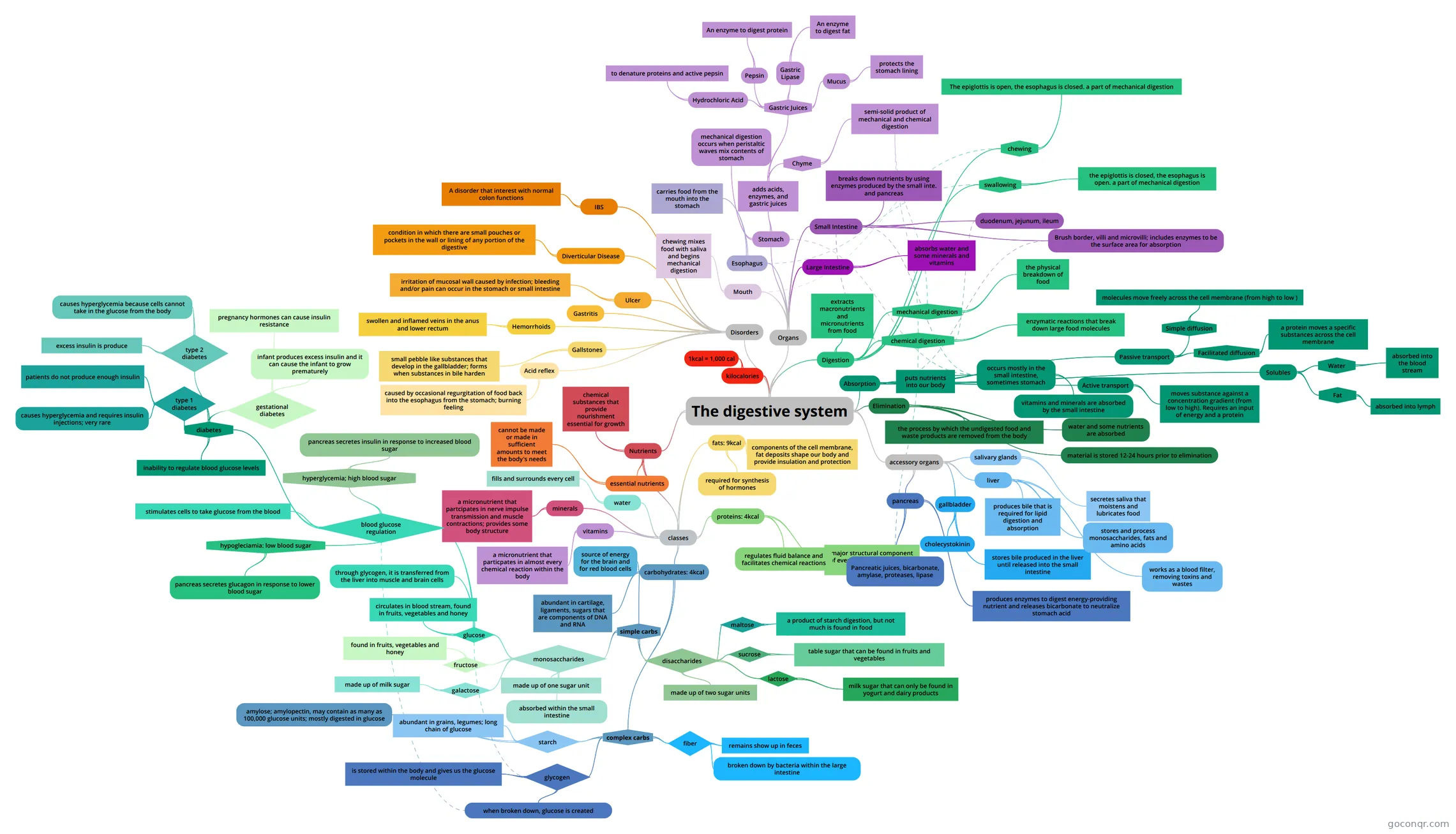
Mind map: The digestive system
Map content
The digestive system
Nutrients
- chemical substances that provide nourishment essential for growth
- essential nutrients
- cannot be made or made in sufficient amounts to meet the body's needs
- classes
- carbohydrates: 4kcal
- abundant in cartilage, ligaments, sugars that are components of DNA and RNA
- source of energy for the brain and for red blood cells
- simple carbs
- monosaccharides
- made up of one sugar unit
- glucose
- circulates in blood stream, found in fruits, vegetables and honey
- through glycogen, it is transferred from the liver into muscle and brain cells
- blood glucose regulation
- hyperglycemia; high blood sugar
- pancreas secretes insulin in response to increased blood sugar
- hypogleciamia: low blood sugar
- pancreas secretes glucagon in response to lower blood sugar
- stimulates cells to take glucose from the blood
- diabetes
- inability to regulate blood glucose levels
- type 1 diabetes
- patients do not produce enough insulin
- causes hyperglycemia and requires insulin injections; very rare
- type 2 diabetes
- excess insulin is produce
- causes hyperglycemia because cells cannot take in the glucose from the body
- gestational diabetes
- pregnancy hormones can cause insulin resistance
- infant produces excess insulin and it can cause the infant to grow prematurely
- hyperglycemia; high blood sugar
- fructose
- found in fruits, vegetables and honey
- galactose
- made up of milk sugar
- absorbed within the small intestine
- disaccharides
- made up of two sugar units
- maltose
- a product of starch digestion, but not much is found in food
- sucrose
- table sugar that can be found in fruits and vegetables
- lactose
- milk sugar that can only be found in yogurt and dairy products
- monosaccharides
- complex carbs
- starch
- abundant in grains, legumes; long chain of glucose
- amylose; amylopectin, may contain as many as 100,000 glucose units; mostly digested in glucose
- fiber
- remains show up in feces
- broken down by bacteria within the large intestine
- glycogen
- is stored within the body and gives us the glucose molecule
- when broken down, glucose is created
- starch
- proteins: 4kcal
- major structural component of every cell and tissue in our body
- regulates fluid balance and facilitates chemical reactions
- fats: 9kcal
- components of the cell membrane, fat deposits shape our body and provide insulation and protection
- required for synthesis of hormones
- vitamins
- a micronutrient that particpates in almost every chemical reaction within the body
- minerals
- a micronutrient that partcipates in nerve impulse transmission and muscle contractions; provides some body structure
- water
- fills and surrounds every cell
- carbohydrates: 4kcal
kilocalories
- 1kcal = 1,000 cal
Digestion
- extracts macronutrients and micronutrients from food
- mechanical digestion
- the physical breakdown of food
- chemical digestion
- enzymatic reactions that break down large food molecules
- chewing
- The epiglottis is open, the esophagus is closed. a part of mechanical digestion
- swallowing
- the epiglottis is closed, the esophagus is open. a part of mechanical digestion
Absorption
- puts nutrients into our body
- occurs mostly in the small intestine, sometimes stomach
- vitamins and minerals are absorbed by the small intestine
- Passive transport
- Simple diffusion
- molecules move freely across the cell membrane (from high to low )
- Facilitated diffusion
- a protein moves a specific substances across the cell membrane
- Simple diffusion
- Active transport
- moves substance against a concentration gradient (from low to high). Requires an input of energy and a protein
- Solubles
- Water
- absorbed into the blood stream
- Fat
- absorbed into lymph
- Water
Elimination
- the process by which the undigested food and waste products are removed from the body
- material is stored 12-24 hours prior to elimination
- water and some nutrients are absorbed
Organs
- Mouth
- chewing mixes food with saliva and begins mechanical digestion
- Esophagus
- carries food from the mouth into the stomach
- Stomach
- adds acids, enzymes, and gastric juices
- Gastric Juices
- Hydrochloric Acid
- to denature proteins and active pepsin
- Pepsin
- An enzyme to digest protein
- Gastric Lipase
- An enzyme to digest fat
- Mucus
- protects the stomach lining
- Hydrochloric Acid
- Chyme
- semi-solid product of mechanical and chemical digestion
- Gastric Juices
- mechanical digestion occurs when peristaltic waves mix contents of stomach
- adds acids, enzymes, and gastric juices
- Small Intestine
- breaks down nutrients by using enzymes produced by the small inte. and pancreas
- duodenum, jejunum, ileum
- Brush border, villi and microvilli; includes enzymes to be the surface area for absorption
- Large Intestine
- absorbs water and some minerals and vitamins
- Mouth
accessory organs
- salivary glands
- secretes saliva that moistens and lubricates food
- liver
- produces bile that is required for lipid digestion and absorption
- stores and process monosaccharides, fats and amino acids
- works as a blood filter, removing toxins and wastes
- gallbladder
- stores bile produced in the liver until released into the small intestine
- cholecystokinin
- pancreas
- produces enzymes to digest energy-providing nutrient and releases bicarbonate to neutralize stomach acid
- Pancreatic juices, bicarbonate, amylase, proteases, lipase
- salivary glands
Disorders
- Acid reflex
- caused by occasional regurgitation of food back into the esophagus from the stomach; burning feeling
- Gallstones
- small pebble like substances that develop in the gallbladder; forms when substances in bile harden
- Hemorrhoids
- swollen and inflamed veins in the anus and lower rectum
- Gastritis
- Ulcer
- irritation of mucosal wall caused by infection; bleeding and/or pain can occur in the stomach or small intestine
- Diverticular Disease
- condition in which there are small pouches or pockets in the wall or lining of any portion of the digestive
- IBS
- A disorder that interest with normal colon functions
- Acid reflex
Information
- Description
- Mind Map on The digestive system, created by Sydney Cullen on 01/10/2022.
- Created by
- Sydney Cullen
- Views
- 2
- Rating
More on Digestive System and Digestion