
Mind map
PROJECT PROCUREMENT MANAGEMENT
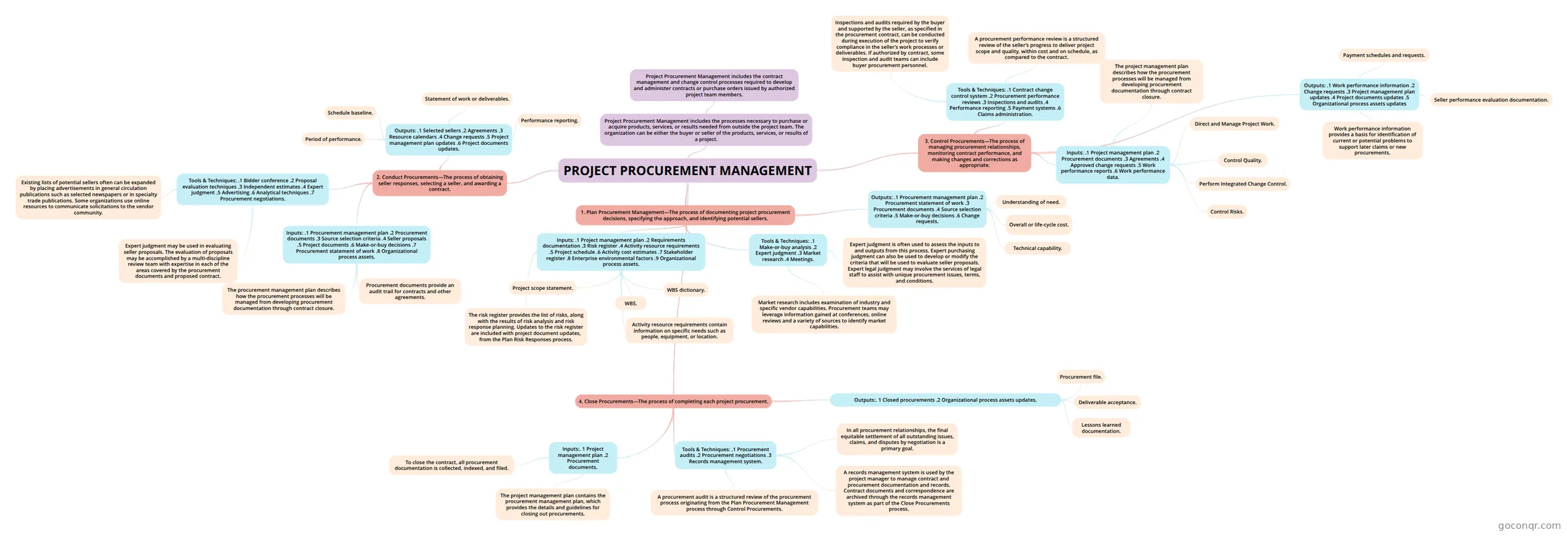
Mind map: Project procurement management
Map content
PROJECT PROCUREMENT MANAGEMENT
Project Procurement Management includes the processes necessary to purchase or acquire products, services, or results needed from outside the project team. The organization can be either the buyer or seller of the products, services, or results of a project.
- Project Procurement Management includes the contract management and change control processes required to develop and administer contracts or purchase orders issued by authorized project team members.
1. Plan Procurement Management—The process of documenting project procurement decisions, specifying the approach, and identifying potential sellers.
- Inputs: .1 Project management plan .2 Requirements documentation .3 Risk register .4 Activity resource requirements .5 Project schedule .6 Activity cost estimates .7 Stakeholder register .8 Enterprise environmental factors .9 Organizational process assets.
- Project scope statement.
- WBS.
- WBS dictionary.
- The risk register provides the list of risks, along with the results of risk analysis and risk response planning. Updates to the risk register are included with project document updates, from the Plan Risk Responses process.
- Activity resource requirements contain information on specific needs such as people, equipment, or location.
- Tools & Techniques: .1 Make-or-buy analysis .2 Expert judgment .3 Market research .4 Meetings.
- Expert judgment is often used to assess the inputs to and outputs from this process. Expert purchasing judgment can also be used to develop or modify the criteria that will be used to evaluate seller proposals. Expert legal judgment may involve the services of legal staff to assist with unique procurement issues, terms, and conditions.
- Market research includes examination of industry and specific vendor capabilities. Procurement teams may leverage information gained at conferences, online reviews and a variety of sources to identify market capabilities.
- Outputs: .1 Procurement management plan .2 Procurement statement of work .3 Procurement documents .4 Source selection criteria .5 Make-or-buy decisions .6 Change requests.
- Understanding of need.
- Overall or life-cycle cost.
- Technical capability.
- Inputs: .1 Project management plan .2 Requirements documentation .3 Risk register .4 Activity resource requirements .5 Project schedule .6 Activity cost estimates .7 Stakeholder register .8 Enterprise environmental factors .9 Organizational process assets.
2. Conduct Procurements—The process of obtaining seller responses, selecting a seller, and awarding a contract.
- Inputs: .1 Procurement management plan .2 Procurement documents .3 Source selection criteria .4 Seller proposals .5 Project documents .6 Make-or-buy decisions .7 Procurement statement of work .8 Organizational process assets.
- The procurement management plan describes how the procurement processes will be managed from developing procurement documentation through contract closure.
- Procurement documents provide an audit trail for contracts and other agreements.
- Tools & Techniques: .1 Bidder conference .2 Proposal evaluation techniques .3 Independent estimates .4 Expert judgment .5 Advertising .6 Analytical techniques .7 Procurement negotiations.
- Existing lists of potential sellers often can be expanded by placing advertisements in general circulation publications such as selected newspapers or in specialty trade publications. Some organizations use online resources to communicate solicitations to the vendor community.
- Expert judgment may be used in evaluating seller proposals. The evaluation of proposals may be accomplished by a multi-discipline review team with expertise in each of the areas covered by the procurement documents and proposed contract.
- Outputs: .1 Selected sellers .2 Agreements .3 Resource calendars .4 Change requests .5 Project management plan updates .6 Project documents updates.
- Statement of work or deliverables.
- Schedule baseline.
- Performance reporting.
- Period of performance.
- Inputs: .1 Procurement management plan .2 Procurement documents .3 Source selection criteria .4 Seller proposals .5 Project documents .6 Make-or-buy decisions .7 Procurement statement of work .8 Organizational process assets.
3. Control Procurements—The process of managing procurement relationships, monitoring contract performance, and making changes and corrections as appropriate.
- Inputs: .1 Project management plan .2 Procurement documents .3 Agreements .4 Approved change requests .5 Work performance reports .6 Work performance data.
- Direct and Manage Project Work.
- Control Quality.
- Perform Integrated Change Control.
- Control Risks.
- The project management plan describes how the procurement processes will be managed from developing procurement documentation through contract closure.
- Tools & Techniques: .1 Contract change control system .2 Procurement performance reviews .3 Inspections and audits .4 Performance reporting .5 Payment systems .6 Claims administration.
- A procurement performance review is a structured review of the seller’s progress to deliver project scope and quality, within cost and on schedule, as compared to the contract.
- Inspections and audits required by the buyer and supported by the seller, as specified in the procurement contract, can be conducted during execution of the project to verify compliance in the seller’s work processes or deliverables. If authorized by contract, some inspection and audit teams can include buyer procurement personnel.
- Outputs: .1 Work performance information .2 Change requests .3 Project management plan updates .4 Project documents updates .5 Organizational process assets updates
- Work performance information provides a basis for identification of current or potential problems to support later claims or new procurements.
- Payment schedules and requests.
- Seller performance evaluation documentation.
- Inputs: .1 Project management plan .2 Procurement documents .3 Agreements .4 Approved change requests .5 Work performance reports .6 Work performance data.
4. Close Procurements—The process of completing each project procurement.
- Inputs:. 1 Project management plan .2 Procurement documents.
- The project management plan contains the procurement management plan, which provides the details and guidelines for closing out procurements.
- To close the contract, all procurement documentation is collected, indexed, and filed.
- Tools & Techniques: .1 Procurement audits .2 Procurement negotiations .3 Records management system.
- A procurement audit is a structured review of the procurement process originating from the Plan Procurement Management process through Control Procurements.
- In all procurement relationships, the final equitable settlement of all outstanding issues, claims, and disputes by negotiation is a primary goal.
- A records management system is used by the project manager to manage contract and procurement documentation and records. Contract documents and correspondence are archived through the records management system as part of the Close Procurements process.
- Outputs:. 1 Closed procurements .2 Organizational process assets updates.
- Procurement file.
- Deliverable acceptance.
- Lessons learned documentation.
- Inputs:. 1 Project management plan .2 Procurement documents.
Information
- Description
- Mind Map on PROJECT PROCUREMENT MANAGEMENT, created by Maria Alejandra Oliveira Gutierrez on 23/10/2022.
- Created by
- Maria Alejandra Oliveira Gutierrez
- Views
- 1
- Rating