
Mind map
MORPHOLOGY AND SYNTAX
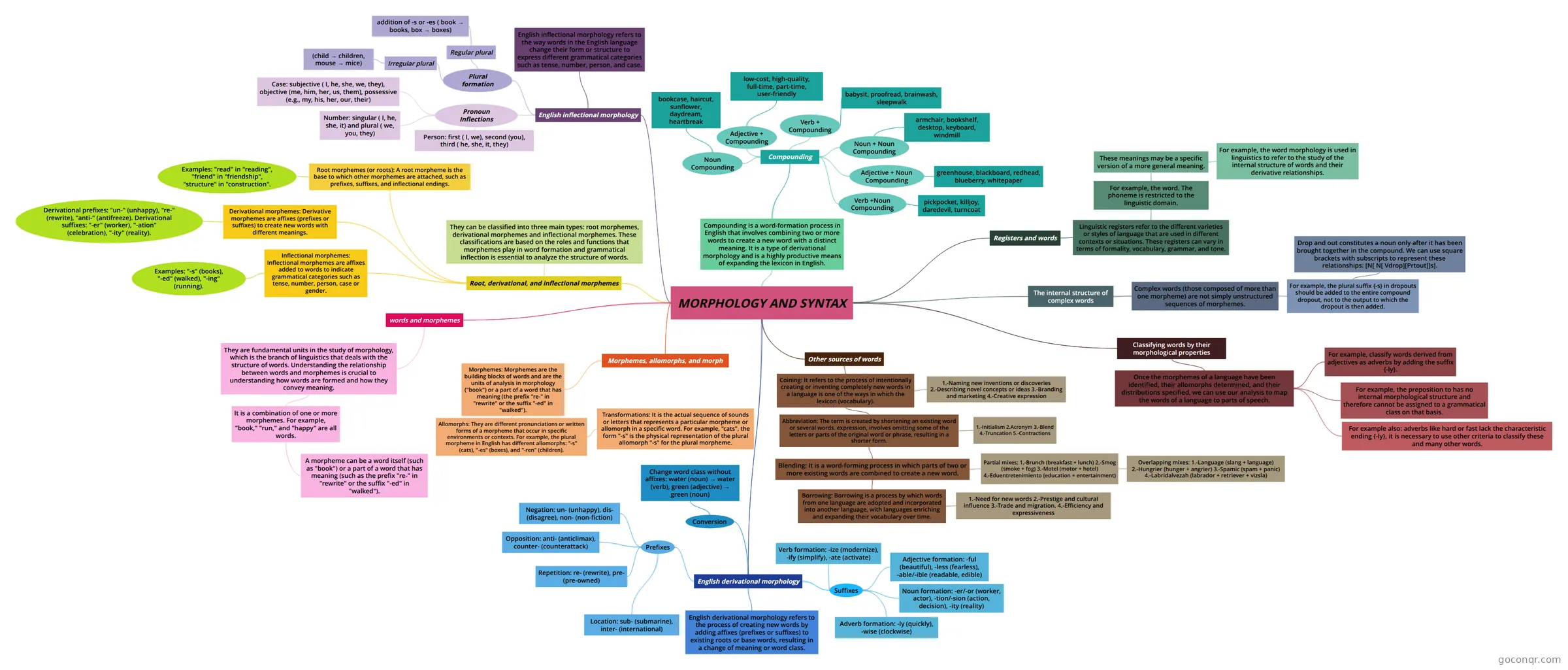
Mind map: English morphology and syntax
Map content
MORPHOLOGY AND SYNTAX
English inflectional morphology
- English inflectional morphology refers to the way words in the English language change their form or structure to express different grammatical categories such as tense, number, person, and case.
- Plural formation
- Regular plural
- addition of -s or -es ( book → books, box → boxes)
- Irregular plural
- (child → children, mouse → mice)
- Regular plural
- Pronoun Inflections
- Case: subjective ( I, he, she, we, they), objective (me, him, her, us, them), possessive (e.g., my, his, her, our, their)
- Number: singular ( I, he, she, it) and plural ( we, you, they)
- Person: first ( I, we), second (you), third ( he, she, it, they)
English derivational morphology
- English derivational morphology refers to the process of creating new words by adding affixes (prefixes or suffixes) to existing roots or base words, resulting in a change of meaning or word class.
- Prefixes
- Negation: un- (unhappy), dis- (disagree), non- (non-fiction)
- Opposition: anti- (anticlimax), counter- (counterattack)
- Repetition: re- (rewrite), pre- (pre-owned)
- Location: sub- (submarine), inter- (international)
- Suffixes
- Noun formation: -er/-or (worker, actor), -tion/-sion (action, decision), -ity (reality)
- Adjective formation: -ful (beautiful), -less (fearless), -able/-ible (readable, edible)
- Verb formation: -ize (modernize), -ify (simplify), -ate (activate)
- Adverb formation: -ly (quickly), -wise (clockwise)
- Conversion
- Change word class without affixes: water (noun) → water (verb), green (adjective) → green (noun)
Compounding is a word-formation process in English that involves combining two or more words to create a new word with a distinct meaning. It is a type of derivational morphology and is a highly productive means of expanding the lexicon in English.
- Compounding
- Noun Compounding
- bookcase, haircut, sunflower, daydream, heartbreak
- Adjective + Compounding
- low-cost, high-quality, full-time, part-time, user-friendly
- Verb + Compounding
- babysit, proofread, brainwash, sleepwalk
- Noun + Noun Compounding
- armchair, bookshelf, desktop, keyboard, windmill
- Adjective + Noun Compounding
- greenhouse, blackboard, redhead, blueberry, whitepaper
- Verb +Noun Compounding
- pickpocket, killjoy, daredevil, turncoat
- Noun Compounding
- Compounding
words and morphemes
- They are fundamental units in the study of morphology, which is the branch of linguistics that deals with the structure of words. Understanding the relationship between words and morphemes is crucial to understanding how words are formed and how they convey meaning.
- It is a combination of one or more morphemes. For example, "book," "run," and "happy" are all words.
- A morpheme can be a word itself (such as "book") or a part of a word that has meaning (such as the prefix "re-" in "rewrite" or the suffix "-ed" in "walked").
- It is a combination of one or more morphemes. For example, "book," "run," and "happy" are all words.
- They are fundamental units in the study of morphology, which is the branch of linguistics that deals with the structure of words. Understanding the relationship between words and morphemes is crucial to understanding how words are formed and how they convey meaning.
Root, derivational, and inflectional morphemes
- They can be classified into three main types: root morphemes, derivational morphemes and inflectional morphemes. These classifications are based on the roles and functions that morphemes play in word formation and grammatical inflection is essential to analyze the structure of words.
- Root morphemes (or roots): A root morpheme is the base to which other morphemes are attached, such as prefixes, suffixes, and inflectional endings.
- Examples: "read" in "reading", "friend" in "friendship", "structure" in "construction".
- Derivational morphemes: Derivative morphemes are affixes (prefixes or suffixes) to create new words with different meanings.
- Derivational prefixes: "un-" (unhappy), "re-" (rewrite), "anti-" (antifreeze). Derivational suffixes: "-er" (worker), "-ation" (celebration), "-ity" (reality).
- Inflectional morphemes: Inflectional morphemes are affixes added to words to indicate grammatical categories such as tense, number, person, case or gender.
- Examples: "-s" (books), "-ed" (walked), "-ing" (running).
Other sources of words
- Coining: It refers to the process of intentionally creating or inventing completely new words in a language is one of the ways in which the lexicon (vocabulary).
- Abbreviation: The term is created by shortening an existing word or several words. expression, involves omitting some of the letters or parts of the original word or phrase, resulting in a shorter form.
- Blending: It is a word-forming process in which parts of two or more existing words are combined to create a new word.
- Borrowing: Borrowing is a process by which words from one language are adopted and incorporated into another language, with languages enriching and expanding their vocabulary over time.
- 1.-Need for new words 2.-Prestige and cultural influence 3.-Trade and migration. 4.-Efficiency and expressiveness
- Partial mixes: 1.-Brunch (breakfast + lunch) 2.-Smog (smoke + fog) 3.-Motel (motor + hotel) 4.-Eduentretenimiento (education + entertainment)
- Overlapping mixes: 1.-Language (slang + language) 2.-Hungrier (hunger + angrier) 3.-Spamic (spam + panic) 4.-Labridalvezah (labrador + retriever + vizsla)
- Borrowing: Borrowing is a process by which words from one language are adopted and incorporated into another language, with languages enriching and expanding their vocabulary over time.
- 1.-Initialism 2.Acronym 3.-Blend 4.-Truncation 5.-Contractions
- Blending: It is a word-forming process in which parts of two or more existing words are combined to create a new word.
- 1.-Naming new inventions or discoveries 2.-Describing novel concepts or ideas 3.-Branding and marketing 4.-Creative expression
- Abbreviation: The term is created by shortening an existing word or several words. expression, involves omitting some of the letters or parts of the original word or phrase, resulting in a shorter form.
- Coining: It refers to the process of intentionally creating or inventing completely new words in a language is one of the ways in which the lexicon (vocabulary).
Morphemes, allomorphs, and morph
- Morphemes: Morphemes are the building blocks of words and are the units of analysis in morphology ("book") or a part of a word that has meaning (the prefix "re-" in "rewrite" or the suffix "-ed" in "walked").
- Allomorphs: They are different pronunciations or written forms of a morpheme that occur in specific environments or contexts. For example, the plural morpheme in English has different allomorphs: "-s" (cats), "-es" (boxes), and "-ren" (children).
- Transformations: It is the actual sequence of sounds or letters that represents a particular morpheme or allomorph in a specific word. For example, "cats", the form "-s" is the physical representation of the plural allomorph "-s" for the plural morpheme.
- Allomorphs: They are different pronunciations or written forms of a morpheme that occur in specific environments or contexts. For example, the plural morpheme in English has different allomorphs: "-s" (cats), "-es" (boxes), and "-ren" (children).
- Morphemes: Morphemes are the building blocks of words and are the units of analysis in morphology ("book") or a part of a word that has meaning (the prefix "re-" in "rewrite" or the suffix "-ed" in "walked").
The internal structure of complex words
- Complex words (those composed of more than one morpheme) are not simply unstructured sequences of morphemes.
- For example, the plural suffix {-s} in dropouts should be added to the entire compound dropout, not to the output to which the dropout is then added.
- Drop and out constitutes a noun only after it has been brought together in the compound. We can use square brackets with subscripts to represent these relationships: [N[ N[ Vdrop][Prtout]]s].
- For example, the plural suffix {-s} in dropouts should be added to the entire compound dropout, not to the output to which the dropout is then added.
- Complex words (those composed of more than one morpheme) are not simply unstructured sequences of morphemes.
Registers and words
- Linguistic registers refer to the different varieties or styles of language that are used in different contexts or situations. These registers can vary in terms of formality, vocabulary, grammar, and tone.
- For example, the word. The phoneme is restricted to the linguistic domain.
- These meanings may be a specific version of a more general meaning.
- For example, the word morphology is used in linguistics to refer to the study of the internal structure of words and their derivative relationships.
- These meanings may be a specific version of a more general meaning.
- For example, the word. The phoneme is restricted to the linguistic domain.
- Linguistic registers refer to the different varieties or styles of language that are used in different contexts or situations. These registers can vary in terms of formality, vocabulary, grammar, and tone.
Classifying words by their morphological properties
- Once the morphemes of a language have been identified, their allomorphs determined, and their distributions specified, we can use our analysis to map the words of a language to parts of speech.
- For example, classify words derived from adjectives as adverbs by adding the suffix {-ly}.
- For example, the preposition to has no internal morphological structure and therefore cannot be assigned to a grammatical class on that basis.
- For example also: adverbs like hard or fast lack the characteristic ending {-ly}, it is necessary to use other criteria to classify these and many other words.
- Once the morphemes of a language have been identified, their allomorphs determined, and their distributions specified, we can use our analysis to map the words of a language to parts of speech.
Information
- Description
- Mind Map on MORPHOLOGY AND SYNTAX, created by Keyla Lizbeth on 08/05/2024.
- Created by
- Keyla Lizbeth
- Views
- 10
- Rating
More on Inflection and Derivation