
Mind map
Chapter 12 & 15 Notes
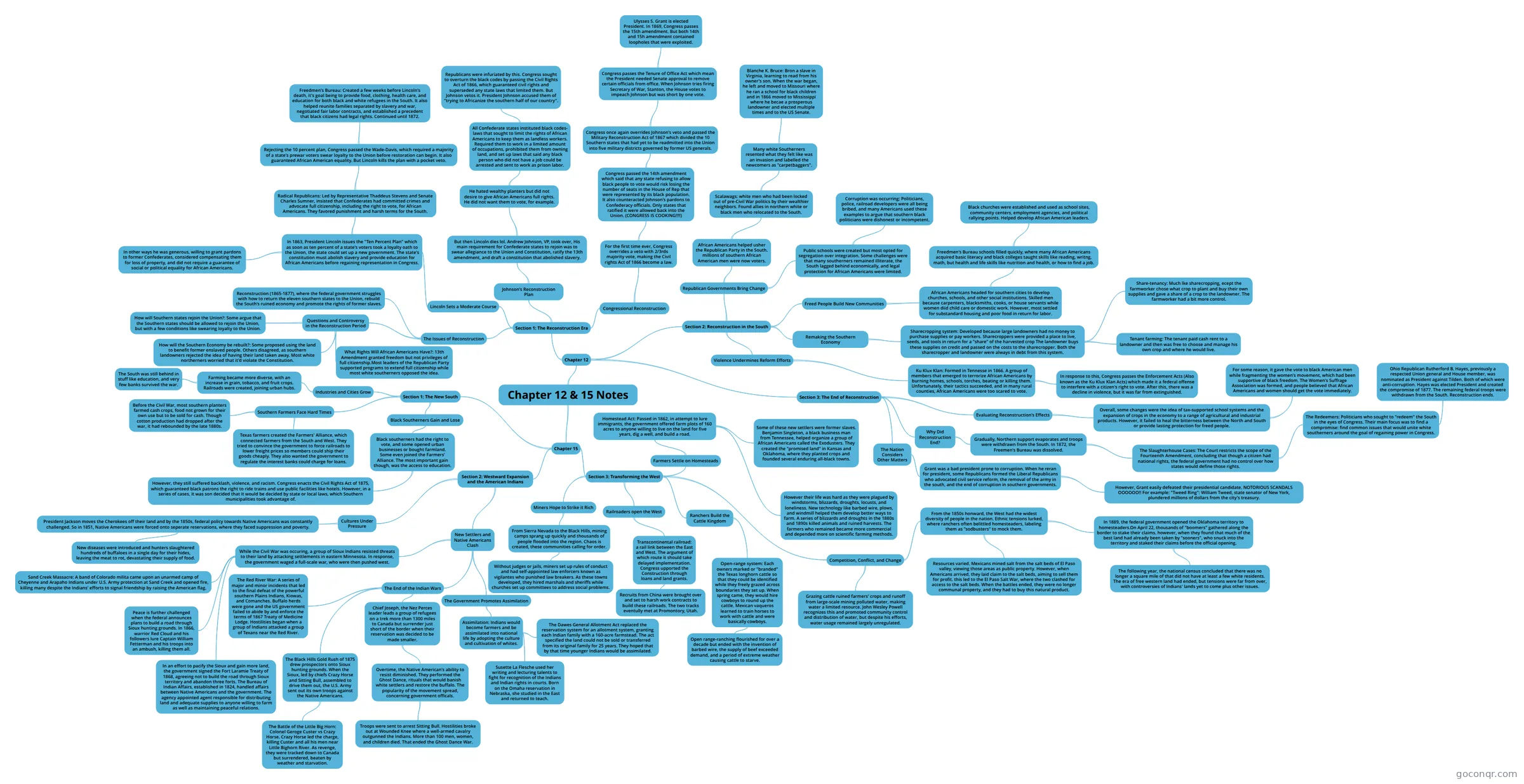
Mind map: Chapter 12 & 15 notes
Map content
Chapter 12 & 15 Notes
Chapter 12
- Section 1: The Reconstruction Era
- The Issues of Reconstruction
- Reconstruction (1865-1877), where the federal government struggles with how to return the eleven southern states to the Union, rebuild the South's ruined economy and promote the rights of former slaves.
- Questions and Controversy in the Reconstruction Period
- How will Southern states rejoin the Union?: Some argue that the Southern states should be allowed to rejoin the Union, but with a few conditions like swearing loyalty to the Union.
- How will the Southern Economy be rebuilt?: Some proposed using the land to benefit former enslaved people. Others disagreed, as southern landowners rejected the idea of having their land taken away. Most white northerners worried that it'd violate the Constitution.
- What Rights Will African Americans Have?: 13th Amendment granted freedom but not privileges of full citizenship.Most leaders of the Republican Party supported programs to extend full citizenship while most white southerners opposed the idea.
- Lincoln Sets a Moderate Course
- In 1863, President Lincoln issues the "Ten Percent Plan" which as soon as ten percent of a state's voters took a loyalty oath to the Union, the state could set up a new government. The state's constitution must abolish slavery and provide education for African Americans before regaining representation in Congress.
- In other ways he was generous, willing to grant pardons to former Confederates, considered compensating them for loss of property, and did not require a guarantee of social or political equality for African Americans.
- Radical Republicans: Led by Representative Thaddeus Stevens and Senate Charles Sumner, insisted that Confederates had committed crimes and advocate full citizenship, including the right to vote, for African Americans. They favored punishment and harsh terms for the South.
- Rejecting the 10 percent plan, Congress passed the Wade-Davis, which required a majority of a state's prewar voters swear loyalty to the Union before restoration can begin. It also guaranteed African American equality. But Lincoln kills the plan with a pocket veto.
- Freedmen's Bureau: Created a few weeks before Lincoln's death, it's goal being to provide food, clothing, health care, and education for both black and white refugees in the South. It also helped reunite families separated by slavery and war, negotiated fair labor contracts, and established a precedent that black citizens had legal rights. Continued until 1872.
- Rejecting the 10 percent plan, Congress passed the Wade-Davis, which required a majority of a state's prewar voters swear loyalty to the Union before restoration can begin. It also guaranteed African American equality. But Lincoln kills the plan with a pocket veto.
- In 1863, President Lincoln issues the "Ten Percent Plan" which as soon as ten percent of a state's voters took a loyalty oath to the Union, the state could set up a new government. The state's constitution must abolish slavery and provide education for African Americans before regaining representation in Congress.
- Johnson's Reconstruction Plan
- But then Lincoln dies lol. Andrew Johnson, VP, took over, His main requirement for Confederate states to rejoin was to swear allegiance to the Union and Constitution, ratify the 13th amendment, and draft a constitution that abolished slavery.
- He hated wealthy planters but did not desire to give African Americans full rights. He did not want them to vote, for example.
- All Confederate states instituted black codes- laws that sought to limit the rights of African Americans to keep them as landless workers. Required them to work in a limited amount of occupations, prohibited them from owning land, and set up laws that said any black person who did not have a job could be arrested and sent to work as prison labor.
- Republicans were infuriated by this. Congress sought to overturn the black codes by passing the Civil Rights Act of 1866, which guaranteed civil rights and superseded any state laws that limited them. But Johnson vetos it. President Johnson accused them of "trying to Africanize the southern half of our country".
- All Confederate states instituted black codes- laws that sought to limit the rights of African Americans to keep them as landless workers. Required them to work in a limited amount of occupations, prohibited them from owning land, and set up laws that said any black person who did not have a job could be arrested and sent to work as prison labor.
- He hated wealthy planters but did not desire to give African Americans full rights. He did not want them to vote, for example.
- But then Lincoln dies lol. Andrew Johnson, VP, took over, His main requirement for Confederate states to rejoin was to swear allegiance to the Union and Constitution, ratify the 13th amendment, and draft a constitution that abolished slavery.
- Congressional Reconstruction
- For the first time ever, Congress overrides a veto with 2/3rds majority vote, making the Civil rights Act of 1866 become a law.
- Congress passed the 14th amendment which said that any state refusing to allow black people to vote would risk losing the number of seats in the House of Rep that were represented by its black population. It also counteracted Johnson's pardons to Confederacy officials. Only states that ratified it were allowed back into the Union. (CONGRESS IS COOKING!!!!)
- Congress once again overrides Johnson's veto and passed the Military Reconstruction Act of 1867 which divided the 10 Southern states that had yet to be readmitted into the Union into five military districts governed by former US generals.
- Congress passes the Tenure of Office Act which mean the President needed Senate approval to remove certain officials from office. When Johnson tries firing Secretary of War, Stanton, the House votes to impeach Johnson but was short by one vote.
- Ulysses S. Grant is elected President. In 1869, Congress passes the 15th amendment. But both 14th and 15h amendment contained loopholes that were exploited.
- Congress passes the Tenure of Office Act which mean the President needed Senate approval to remove certain officials from office. When Johnson tries firing Secretary of War, Stanton, the House votes to impeach Johnson but was short by one vote.
- Congress once again overrides Johnson's veto and passed the Military Reconstruction Act of 1867 which divided the 10 Southern states that had yet to be readmitted into the Union into five military districts governed by former US generals.
- Congress passed the 14th amendment which said that any state refusing to allow black people to vote would risk losing the number of seats in the House of Rep that were represented by its black population. It also counteracted Johnson's pardons to Confederacy officials. Only states that ratified it were allowed back into the Union. (CONGRESS IS COOKING!!!!)
- For the first time ever, Congress overrides a veto with 2/3rds majority vote, making the Civil rights Act of 1866 become a law.
- The Issues of Reconstruction
- Section 2: Reconstruction in the South
- Republican Governments Bring Change
- African Americans helped usher the Republican Party in the South. millions of southern African American men were now voters.
- Scalawags: white men who had been locked out of pre-Civil War politics by their wealthier neighbors. Found allies in northern white or black men who relocated to the South.
- Many white Southerners resented what they felt like was an invasion and labelled the newcomers as "carpetbaggers".
- Blanche K. Bruce: Bron a slave in Virginia, learning to read from his owner's son. When the war began, he left and moved to Missouri where he ran a school for black children and in 1866 moved to Mississippi where he becae a prosperous landowner and elected multiple times and to the US Senate.
- Many white Southerners resented what they felt like was an invasion and labelled the newcomers as "carpetbaggers".
- Scalawags: white men who had been locked out of pre-Civil War politics by their wealthier neighbors. Found allies in northern white or black men who relocated to the South.
- Public schools were created but most opted for segregation over integration. Some challenges were that many southerners remained illiterate, the South lagged behind economically, and legal protection for African Americans were limited.
- Corruption was occurring: Politicians, police, railroad developers were all being bribed, and many Americans used these examples to argue that southern black politicians were dishonest or incompetent.
- African Americans helped usher the Republican Party in the South. millions of southern African American men were now voters.
- Freed People Build New Communities
- African Americans headed for southern cities to develop churches, schools, and other social institutions. Skilled men because carpenters, blacksmiths, cooks, or house servants while women diid child care or domestic work. However, most settled for substandard housing and poor food in return for labor.
- Freedmen's Bureau schools filled quickly, where many African Americans acquired basic literacy and black colleges taught skills like reading, writng, math, but health and life skills like nutrition and health, or how to find a job.
- Black churches were established and used as school sites, community centers, employment agencies, and political rallying points. Helped develop African American leaders.
- Freedmen's Bureau schools filled quickly, where many African Americans acquired basic literacy and black colleges taught skills like reading, writng, math, but health and life skills like nutrition and health, or how to find a job.
- African Americans headed for southern cities to develop churches, schools, and other social institutions. Skilled men because carpenters, blacksmiths, cooks, or house servants while women diid child care or domestic work. However, most settled for substandard housing and poor food in return for labor.
- Remaking the Southern Economy
- Sharecropping system: Developed because large landowners had no money to purchase supplies or pay workers. Sharecroppers were provided a place to live, seeds, and tools in return for a "share" of the harvested crop The landowner buys these supplies on credit and passed on the costs to the sharecropper. Both the sharecropper and landowner were always in debt from this system.
- Share-tenancy: Much lke sharecropping, ecept the farmworker chose what crop to plant and buy their own supplies and gave a share of a crop to the landowner. The farmworker had a bit more control.
- Tenant farming: The tenant paid cash rent to a landowner and then was free to choose and manage his own crop and where he would live.
- Sharecropping system: Developed because large landowners had no money to purchase supplies or pay workers. Sharecroppers were provided a place to live, seeds, and tools in return for a "share" of the harvested crop The landowner buys these supplies on credit and passed on the costs to the sharecropper. Both the sharecropper and landowner were always in debt from this system.
- Violence Undermines Reform Efforts
- Ku Klux Klan: Formed in Tennesse in 1866. A group of members that emerged to terrorize African Americans by burning homes, schools, torches, beating or killing them. Unfortunately, their tactics succeeded, and in many rural counties, African Americans were too scared to vote.
- In response to this, Congress passes the Enforcement Acts (Also known as the Ku Klux Klan Acts) which made it a federal offense to interfere with a citizen's right to vote. After this, there was a decline in violence, but it was far from extinguished.
- Ku Klux Klan: Formed in Tennesse in 1866. A group of members that emerged to terrorize African Americans by burning homes, schools, torches, beating or killing them. Unfortunately, their tactics succeeded, and in many rural counties, African Americans were too scared to vote.
- Republican Governments Bring Change
- Section 3: The End of Reconstruction
- The Nation Considers Other Matters
- Grant was a bad president prone to corruption. When he reran for president, some Republicans formed the Liberal Republicans who advocated civil service reform, the removal of the army in the south, and the end of corruption in southern governments.
- However, Grant easily defeated their presidential candidate. NOTORIOUS SCANDALS OOOOOO!! For example: "Tweed Ring": William Tweed, state senator of New York, plundered millions of dollars from the city's treasury.
- Grant was a bad president prone to corruption. When he reran for president, some Republicans formed the Liberal Republicans who advocated civil service reform, the removal of the army in the south, and the end of corruption in southern governments.
- Why Did Reconstruction End?
- Gradually, Northern support evaporates and troops were withdrawn from the South. In 1872, the Freemen's Bureau was dissolved.
- The Slaughterhouse Cases: The Court restricts the scope of the Fourteenth Amendment, concluding that though a citizen had national rights, the federal government had no control over how states would define those rights.
- The Redeemers: Politicians who sought to "redeem" the South in the eyes of Congress. Their main focus was to find a compromise: find common issues that would unite white southerners around the goal of regaining power in Congress.
- Ohio Republican Rutherford B. Hayes, previously a respected Union general and House member, was nominated as President against Tilden. Both of which were anti-corruption. Hayes was elected President and created the compromise of 1877. The remaining federal troops were withdrawn from the South. Reconstruction ends.
- The Redeemers: Politicians who sought to "redeem" the South in the eyes of Congress. Their main focus was to find a compromise: find common issues that would unite white southerners around the goal of regaining power in Congress.
- The Slaughterhouse Cases: The Court restricts the scope of the Fourteenth Amendment, concluding that though a citizen had national rights, the federal government had no control over how states would define those rights.
- Gradually, Northern support evaporates and troops were withdrawn from the South. In 1872, the Freemen's Bureau was dissolved.
- Evaluating Reconstruction's Effects
- Overall, some changes were the idea of tax-supported school systems and the expansion of crops in the economy to a range of agricultural and industrial products. However, it failed to heal the bitterness between the North and South or provide lasting protection for freed people.
- For some reason, it gave the vote to black American men while fragmenting the women's movement, which had been supportive of black freedom. The Women's Suffrage Association was formed, and people believed that African Americans and women should get the vote immediately.
- Overall, some changes were the idea of tax-supported school systems and the expansion of crops in the economy to a range of agricultural and industrial products. However, it failed to heal the bitterness between the North and South or provide lasting protection for freed people.
- The Nation Considers Other Matters
- Section 1: The Reconstruction Era
Chapter 15
- Section 1: The New South
- Industries and Cities Grow
- Farming became more diverse, with an increase in grain, tobacco, and fruit crops. Railroads were created, joining urban hubs.
- The South was still behind in stuff like education, and very few banks survived the war.
- Farming became more diverse, with an increase in grain, tobacco, and fruit crops. Railroads were created, joining urban hubs.
- Southern Farmers Face Hard Times
- Before the Civil War, most southern planters farmed cash crops, food not grown for their own use but to be sold for cash. Though cotton production had dropped after the war, it had rebounded by the late 1880s.
- Texas farmers created the Farmers' Alliance, which connected farmers from the South and West. They tried to convince the government to force railroads to lower freight prices so members could ship their goods cheaply. They also wanted the government to regulate the interest banks could charge for loans.
- Black Southerners Gain and Lose
- Black southerners had the right to vote, and some opened urban businesses or bought farmland. Some even joined the Farmers' Alliance. The most important gain though, was the access to education.
- However, they still suffered backlash, violence, and racism. Congress enacts the Civil Rights Act of 1875, which guaranteed black patrons the right to ride trains and use public facilities like hotels. However, in a series of cases, it was son decided that it would be decided by state or local laws, which Southern municipalities took advantage of.
- Black southerners had the right to vote, and some opened urban businesses or bought farmland. Some even joined the Farmers' Alliance. The most important gain though, was the access to education.
- Industries and Cities Grow
- Section 2: Westward Expansion and the American Indians
- Cultures Under Pressure
- President Jackson moves the Cherokees off their land and by the 1850s, federal policy towards Native Americans was constantly challenged. So in 1851, Native Americans were forced onto seperate reservations, where they faced suppression and poverty.
- New diseases were introduced and hunters slaughtered hundreds of buffaloes in a single day for their hides, leaving the meat to rot, devastating their supply of food.
- President Jackson moves the Cherokees off their land and by the 1850s, federal policy towards Native Americans was constantly challenged. So in 1851, Native Americans were forced onto seperate reservations, where they faced suppression and poverty.
- New Settlers and Native Americans Clash
- While the Civil War was occuring, a group of Sioux Indians resisted threats to their land by attacking settlements in eastern Minnesota. In response, the government waged a full-scale war, who were then pushed west.
- Sand Creek Massacre: A band of Colorado milita came upon an unarmed camp of Cheyenne and Arapaho Indians under U.S. Army protection at Sand Creek and opened fire, killing many despite the Indians' efforts to signal friendship by raising the American flag.
- Peace is further challenged when the federal announces plans to build a road through Sioux hunting grounds. In 1866, warrior Red Cloud and his followers lure Captain William Fetterman and his troops into an ambush, killing them all.
- In an effort to pacify the Sioux and gain more land, the government signed the Fort Laramie Treaty of 1868, agreeing not to build the road through Sioux territory and abandon three forts. The Bureau of Indian Affairs, established in 1824, handled affairs between Native Americans and the government. The agency appointed agent responsible for distributing land and adequate supplies to anyone willing to farm as well as maintaining peaceful relations.
- The End of the Indian Wars
- The Red River War: A series of major and minor incidents that led to the final defeat of the powerful southern Plains Indians, Kiowas, and Comanches. Buffalo herds were gone and the US government failed to abide by and enforce the terms of 1867 Treaty of Medicine Lodge. Hostilities began when a group of Indians attacked a group of Texans near the Red River.
- The Black Hills Gold Rush of 1875 drew prospectors onto Sioux hunting grounds. When the Sioux, led by chiefs Crazy Horse and Sitting Bull, assembled to drive them out, the U.S. Army sent out its own troops against the Native Americans.
- The Battle of the Little Big Horn: Colonel Geroge Custer vs Crazy Horse. Crazy Horse led the charge, killing Custer and all his men near Little Bighorn River. As revenge, they were tracked down to Canada but surrendered, beaten by weather and starvation.
- Chief Joseph, the Nez Perces leader leads a group of refugees on a trek more than 1300 miles to Canada but surrender just short of the border when their reservation was decided to be made smaller.
- Overtime, the Native American's ability to resist diminished. They performed the Ghost Dance, rituals that would banish white settlers and restore the buffalo. The popularity of the movement spread, concerning government officals.
- Troops were sent to arrest Sitting Bull. Hostilities broke out at Wounded Knee where a well-armed cavalry outgunned the Indians. More than 100 men, women, and children died. That ended the Ghost Dance War.
- Overtime, the Native American's ability to resist diminished. They performed the Ghost Dance, rituals that would banish white settlers and restore the buffalo. The popularity of the movement spread, concerning government officals.
- The Government Promotes Assimilation
- Assimilation: Indians would become farmers and be assimilated into national life by adopting the culture and cultivation of whites.
- Susette La Flesche used her writing and lecturing talents to fight for recognition of the Indians and Indian rights in courts. Born on the Omaha reservation in Nebraska, she studied in the East and returned to teach.
- The Dawes General Allotment Act replaced the reservation system for an allotment system, granting each Indian family with a 160-acre farmstead. The act specified the land could not be sold or transferred from its original family for 25 years. They hoped that by that time younger Indians would be assimilated.
- Assimilation: Indians would become farmers and be assimilated into national life by adopting the culture and cultivation of whites.
- While the Civil War was occuring, a group of Sioux Indians resisted threats to their land by attacking settlements in eastern Minnesota. In response, the government waged a full-scale war, who were then pushed west.
- Cultures Under Pressure
- Section 3: Transforming the West
- Miners Hope to Strike it Rich
- From Sierra Nevada to the Black Hills, mining camps sprang up quickly and thousands of people flooded into the region. Chaos is created, these communities calling for order.
- Without judges or jails, miners set up rules of conduct and had self-appointed law enforcers known as vigilantes who punished law breakers. As these towns developed, they hired marshals and sheriffs while churches set up committees to address social problems.
- From Sierra Nevada to the Black Hills, mining camps sprang up quickly and thousands of people flooded into the region. Chaos is created, these communities calling for order.
- Railroaders open the West
- Transcontinental railroad: a rail link between the East and West. The argument of which route it should take delayed implementation. Congress upported the Construction through loans and land grants.
- Recruits from China were brought over and set to harsh work contracts to build these railroads. The two tracks eventully met at Promontory, Utah.
- Transcontinental railroad: a rail link between the East and West. The argument of which route it should take delayed implementation. Congress upported the Construction through loans and land grants.
- Ranchers Build the Cattle Kingdom
- Open-range system: Each owners marked or "branded" the Texas longhorn cattle so that they could be identified while they freely grazed across boundaries they set up. When spring came, they would hire cowboys to round up the cattle. Mexican vaqueros learned to train horses to work with cattle and were basically cowboys.
- Open range-ranching flourished for over a decade but ended with the invention of barbed wire, the supply of beef exceeded demand, and a period of extreme weather causing cattle to starve.
- Open-range system: Each owners marked or "branded" the Texas longhorn cattle so that they could be identified while they freely grazed across boundaries they set up. When spring came, they would hire cowboys to round up the cattle. Mexican vaqueros learned to train horses to work with cattle and were basically cowboys.
- Farmers Settle on Homesteads
- Homestead Act: Passed in 1862, in attempt to lure immigrants, the government offered farm plots of 160 acres to anyone willing to live on the land for five years, dig a well, and build a road.
- Some of these new settlers were former slaves. Benjamin Singleton, a black business man from Tennessee, helped organize a group of African Americans called the Exodusters. They created the "promised land" in Kansas and Oklahoma, where they planted crops and founded several enduring all-black towns.
- However their life was hard as they were plagued by windstorms, blizzards, droughts, locusts, and loneliness. New technology like barbed wire, plows, and windmill helped them develop better ways to farm. A series of blizzards and droughts in the 1880s and 1890s killed animals and ruined harvests. The farmers who remained became more commercial and depended more on scientific farming methods.
- Homestead Act: Passed in 1862, in attempt to lure immigrants, the government offered farm plots of 160 acres to anyone willing to live on the land for five years, dig a well, and build a road.
- Competition, Conflict, and Change
- Grazing cattle ruined farmers' crops and runoff from large-scale mining polluted water, making water a limited resource. John Wesley Powell recognizes this and promoted community control and distribution of water, but despite his efforts, water usage remained largely unregulated.
- From the 1850s honward, the West had the widest diversity of people in the nation. Ethnic tensions lurked, where ranchers often belittled homesteaders, labeling them as "sodbusters" to mock them.
- Resources varied. Mexicans mined salt from the salt beds of El Paso valley, viewing those areas as public property. However, when Americans arrived, they laid claim to the salt beds, aiming to sell them for profit. this led to the El Paso Salt War, where the two clashed for access to the salt beds. When the battles ended, they were no longer communal property, and they had to buy this natural product.
- In 1889, the federal government opened the Oklahoma territory to homesteaders.On April 22, thousands of "boomers" gathered along the border to stake their claims. however, when they found that much of the best land had already been taken by "sooners", who snuck into the territory and staked their claims before the official opening.
- The following year, the national census concluded that there was no longer a square mile of that did not have at least a few white residents. The era of free western land had ended, but tensions were far from over, with controversies of Indians' lands yet to come plus other issues.
- Miners Hope to Strike it Rich
- Section 1: The New South
Information
- Description
- Mind Map on Chapter 12 & 15 Notes, created by The Last Hooman on 06/03/2025.
- Created by
- The Last Hooman
- Views
- 4
- Rating