
Mind map
Cancer and metabolism, pt.2
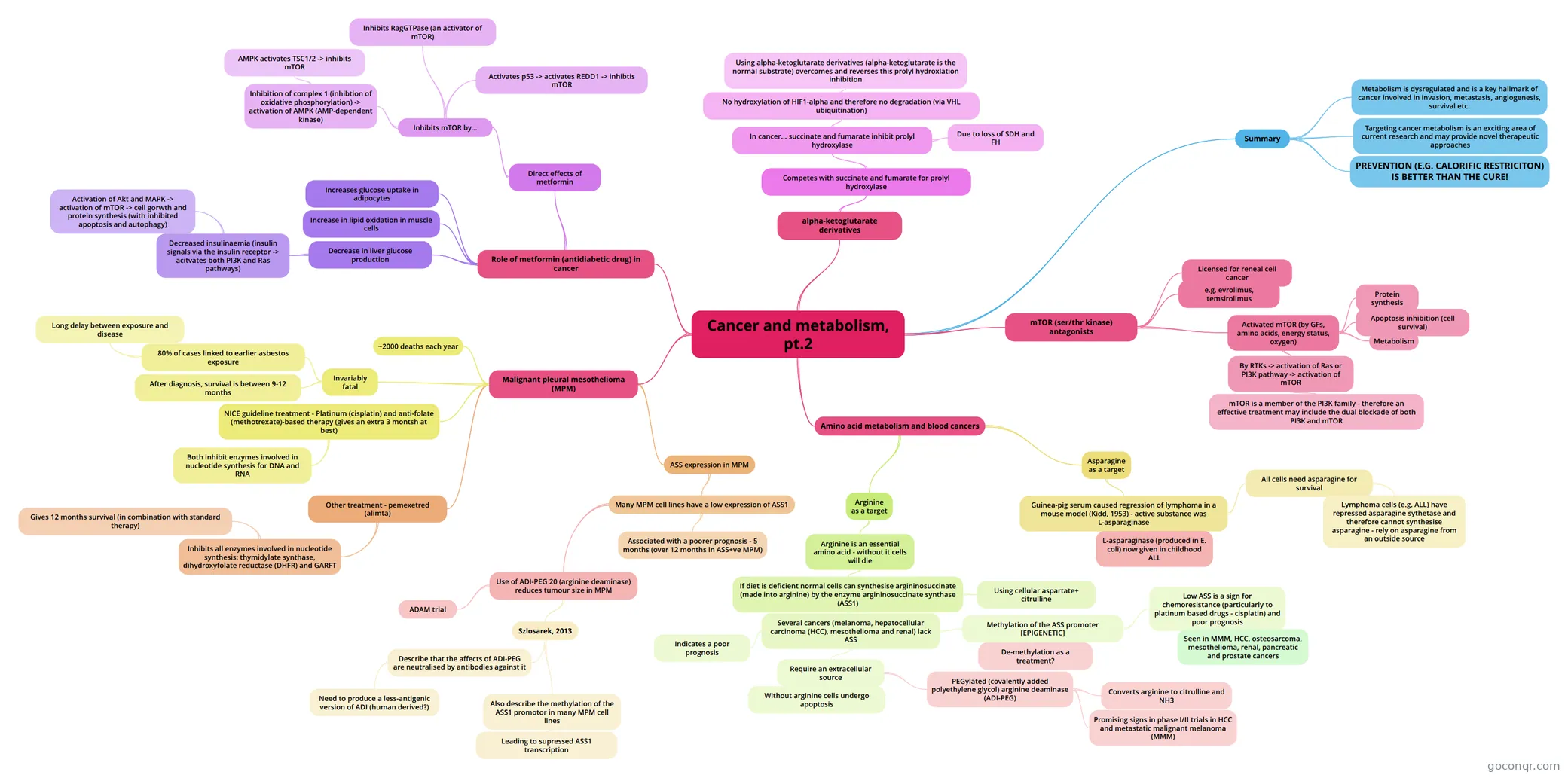
Mind map: Cancer and metabolism
Map content
Cancer and metabolism, pt.2
Role of metformin (antidiabetic drug) in cancer
- Increases glucose uptake in adipocytes
- Increase in lipid oxidation in muscle cells
- Decrease in liver glucose production
- Decreased insulinaemia (insulin signals via the insulin receptor -> acitvates both PI3K and Ras pathways)
- Activation of Akt and MAPK -> activation of mTOR -> cell gorwth and protein synthesis (with inhibited apoptosis and autophagy)
- Decreased insulinaemia (insulin signals via the insulin receptor -> acitvates both PI3K and Ras pathways)
- Direct effects of metformin
- Inhibits mTOR by...
- Inhibition of complex 1 (inhibtion of oxidative phosphorylation) -> activation of AMPK (AMP-dependent kinase)
- AMPK activates TSC1/2 -> inhibits mTOR
- Inhibits RagGTPase (an activator of mTOR)
- Activates p53 -> activates REDD1 -> inhibtis mTOR
- Inhibition of complex 1 (inhibtion of oxidative phosphorylation) -> activation of AMPK (AMP-dependent kinase)
- Inhibits mTOR by...
alpha-ketoglutarate derivatives
- Competes with succinate and fumarate for prolyl hydroxylase
- In cancer... succinate and fumarate inhibit prolyl hydroxylase
- No hydroxylation of HIF1-alpha and therefore no degradation (via VHL ubiquitination)
- Using alpha-ketoglutarate derivatives (alpha-ketoglutarate is the normal substrate) overcomes and reverses this prolyl hydroxlation inhibition
- Due to loss of SDH and FH
- No hydroxylation of HIF1-alpha and therefore no degradation (via VHL ubiquitination)
- In cancer... succinate and fumarate inhibit prolyl hydroxylase
- Competes with succinate and fumarate for prolyl hydroxylase
mTOR (ser/thr kinase) antagonists
- Licensed for reneal cell cancer
- e.g. evrolimus, temsirolimus
- Activated mTOR (by GFs, amino acids, energy status, oxygen)
- Protein synthesis
- Apoptosis inhibition (cell survival)
- Metabolism
- By RTKs -> activation of Ras or PI3K pathway -> activation of mTOR
- mTOR is a member of the PI3K family - therefore an effective treatment may include the dual blockade of both PI3K and mTOR
Amino acid metabolism and blood cancers
- Asparagine as a target
- Guinea-pig serum caused regression of lymphoma in a mouse model (Kidd, 1953) - active substance was L-asparaginase
- L-asparaginase (produced in E. coli) now given in childhood ALL
- All cells need asparagine for survival
- Lymphoma cells (e.g. ALL) have repressed asparagine sythetase and therefore cannot synthesise asparagine - rely on asparagine from an outside source
- Guinea-pig serum caused regression of lymphoma in a mouse model (Kidd, 1953) - active substance was L-asparaginase
- Arginine as a target
- Arginine is an essential amino acid - without it cells will die
- If diet is deficient normal cells can synthesise argininosuccinate (made into arginine) by the enzyme argininosuccinate synthase (ASS1)
- Using cellular aspartate+ citrulline
- Several cancers (melanoma, hepatocellular carcinoma (HCC), mesothelioma and renal) lack ASS
- Require an extracellular source
- PEGylated (covalently added polyethylene glycol) arginine deaminase (ADI-PEG)
- Converts arginine to citrulline and NH3
- Promising signs in phase I/II trials in HCC and metastatic malignant melanoma (MMM)
- Without arginine cells undergo apoptosis
- PEGylated (covalently added polyethylene glycol) arginine deaminase (ADI-PEG)
- Methylation of the ASS promoter [EPIGENETIC]
- Low ASS is a sign for chemoresistance (particularly to platinum based drugs - cisplatin) and poor prognosis
- Seen in MMM, HCC, osteosarcoma, mesothelioma, renal, pancreatic and prostate cancers
- De-methylation as a treatment?
- Low ASS is a sign for chemoresistance (particularly to platinum based drugs - cisplatin) and poor prognosis
- Indicates a poor prognosis
- Require an extracellular source
- If diet is deficient normal cells can synthesise argininosuccinate (made into arginine) by the enzyme argininosuccinate synthase (ASS1)
- Arginine is an essential amino acid - without it cells will die
- Asparagine as a target
Malignant pleural mesothelioma (MPM)
- Invariably fatal
- 80% of cases linked to earlier asbestos exposure
- Long delay between exposure and disease
- After diagnosis, survival is between 9-12 months
- 80% of cases linked to earlier asbestos exposure
- ~2000 deaths each year
- NICE guideline treatment - Platinum (cisplatin) and anti-folate (methotrexate)-based therapy (gives an extra 3 montsh at best)
- Both inhibit enzymes involved in nucleotide synthesis for DNA and RNA
- Other treatment - pemexetred (alimta)
- Inhibits all enzymes involved in nucleotide synthesis: thymidylate synthase, dihydroxyfolate reductase (DHFR) and GARFT
- Gives 12 months survival (in combination with standard therapy)
- Inhibits all enzymes involved in nucleotide synthesis: thymidylate synthase, dihydroxyfolate reductase (DHFR) and GARFT
- ASS expression in MPM
- Many MPM cell lines have a low expression of ASS1
- Associated with a poorer prognosis - 5 months (over 12 months in ASS+ve MPM)
- Use of ADI-PEG 20 (arginine deaminase) reduces tumour size in MPM
- ADAM trial
- Szlosarek, 2013
- Describe that the affects of ADI-PEG are neutralised by antibodies against it
- Need to produce a less-antigenic version of ADI (human derived?)
- Also describe the methylation of the ASS1 promotor in many MPM cell lines
- Leading to supressed ASS1 transcription
- Describe that the affects of ADI-PEG are neutralised by antibodies against it
- Many MPM cell lines have a low expression of ASS1
- Invariably fatal
Summary
- Metabolism is dysregulated and is a key hallmark of cancer involved in invasion, metastasis, angiogenesis, survival etc.
- Targeting cancer metabolism is an exciting area of current research and may provide novel therapeutic approaches
- PREVENTION (E.G. CALORIFIC RESTRICITON) IS BETTER THAN THE CURE!
Information
- Description
- Cancer Biology Mind Map on Cancer and metabolism, pt.2, created by maisie_oj on 11/04/2013.
- Created by
- maisie_oj
- Views
- 141
- Tags
- Rating