
Mind map
Motivational Interviewing
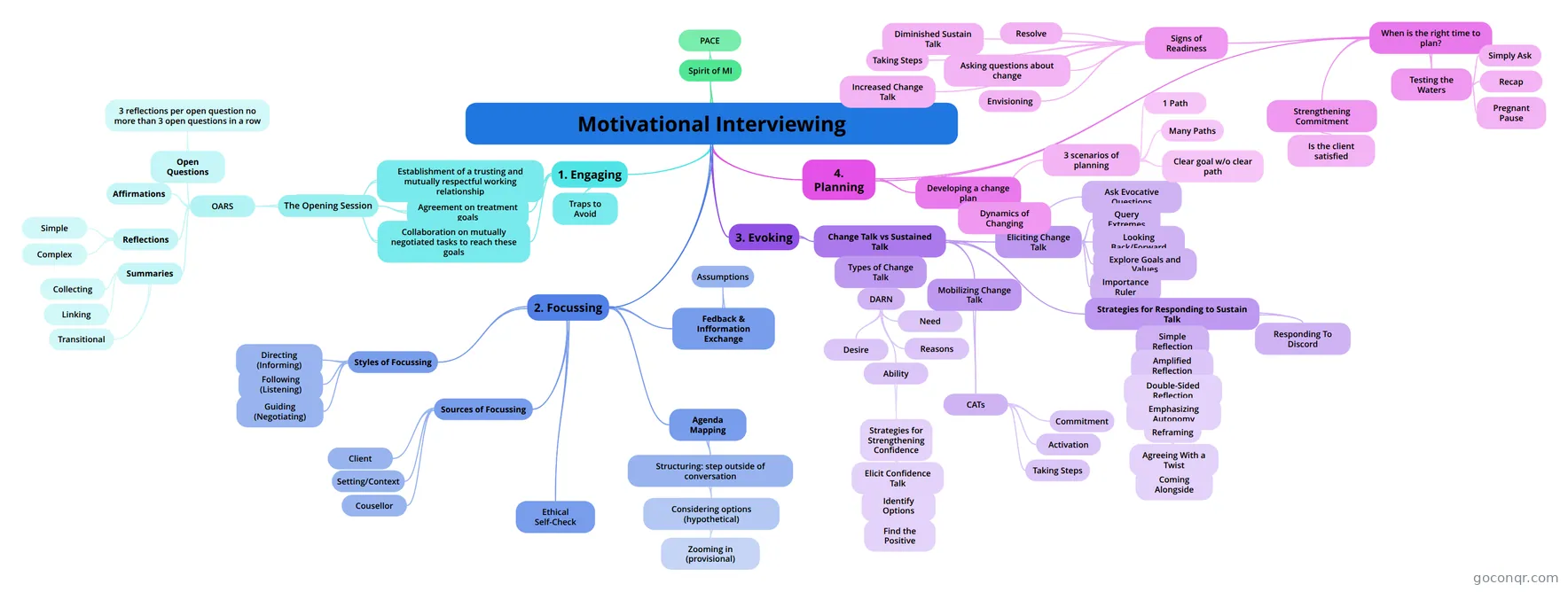
Mind map: Motivational interviewing
Map content
Motivational Interviewing
2. Focussing
- Sources of Focussing
- Client
- Setting/Context
- Cousellor
- Styles of Focussing
- Following (Listening)
- client is in charge of the agenda
- Directing (Informing)
- counsellor provides the focus (agenda) based on their expertise/setting
- Guiding (Negotiating)
- collaborative search for direction, the focus of treatment is negotiated
- Following (Listening)
- Agenda Mapping
- Structuring: step outside of conversation
- step back to discuss direction, ask permission and offer a structuring statement
- Considering options (hypothetical)
- allow client time to list and reflect on options, use affirmations and support autonomy, use reflective listening
- Zooming in (provisional)
- exchanging information and agreement on focus, use summary before moving on
- Structuring: step outside of conversation
- Ethical Self-Check
- Check when: Clinician-client aspirations differ When change imposed by 3rd party When clinician has conflict of interest When clinician has coercive power When MI would not beneficial
- Fedback & Infformation Exchange
- WHAT - sharing expertise with clients- sharing one's concerns with client- providing information about client's current situation- offering advice/providing options for improving client's current situation
- WHEN - when the client asks for it - when the councellor thinks it could be helpful
- HOW - offer information, don't impose anything - Find out if clients want the information before you give it - Ask permission - Provide information in the context of other clients - Give clients permission to disagree with you - Use a menu of options - Use client statements - Use information that is factually or normatively based - Invite clients to decide what the information means for them - Your client is a person, not an information receptacle
- Assumptions
- Sources of Focussing
1. Engaging
- Establishment of a trusting and mutually respectful working relationship
- "passive" should be said as "active listening" to patient/client
- Agreement on treatment goals
- The Opening Session
- Sets the tone and expectation for the counsellor-client relationship: - introduction - time available - counsellor's role - client's role - specific questions - taking notes? ask permission - open question
- OARS
- Open Questions
- invite the person to reflect/elaborate
- 3 reflections per open question no more than 3 open questions in a row
- Affirmations
- Recognizing and commenting on the client's particular strengths, abilities, good intentions, and efforts (must be sincere)...can use re-framing to recognize weakness as a strength
- Reflections
- statements (not questions) that are used to check for meaning, words may be similar but delivery and tone of voice change
- So you feel... It sounds like you... You're wondering if... You...
- Simple
- Repeating or rephrasing. Useful to demonstrate understanding and to keep the conversation alive
- Complex
- Paraphrasing and Emphasizing. Used when you want to add to the client's understanding, to find meaning, or to direct conversation
- Summaries
- reflections that pull together several things the client has told you
- Collecting
- recalls a series of interrelated items as they accumulate, usually within one session
- Linking
- used to contrast and tie together things the person has said, often from multiple sessions. Use AND not BUT
- Transitional
- use to wrap-up or move from one process to another
- Open Questions
- The Opening Session
- Collaboration on mutually negotiated tasks to reach these goals
- Traps to Avoid
- Question-Answer (assessment) Taking Sides Expert Labelling Premature Focus Blaming Chat
- Establishment of a trusting and mutually respectful working relationship
4. Planning
- When is the right time to plan?
- Testing the Waters
- Simply Ask
- "would it make sense to consider how you might go about..." "are you willing to think about..."
- Recap
- Pregnant Pause
- Simply Ask
- Signs of Readiness
- Increased Change Talk
- Taking Steps
- Diminished Sustain Talk
- Resolve
- Resolution Resignation Pensiveness Passivity
- Envisioning
- Asking questions about change
- Strengthening Commitment
- Is the client satisfied
- Testing the Waters
- Developing a change plan
- Dynamics of Changing
- goal>specfc actions>self efficacy general>specific SMART goals
- 3 scenarios of planning
- 1 Path
- Summarize the plan. Calling the CATs. (evoke activation, get more specific, set a date, preparing, ask for commitment) Troubleshoot.
- Many Paths
- Path mapping. - confirm goal - itemize options - elicit the client's hunches/preferences - summarize the plan and strengthen commitment - Troubleshoot
- Clear goal w/o clear path
- Collaborating. - confirm the goal - generate possibilities (avoid evaluation!) - summarize - Troubleshoot
- 1 Path
- Dynamics of Changing
- When is the right time to plan?
3. Evoking
- Change Talk vs Sustained Talk
- Approach-Approach: person is torn between two positive choices Avoidance-Avoidance: person is torn between to negative choices (think: grass looks greener on the other side; stuck between a rock and a hard place) Approach-Avoidance: only one choice is being considered but it has both positive and negative aspects Double Approach: two choices considered, both with important positive and negative aspects
- Types of Change Talk
- DARN
- Desire
- Ability
- signals change might be possible
- Strategies for Strengthening Confidence
- Elicit Confidence Talk
- open questions, confidence ruler
- Identify Options
- ask client first, then give advice, brainstorm!
- Find the Positive
- identify/affirm strengths identify past successes reframe
- Elicit Confidence Talk
- Reasons
- Need
- DARN
- Mobilizing Change Talk
- CATs
- Commitment
- I will
- Activation
- I am willing...shows movement toward action
- Taking Steps
- I tried
- Commitment
- CATs
- Eliciting Change Talk
- Ask Evocative Questions
- Query Extremes
- Looking Back/Forward
- Explore Goals and Values
- Importance Ruler
- ask, "why a 5 and not a 2?" to further elicit change talk
- Strategies for Responding to Sustain Talk
- Simple Reflection
- Amplified Reflection
- Double-Sided Reflection
- Emphasizing Autonomy
- Reframing
- Agreeing With a Twist
- Coming Alongside
- Agreeing With a Twist
- Reframing
- Emphasizing Autonomy
- Double-Sided Reflection
- Amplified Reflection
- Responding To Discord
- Apologizing, affirming, shifting focus
- Simple Reflection
- Change Talk vs Sustained Talk
Spirit of MI
- PACE
- Partnership Acceptance Compassion Evocation
- PACE
Information
- Description
- Mind Map on Motivational Interviewing, created by sacha.taylor on 23/01/2014.
- Created by
- sacha.taylor
- Views
- 73
- Rating