
Mind map
Water World
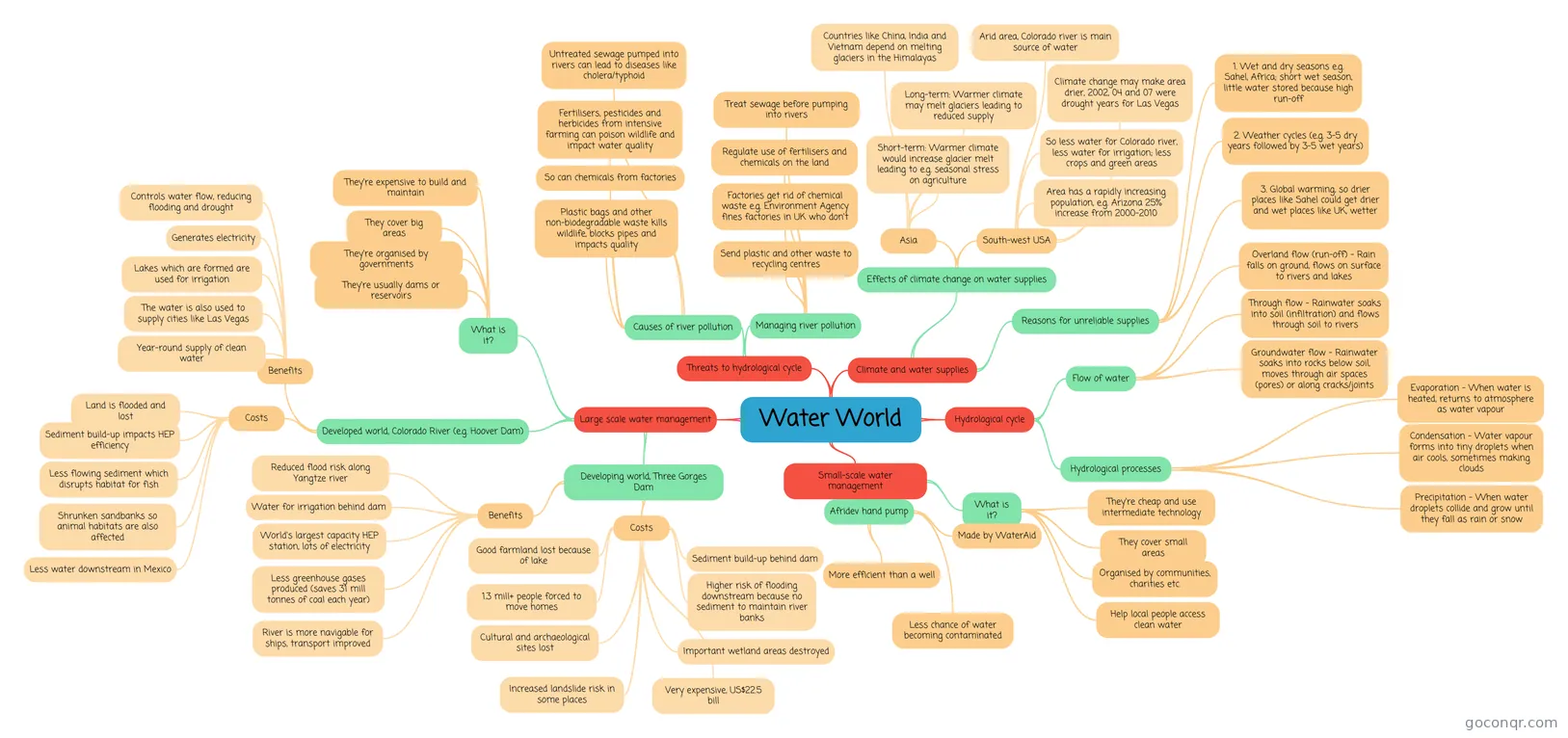
Mind map: Water World
Map content
Water World
Hydrological cycle
- Flow of water
- Overland flow (run-off) - Rain falls on ground, flows on surface to rivers and lakes
- Through flow - Rainwater soaks into soil (infiltration) and flows through soil to rivers
- Groundwater flow - Rainwater soaks into rocks below soil, moves through air spaces (pores) or along cracks/joints
- Hydrological processes
- Evaporation - When water is heated, returns to atmosphere as water vapour
- Condensation - Water vapour forms into tiny droplets when air cools, sometimes making clouds
- Precipitation - When water droplets collide and grow until they fall as rain or snow
- Flow of water
Climate and water supplies
- Reasons for unreliable supplies
- 1. Wet and dry seasons e.g. Sahel, Africa; short wet season, little water stored because high run-off
- 2. Weather cycles (e.g. 3-5 dry years followed by 3-5 wet years)
- 3. Global warming, so drier places like Sahel could get drier and wet places like UK, wetter
- Effects of climate change on water supplies
- South-west USA
- Arid area, Colorado river is main source of water
- Climate change may make area drier, 2002, 04 and 07 were drought years for Las Vegas
- So less water for Colorado river, less water for irrigation; less crops and green areas
- Area has a rapidly increasing population, e.g. Arizona 25% increase from 2000-2010
- Asia
- Countries like China, India and Vietnam depend on melting glaciers in the Himalayas
- Long-term: Warmer climate may melt glaciers leading to reduced supply
- Short-term: Warmer climate would increase glacier melt leading to e.g. seasonal stress on agriculture
- South-west USA
- Reasons for unreliable supplies
Threats to hydrological cycle
- Causes of river pollution
- Untreated sewage pumped into rivers can lead to diseases like cholera/typhoid
- Fertilisers, pesticides and herbicides from intensive farming can poison wildlife and impact water quality
- So can chemicals from factories
- Plastic bags and other non-biodegradable waste kills wildlife, blocks pipes and impacts quality
- Managing river pollution
- Treat sewage before pumping into rivers
- Regulate use of fertilisers and chemicals on the land
- Factories get rid of chemical waste e.g. Environment Agency fines factories in UK who don't
- Send plastic and other waste to recycling centres
- Causes of river pollution
Large scale water management
- What is it?
- They're expensive to build and maintain
- They cover big areas
- They're organised by governments
- They're usually dams or reservoirs
- Developed world, Colorado River (e.g. Hoover Dam)
- Benefits
- Controls water flow, reducing flooding and drought
- Generates electricity
- Lakes which are formed are used for irrigation
- The water is also used to supply cities like Las Vegas
- Year-round supply of clean water
- Costs
- Land is flooded and lost
- Sediment build-up impacts HEP efficiency
- Less flowing sediment which disrupts habitat for fish
- Shrunken sandbanks so animal habitats are also affected
- Less water downstream in Mexico
- Benefits
- Developing world, Three Gorges Dam
- Benefits
- Reduced flood risk along Yangtze river
- Water for irrigation behind dam
- World's largest capacity HEP station, lots of electricity
- Less greenhouse gases produced (saves 31 mill tonnes of coal each year)
- River is more navigable for ships, transport improved
- Costs
- Good farmland lost because of lake
- 1.3 mill+ people forced to move homes
- Cultural and archaeological sites lost
- Increased landslide risk in some places
- Very expensive, US$22.5 bill
- Sediment build-up behind dam
- Higher risk of flooding downstream because no sediment to maintain river banks
- Important wetland areas destroyed
- Benefits
- What is it?
Small-scale water management
- What is it?
- They're cheap and use intermediate technology
- They cover small areas
- Organised by communities, charities etc.
- Help local people access clean water
- Afridev hand pump
- Made by WaterAid
- More efficient than a well
- Less chance of water becoming contaminated
- What is it?
Information
- Description
- Mind Map on Water World, created by Maximillian Holwell on 05/04/2016.
- Created by
- Maximillian Holwell
- Views
- 0
- Rating