
Mind map
Enzyme-Linked Receptors
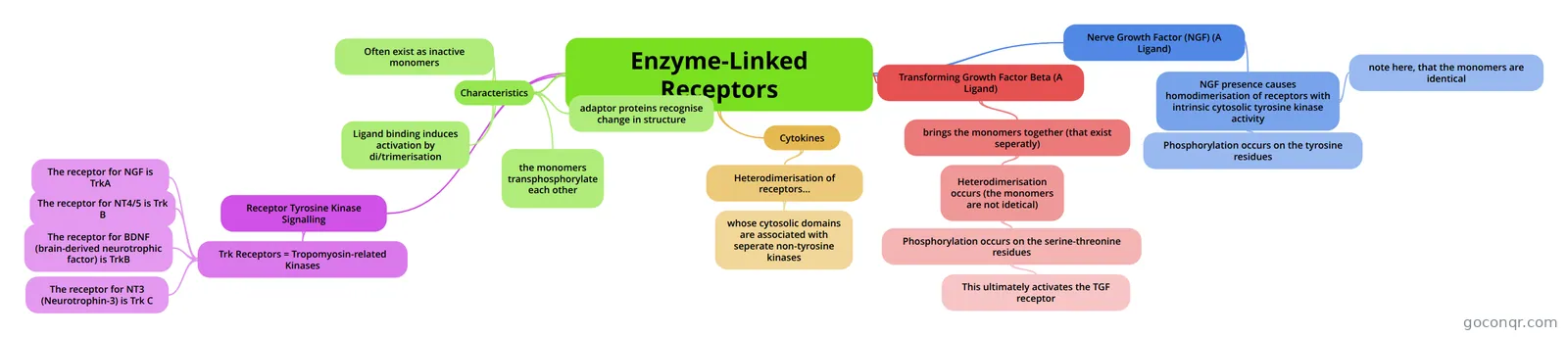
Mind map: Enzyme-linked receptors
Map content
Enzyme-Linked Receptors
Characteristics
- Often exist as inactive monomers
- Ligand binding induces activation by di/trimerisation
- the monomers transphosphorylate each other
- adaptor proteins recognise change in structure
Transforming Growth Factor Beta (A Ligand)
- brings the monomers together (that exist seperatly)
- Heterodimerisation occurs (the monomers are not idetical)
- Phosphorylation occurs on the serine-threonine residues
- This ultimately activates the TGF receptor
- Phosphorylation occurs on the serine-threonine residues
- Heterodimerisation occurs (the monomers are not idetical)
- brings the monomers together (that exist seperatly)
Nerve Growth Factor (NGF) (A Ligand)
- NGF presence causes homodimerisation of receptors with intrinsic cytosolic tyrosine kinase activity
- Phosphorylation occurs on the tyrosine residues
- note here, that the monomers are identical
- NGF presence causes homodimerisation of receptors with intrinsic cytosolic tyrosine kinase activity
Cytokines
- Heterodimerisation of receptors...
- whose cytosolic domains are associated with seperate non-tyrosine kinases
- Heterodimerisation of receptors...
Receptor Tyrosine Kinase Signalling
- Trk Receptors = Tropomyosin-related Kinases
- The receptor for NGF is TrkA
- The receptor for BDNF (brain-derived neurotrophic factor) is TrkB
- The receptor for NT3 (Neurotrophin-3) is Trk C
- The receptor for NT4/5 is Trk B
- Trk Receptors = Tropomyosin-related Kinases
Information
- Description
- Undergraduate Cellular Pathology (Signal Transduction Pathways) Mind Map on Enzyme-Linked Receptors, created by Sophie Barrett on 14/02/2014.
- Created by
- Sophie Barrett
- Views
- 53
- Tags
- Rating