
Mind map
Causes of elevated LDL
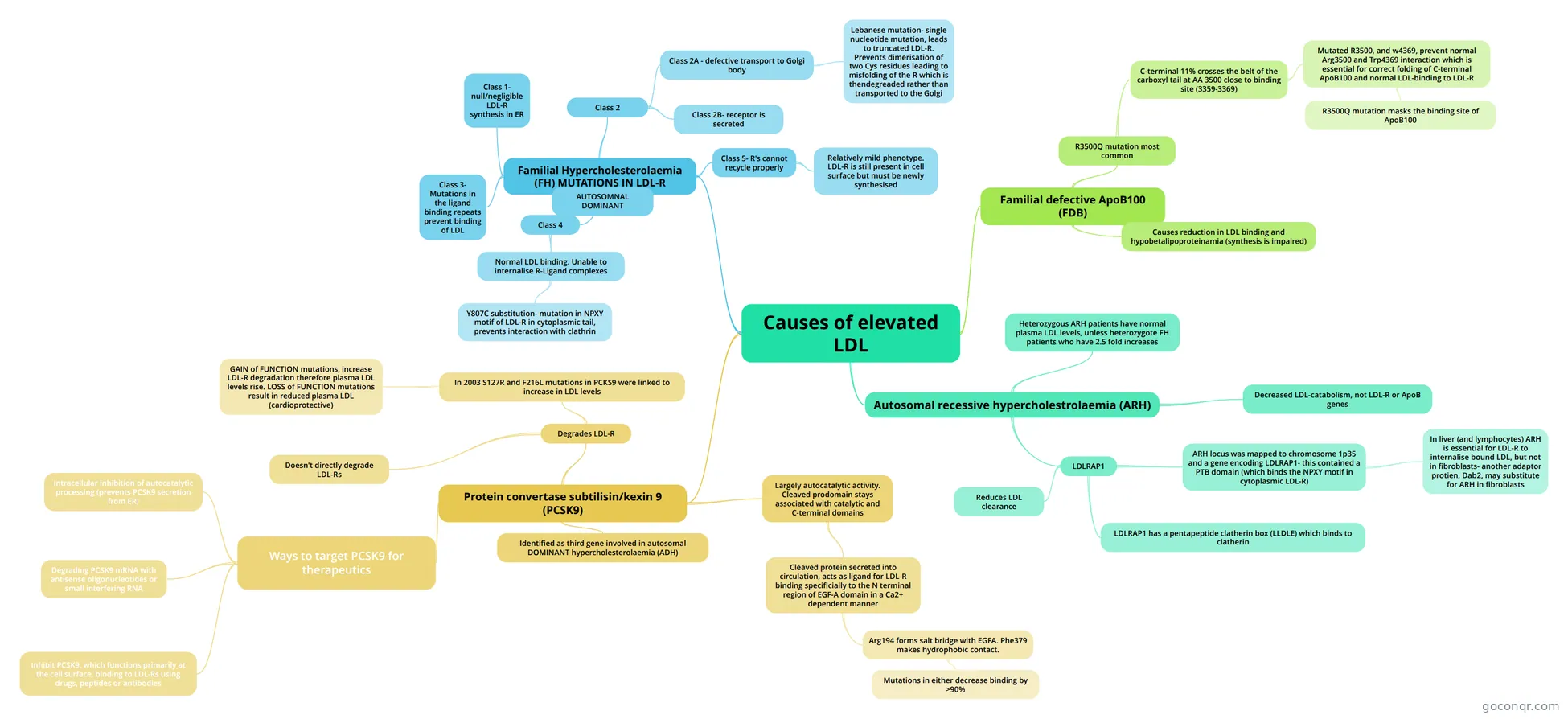
Mind map: Causes of elevated LDL
Map content
Causes of elevated LDL
Familial Hypercholesterolaemia (FH) MUTATIONS IN LDL-R
- Class 1- null/negligible LDL-R synthesis in ER
- Class 2
- Class 2A - defective transport to Golgi body
- Lebanese mutation- single nucleotide mutation, leads to truncated LDL-R. Prevents dimerisation of two Cys residues leading to misfolding of the R which is thendegreaded rather than transported to the Golgi
- Class 2B- receptor is secreted
- Class 2A - defective transport to Golgi body
- Class 3- Mutations in the ligand binding repeats prevent binding of LDL
- Class 4
- Normal LDL binding. Unable to internalise R-Ligand complexes
- Y807C substitution- mutation in NPXY motif of LDL-R in cytoplasmic tail, prevents interaction with clathrin
- Normal LDL binding. Unable to internalise R-Ligand complexes
- Class 5- R's cannot recycle properly
- Relatively mild phenotype. LDL-R is still present in cell surface but must be newly synthesised
- AUTOSOMNAL DOMINANT
Familial defective ApoB100 (FDB)
- R3500Q mutation most common
- C-terminal 11% crosses the belt of the carboxyl tail at AA 3500 close to binding site (3359-3369)
- Mutated R3500, and w4369, prevent normal Arg3500 and Trp4369 interaction which is essential for correct folding of C-terminal ApoB100 and normal LDL-binding to LDL-R
- R3500Q mutation masks the binding site of ApoB100
- Mutated R3500, and w4369, prevent normal Arg3500 and Trp4369 interaction which is essential for correct folding of C-terminal ApoB100 and normal LDL-binding to LDL-R
- C-terminal 11% crosses the belt of the carboxyl tail at AA 3500 close to binding site (3359-3369)
- Causes reduction in LDL binding and hypobetalipoproteinamia (synthesis is impaired)
- R3500Q mutation most common
Autosomal recessive hypercholestrolaemia (ARH)
- Decreased LDL-catabolism, not LDL-R or ApoB genes
- LDLRAP1
- ARH locus was mapped to chromosome 1p35 and a gene encoding LDLRAP1- this contained a PTB domain (which binds the NPXY motif in cytoplasmic LDL-R)
- In liver (and lymphocytes) ARH is essential for LDL-R to internalise bound LDL, but not in fibroblasts- another adaptor protien, Dab2, may substitute for ARH in fibroblasts
- Reduces LDL clearance
- LDLRAP1 has a pentapeptide clatherin box (LLDLE) which binds to clatherin
- ARH locus was mapped to chromosome 1p35 and a gene encoding LDLRAP1- this contained a PTB domain (which binds the NPXY motif in cytoplasmic LDL-R)
- Heterozygous ARH patients have normal plasma LDL levels, unless heterozygote FH patients who have 2.5 fold increases
Protein convertase subtilisin/kexin 9 (PCSK9)
- Identified as third gene involved in autosomal DOMINANT hypercholesterolaemia (ADH)
- Degrades LDL-R
- In 2003 S127R and F216L mutations in PCKS9 were linked to increase in LDL levels
- GAIN of FUNCTION mutations, increase LDL-R degradation therefore plasma LDL levels rise. LOSS of FUNCTION mutations result in reduced plasma LDL (cardioprotective)
- Doesn't directly degrade LDL-Rs
- In 2003 S127R and F216L mutations in PCKS9 were linked to increase in LDL levels
- Largely autocatalytic activity. Cleaved prodomain stays associated with catalytic and C-terminal domains
- Cleaved protein secreted into circulation, acts as ligand for LDL-R binding specificially to the N terminal region of EGF-A domain in a Ca2+ dependent manner
- Arg194 forms salt bridge with EGFA. Phe379 makes hydrophobic contact.
- Mutations in either decrease binding by >90%
- Arg194 forms salt bridge with EGFA. Phe379 makes hydrophobic contact.
- Cleaved protein secreted into circulation, acts as ligand for LDL-R binding specificially to the N terminal region of EGF-A domain in a Ca2+ dependent manner
- Ways to target PCSK9 for therapeutics
- Intracellular inhibition of autocatalytic processing (prevents PCSK9 secretion from ER)
- Degrading PCSK9 mRNA with antisense oligonucleotides or small interfering RNA
- Inhibit PCSK9, which functions primarily at the cell surface, binding to LDL-Rs using drugs, peptides or antibodies
Information
- Description
- Mind Map on Causes of elevated LDL, created by nicole_k on 15/02/2014.
- Created by
- nicole_k
- Views
- 23
- Rating