
Mind map
RTAs
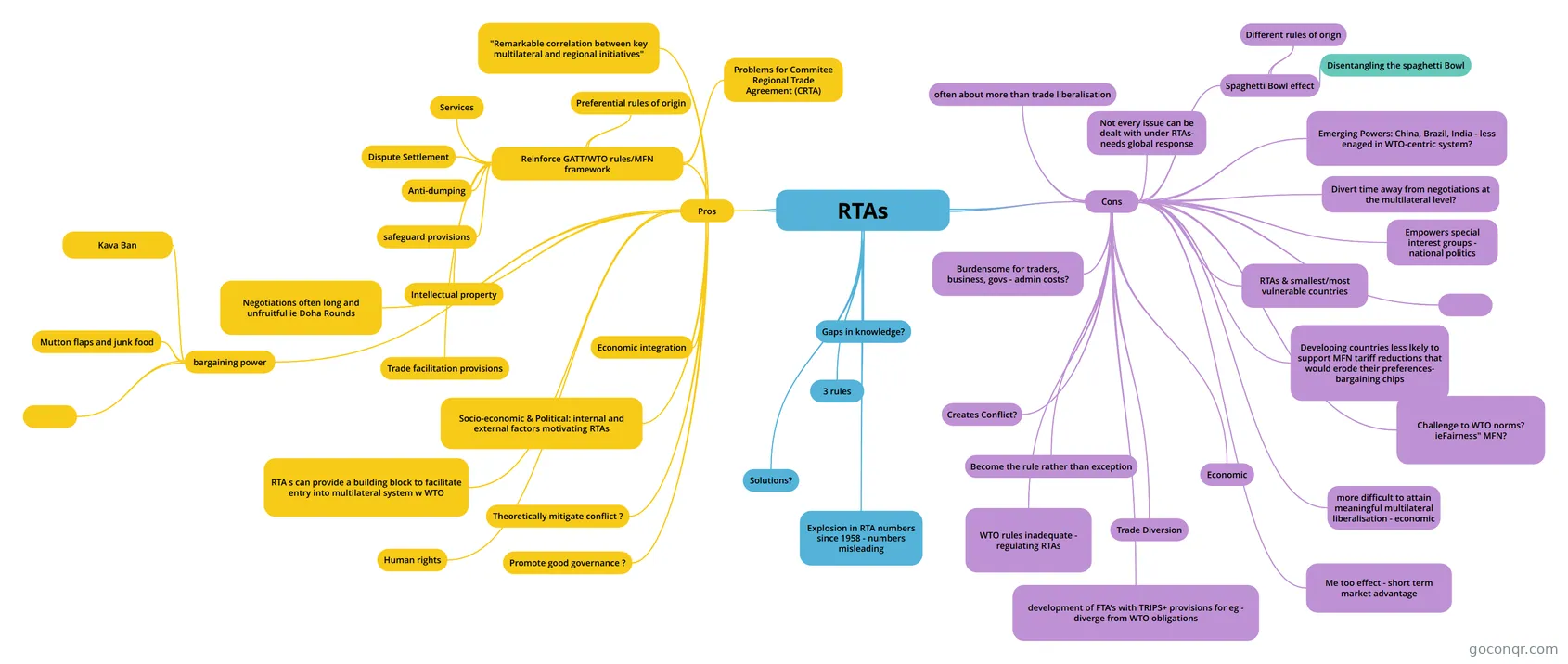
Mind map: RTAs
Map content
RTAs
- "the exceptions and ambiguities which have thus been permitted have seriously weakened the trade rules. They have set a dangerous precedent for further special deals, fragmentation of the trading system, and damage to the trade interests of non-participants... GATT rules on customs unions and free trade areas should be examined, redefined so as to avoid ambiguity, and more strictly applied." - Arthur Dunkel, Director of the GATT 1980-1993 cited in Chap 2 'Rethinking the World Trade Order: Towards a Better Legal Understanding of....Mohammed F A Nsour pg 45 "Five decades after the founding of the GATT, MFN is no longer the rule; it is almost the exception. Certainly, much trade between the economies is still conducted on an MFN basis. However, what has been termed as the 'spaghetti bowl' of customs unions, common markets and regional bilateral free trade agreements, preerences and endless assortment of miscellaneous trade deals has almost reached a point where MFN treatment is exceptional treatment. Certainly the term might better be defined now as LFN, Least Favoured Nation Principle. (The Sutherland Report, 2005) cited in p45 Nsour (above) r
- "FTAs are a rapidly growing elephant- an elephant that currently sits upon and blocks much of the road that the multilateral journey must take" (Buckley, Lo, Boulle 2008 pg 2)
- 3 categories RTAs, *Article XXIV *enabling clause *exception under art `
Pros
- Reinforce GATT/WTO rules/MFN framework
- https://www.wto.org/english/res_e/reser_e/ersd201219_e.pdf ???? Book sept 2016 https://www.wto.org/english/res_e/publications_e/rtamultilateral16_e.htm https://www.wto.org/english/tratop_e/region_e/sem_april02_e/joel_trachtman.pdf - good but need to revisit when understand
- it is hard to deny that preferential trade liberalization and regional trade policy negotiations, are increasingly paralleling the efforts pursued within the MFN framework. (2002, wto seminar) https://www.wto.org/english/tratop_e/region_e/sem_april02_e/sem_april02_prog_e.htm ^same paper pg ...13 This situation has highlighted several areas requiring action. The conformity of regional trade initiatives with the basic message of deeper liberalization underlying the relevant WTO provisions is consistently put into question. The rising number of RTAs is also increasing the risk of incoherent trade policy regulations being implemented through these special regimes. And, lastly, detailed WTO rules and procedures applicable to RTAs are often considered inadequate to steer RTAs concluded by Members and, a fortiori, those announced for the coming years.
- Services
- https://www.wto.org/english/res_e/reser_e/ersd201219_e.pdf ??? https://www.wto.org/english/res_e/reser_e/ersd201118_e.pdf ????
- Preferential rules of origin
- https://www.wto.org/english/res_e/reser_e/ersd201305_e.pdf world trade report 2011 https://www.wto.org/english/res_e/booksp_e/anrep_e/wtr11-2e_e.pdf
- Anti-dumping
- https://www.wto.org/english/res_e/reser_e/ersd201222_e.pdf ??
- safeguard provisions
- https://www.wto.org/english/res_e/reser_e/ersd201310_e.pdf ???
- Intellectual property
- https://www.wto.org/english/res_e/reser_e/ersd201414_e.pdf ??
- Trade facilitation provisions
- https://www.wto.org/english/res_e/reser_e/ersd201401_e.pdf
- Dispute Settlement
- https://www.wto.org/english/res_e/reser_e/ersd201307_e.pdf
- Problems for Commitee Regional Trade Agreement (CRTA)
- "The task of verifying the compliance of the RTAs notified by Members with these provisions is entrusted to the Committee on Regional Trade Agreement (CRTA).[1] This Body, however, has enjoyed no success so far in assessing the consistency of the more than 100 RTAs notified to the WTO,[2] (see Chart 3) due to various political and legal difficulties, most of which were inherited from the GATT years. One problem derives from the possible links between any CRTA consistency judgement and the dispute settlement process. Also, there are long-standing controversies about the interpretation of the WTO provisions against which RTAs are assessed, and institutional problems arising from either the absence of WTO rules (e.g., on preferential rules of origin), or from troublesome discrepancies between existing WTO rules and those contained in some RTAs." [1] The CRTA was established in 1996, in particular (a) to oversee, under a single framework, all regional trade agreements, and (b) to consider the implications of such agreements and regional initiatives for the multilateral trading system and the relationship between them. [2] As of December 2001, the Committee had 17 RTAs under active consideration ("factual examination"), and 23 in the waiting list. "Factual examination" had been completed for 82 RTAs, whose draft examination reports were in various stages of consultation and finalization. (2002, Seminar WTO) https://www.wto.org/english/tratop_e/region_e/sem_april02_e/sem_april02_prog_e.htm
- https://www.wto.org/english/res_e/booksp_e/anrep_e/wtr11-2e_e.pdf world trade report - overview issues useful
- Economic integration
- "The WTO acknowledges that RTAs encourage closer economic integration among participating members and may contribute to members’ economic growth policies." https://www.wto.org/english/thewto_e/minist_e/mc10_e/briefing_notes_e/brief_rta_e.htm
- Socio-economic & Political: internal and external factors motivating RTAs
- Internal factors : *new markets and trade opportunities *geostrategic and political interests *growing frustration with multilateral trade negotiations *counterbalancing the negotiating power of other blocs *building on socio-cultural similarities *reducing illegal trade and smuggling external: *exporting the model of regional integration *pursuing strategic bilateralism
- Theoretically mitigate conflict ?
- "Trade can be a powerful driver of growth, reducing poverty and creating jobs. In theory at least, there are a number of ways that regional trade integration can support peace. 1. ..."poorer countries mutual development gains through pooled resources" 2. "attacking a neighbouring economy becomes just as damaging as attacking one's own." 3. trade as access to resources rather than need for violence to access them "MERCOSUR/SAARC "Can serve as aspirational clubs.." 5. "RTAs provide non military ways of resolving disputes.. promote understanding and dialogue" ... "in practice, several economic and trading arrangements have been established with the explicit purpose of preventing conflict between or within states. For instance: *concerns about the threat of the spread of fundamentalism motivated by the governments of Egypt, Morocco and Tunisia to negotiate regional agreements with the EU. *MERCOSUR originally established to reduce tensions between Argentina and Brazil *stability pact for South-Eastern Europe was created in 2000 - economic recovery and integration in Balkans *Dec 2004 - Egypt and Israel signed trade protocol with US to accelerate two countries' rapprochement" (6-7) Brown Khan Shaheen. "ECOWAS, SADC- signatory countries agreed to co-operate on specific security concerns and establish ways of mitigating conflict between members. Provisions also contained ,.. weak... human rights, democracy, rule of law. " (7) Brown, Khan, Shaheen. ... "study by the US State Failure task force found.. those countries outside regional integration process, or with no obvious regional club to join such as Myanmar, Afghanistan or Turkmenistan are more likely to suffer state failure and further isolation" 12
- Promote good governance ?
- "RTAs can play a role in promoting elements of good governance such as budgetary transparency, careful fiscal management and an independent judiciary. A notable trend in North South trade agreements is the increasing inclusion of non trade commitments as part of the agreement. The 2000 Contou agreement between the EU and the countries of the African-Carribean Pacific region is a case in point. It lists 3 so called 'essential elements: respect for human rights, democracy, and the rule of law. If contravened, these conditions can lead to suspension of co-operation - including cancellation of preferential access." (7) ... similar conditions attached (EPAs) - EU & African, Carribean and Pacific countries. "In short, rich countries are using trade agreements as an inducement for largely unrelated governance concerns. That this is possible at all is indicative of their negotiating power. South-South RTAs have not gone as far down this path." "Nevertheless several south-south RTAs do include such provisions. The trend seems to be catching on." (7) Brown Khan Shaheen.
- "Remarkable correlation between key multilateral and regional initiatives"
- Baldwin (2006) cited in Baldwin 2011 1st wave regionalism ~ EEC triggered the Dillion round, the kened round was launched just before the major spread of North-North Regionalism in 1965 and the Tokyo round launched same year Western Europe completed virtual free trade zone. 2nd wage regionalism ~ Uruguay Rund launched same year as Us-Canada FTA talks and West Europe - massive deepening preferential liberalisation 3rd wave ~ Doha Round 2001 - soon after third wave Baldwin, Carpenter 2011 pg 142 (Chapter) more evidence : Lendle 2007, Estevadeordal, Freund and Ornelas (2008)
- Negotiations often long and unfruitful ie Doha Rounds
- "Past gains will not be lost, but further progress in liberalising the multilateral system is at a standstill. The Doha Development Round, so named because it was intended to promote development in poorer nations around the world, has in six years, delivered nothing, while many countries remain effectively outside the dominant global trade regime." (1, intro ~ Challenges to Multilateral Trade: The impact of bilateral, preferential and regional agreements eds Buckley, Lo and Boulle, 2008)
- Doha round is not moving forward -RTA is only feasible option for China to achieve trade liberalisation.. 63 GAo in Buckley et al 2008 *Gao expands on this pg 63 "by some accounts, the failure of the Doha round from seattle onwards was the impetus for the Asian region to turn to regional agreements instead of relying on global solutions." 71 Toohey in Buckley et al 2008.
- most countries feel better able to participate in negotiations at regional level Das Regionalism in Global Trade pg 26 NLA
- RTA s can provide a building block to facilitate entry into multilateral system w WTO
- Toohey - case of Vietnam - in Buckley et al 2008 - "Vietnam's pre-WTO engagement with regional organisations such as ASEAN was widely seen as an important stepping stone towards the WTO. For example in the Report of the Working Party for Vietnam's WTO accession, the WTO Secretariat commented that; 'having joined the ASEAN, the ASEM, APEC, Vietnam was participating in regional organisations which were committed to WTO principles and rules, and preparatory and substantially supportive of Viet Nam's accession to the WTO.' > WTO itself acknowledging > undertakings included cmmitments to tarrification and tarrif reductions under the CEPT Agreement, the removal of non-tariff barriers, and harmonisation of customs procedures. pg 80 Toohey
- Human rights
- In 2004 the WTO did assess comparable provisions of a EC regulation linking trade preferences to efforts by developing- appellate body confirmed panel's ruling that the 1979 enabling clause was the source of the legal discipline under the WTO agreement. The Appellate Body nonetheless accepted that some differentiation between developing states was consistent with the Enabling Clause..."thus left open the possibility that the arrangements referred to above linking trade preferences to human rights will be found to be consistent with obligations under the WTO Agreement" Cassimatis p 202 Buckley et al 2008
- US- Chile FTA Article 18.1 - lLO (soft law) but supplemented by 18.2.1 hard law enforcement of domestic laws. ... 18.8 ... see Cassimatis pg 204 Cotonou Agreement- African, Carribean, Pacific States - European Market - art 50, art 96 -
- bargaining power
- "major objective is to increase bargaining power vis a vis third countries by becoming part of an RIA. This argument applies more to small developing economies as well as small states like the island countries in the Carribean. In this case, the RIA that can help more is the customs union rather than the free trade kind." 26 Das Regionalism in Global Trade
- Kava Ban
- Kava - became very popular in the 1990s- in the US, Australia, Europe - natural medicines to relieve stress, anxiety and insomnia. Major pharmaceutical companies started producing kava pills and capsules...this contributed to growing kava export trade for countries like Fiji, Vanuatu, Tonga and Samoa, amounting to nearly US$200 million per annum (PANG 2007,3). Many farmers started planting more kava - initiative of small scale farming rather than agribusiness... 2001 - German report - kava damages liver - 75% reduction - exports in aus banned despite aus food reg saying no evidence... estimated 1.4 billion in earnings over 7 years due to bans. VITAL QUOTE: "It is hard to imagine that this barrier to trade wouldn't have been overcome much earlier, had the roles of the EU and the PICS been reversed. Given that the EU economy is 14000 times bigger than the PIC economies (and the EU has a massive pharamceutical industry) it seems certain that EUropean growers and producers would quickly eliminate trade barriers of this kind, if a significant percentage of their export earnings were to be affected. The experience of trade bans and kava exports highlights the fact that there is no such thing as a 'level playing field' in international trade. The experience the kava export industry to Europe also indicates the signifcant barriers to trade with Europe which are hurting pacific producers in other areas. Stringent sanitary requirements make it virtually impossible for small scale agricultural producers in the Pacific to export to the EU (Pang 2007, 7) pg (woaards end - no pg numbers) https://books.google.com.au/books?id=Yn8GDAAAQBAJ&pg=PT466&lpg=PT466&dq=regionalism+wto+pacific+regional+mutton+flaps&source=bl&ots=wWnB9caDDX&sig=o8MSHAXNr6Dn250HJqq3XXw0Fm0&hl=en&sa=X&ved=0ahUKEwjlk5XWu8PPAhUC4oMKHXbLDMMQ6AEIHTAA#v=onepage&q=regionalism%20wto%20pacific%20regional%20mutton%20flaps&f=false
- Mutton flaps and junk food
- NZ threatened to take fiji to the WTO disputes process Tonga wanted accession to WTO so was forced to shelve ban danger of agreements like PACER- Plus art 16(1)(b) of PICTA allows countries to claim a trade restriction necessary to protect human health. under art XX(b) of the GATT countries may adopt trade measures necessary to 'protect human, animal or plant life or health'. "But these provisions place onerous burdens on the country to prove that no other measures are possible and that the regulations do not constitute a 'disguised restriction on international trade.' Poor island nations do not have the human or financial resources to utilise effectively the WTO disputes procedure, and will be under significant pressure under PACER-Plus to abstain from measures that will hinder Australia and NZ based exporters." 305 Fair Trade, Corporate Accountability and Beyond.
- Reinforce GATT/WTO rules/MFN framework
Cons
- Not every issue can be dealt with under RTAs- needs global response
- Director General Roberto Azevedo "there are many big issues which can only be tackled in an efficient manner in the multilateral context through the WTO. Trade facilitation was negotiated successfully in the WTO because it makes no economic sense to cut red tape or simplify trade procedures at the border for one or two countries...Financial r telecoms regulations can’t be efficiently liberalised for just one trade partner..Nor can farming or fisheries subsides be tackled in bilateral deals. Disciplines on trade remedies, such as the application of anti-dumping or countervailing duties, cannot significantly go beyond WTO rules" speech https://www.wto.org/english/news_e/spra_e/spra33_e.htm
- "While piecemeal reduction of tariffs through bilateral agreements does in some ways contribute to multilateral trade liberalisation goals by chipping away at the overall wall of trade impediments, there are some systemic issues that can only be addressed multilaterally. These issues, which include problems relating to inconsistent rules of origin, regulation of antidumping, and the problems of agricultural and fisheries subsidies cannot be resolved at the bilateral level." Kolsky Lewis 24 in Buckley et al 2008
- RTAs & smallest/most vulnerable countries
- Director General Robert Azevedo And as our economies become more interconnected across borders and regions, RTAs do not — and probably cannot — fully address the gains from trade that can be obtained through global value chains. Indeed, the strict, product specific rules of origin that often accompany RTAs may actually be detrimental to value chains and therefore exclusionary for some. The smaller the country, the smaller the company, the smaller the trader, the bigger the likelihood is that they will be excluded." https://www.wto.org/english/news_e/spra_e/spra33_e.htm
- "Preferential origin rules are complex and inconsistent. We are still without the harmonised ruels of origin promised at the end of the Uruguay Round - though, admittedly, preferential arrangements were excluded from the negotiating mandate. That is a pity, especially since the globalisation of production and trade means that many products contain components adn inputs from a variety of sources. As of now, "local value added" or "transformation" tests are built in, purely arbitrarily, to define origin... Many observers have noted that this situation increases substantially the transaction costs of trade in the trading system today. But as South Africa's former Trade Minister Alec Erwin has emphasised these costs are particularly onerous for small corporations and traders, and hence for the developing countries" ..."in effect, they constitute a significantly greater tax on the trade of poor nations than for larger corporations from the rich countries. Added to the formal costs of administering preferences, the potential for informal costs, through corrupt practices at the border - for isntance, as bribes are paid to ensure decisions on origin attract the preferential tariff - must be added in to the equation." 22 http://www.ipu.org/splz-e/wto-symp05/future_WTO.pdf
- "it is important to note that the spaghetti bowl is well organised for firms located in the uS and the EU. These trade giants have used their bargaining power to establish harmonious rules of origin and market access. The confusion and inefficiencies of today's spaghetti bowl of trade preferences is much more of a problem for firms located in poor and/or small nations In short, the spaghetti bowl falls much harder on the heads of the world's small and poor nations." (Baldwin, Carpenter 2011 150)
- "their openness to capture by the more powerful country" ~ pg 1 Buckley, Lo, Boulle 2008 "how different pacific rim nations have used and abused them and might use and abuse them in the future" (2 (Buckley, Lo, Boulle 2008 ) "Least able to manage trading system riddled by complex preferences and rules of origins. They can also simply be left aside of trade flows" pg 9 Lagarde in Buckley et al 2008
- inequality in bargaining power more pronounced in bilateral negotiation context.. "at least in the WTO forum, the weakest and smallest numbers have the power of numbers. By banding together with similarly situated members, developing countries and LFCs have been able to have a significant impact on the direction of the multilateral trade agenda." 26 Kolsky Lewis in Buckley et al 2008
- Burdensome for traders, business, govs - admin costs?
- Roberto Azevedo "There is also concern that by creating different sets of rules and regulations, RTAs may be burdensome for traders and business. This is the complexity point that is a concern for many." https://www.wto.org/english/news_e/spra_e/spra33_e.htm
- "the quite extraordinary administrative costs on corporations and governments of complying, or ensuring compliance with, so many different bundles of rules" (Buckley, Lo, Boulle 2008 pg 1)
- often about more than trade liberalisation
- Paper Jo Ann Crawford "sample of the evolution of trade flows for the ten countries most active in RTAs indicates that trade shares with a majority of their preferential trading partners are negligible, thus suggesting that motivations other than a desire to increase market access may account for countries' participation in RTAs. Further work is necessary to explore this observation." https://www.wto.org/english/res_e/reser_e/ersd201220_e.pdf
- "Also the last generation of PTAs has seen dminished attention to tariff issues relative to increased focus on regulatory issues in goods and services trade. This creating complex networks of trade regimes potentially undermining transparency and predictability in trade relations. Thus while these so called WTO-plus PTAs may act as testing grounds for new multilateral trade policy disciplines and regulations, the discretion enjoyed by PTA parties in designing such regulatory regimes can strike a serious WTO minus note for the multilateral trading system" 23 http://www.ipu.org/splz-e/wto-symp05/future_WTO.pdf
- "One other unanticipated and significant issue that has arisen with the growth of PTAs is the injection of particular "non trade" objectives into trade agreements. Apart from comparitively ambitious and one sided provisions on intellectual property rights, we have seen an increasing tendency on the part of preference givers to demand significant labour and environmental protection undertakings and even restrictions on the use of capital controls- as the price for preferential treatment...forerunners of new demands in the WTO. After all, as more and more countries concede non-trade provisions of this kind at the pTA level the less these WTO members are likely to stand out against demands for their eventual inclusion in the multilateral rules. We would argue that if such requirements cannot be justified at the front door of the WTO they probably should not be encouraged through the side door." (23) http://www.ipu.org/splz-e/wto-symp05/future_WTO.pdf
- Bhagwati against extraneous considerations (ie labour standards, environment)
- Gao thinks that China will continue to pursue RTAs in the future because the strategy is a part of a broader plan to address geopolitical concerns... Historically US-Japan exerted considerable influence in the region..."as it will take some time before China can challenge the military dominance of the US in Asia, the economic integration with ASEAn and other economies in Asia will be the way to achieve political ends using economic means. When the ASEAN economies find out that they are too dependent on China for their economic well being, they can hardly ignore the poltiical message from Beijing. Therefore even though many commentators have doubted the economic benefit to China from an ASEAN-China FTA, as the two are competitors on many products, China has adopted the guideline of 'give a lot while demand little' in FTA negotiations because the political significance of such an FTA greatly outweighs economic considerations." 63 Gao in Buckley et al 2008
- Divert time away from negotiations at the multilateral level?
- "At the very least, the diversion of skilled and experienced negotiating resources into PTAs- especially for deevloping nations and probably for rich countries also- is too great to permit adequate focus on the multilateral stage. Despite all the efforts at training negotiators in developing countries, there are just not enough capable people for most of them to concentrate adequately on more than one serious trade negotiation at a time. In recent years, we fear it is the WTO that has lost out in terms of negotiating focus. 23 http://www.ipu.org/splz-e/wto-symp05/future_WTO.pdf
- "their tendency, especially in poorer nations, towards consuming the available administrative capacity and thus precluding progress on multilateral negotiations" ~ (Buckley, Lo, Boulle pg 1 2008)
- Spaghetti Bowl effect
- "Spaghetti bowl" - term was first coined by Bhagwati Geoff Raby, former Australian Ambassador to the WTO once said "the pesto saucec in the spaghetti has now been replaced by diesel oil, the cheese by nuts and bolts" pg 9 Lagarde in Buckley et al 2008 Overlapping raises a number ofissues: firstly, differing rules of origin create a maze of (sometimesconflicting) criteria for the granting of origin which raises the cost ofadministering such agreements; secondly, membership in a number of differentRTAs for a given country can result in the duplication and maintenance oftariff schedules for each preferential partner with different phase-outperiods; thirdly, the difficulty in sustaining membership in two or moreoverlapping plurilateral RTAs (which is the case for several countries in Africa and Central Asia) should lead to the consolidation of RTAs andrationalization among participants who may be forced to align themselves with one or other regional grouping; fourthly, the dedication of resources to the negotiation and maintenance of agreements at the regional level may divert attention from negotiations at the multilateral level - seminar 2002 pg 11 https://www.wto.org/english/tratop_e/region_e/sem_april02_e/sem_april02_prog_e.htm
- Complexity of spaghetti bowl multiplied by two things: *offshoring *rules of origin Baldwin Carpenter (2011) pg 145
- "
- Disentangling the spaghetti Bowl
- "We would like to think that governments will take into account the damage being done to the multilateral trading system before they embark on new discriminatory initiatives. If the motivation is to promote non-trade agendas or simply an instinctive desire to 'catch up' with others or follow suit they should at the very least, show restraint. At the very least, we need to be clear that future initiatives are taken above all other considerations genuinely to improve trading and development prospects of beneficiaries or PTA members...." "if old PTA's cannot be scrapped and new ones cannot be prohibited, the remedy to the spaghetti bowl of discriminatory preferences that they spawn would be to attack them indirectly through effective reduction of MFN tariffs and non-tariff measures in multilateral trade negotiations. Hence, the urgency of success in the Doha Round is manifest from this perspective- and perhaps a commitment by developed members of the WTO to establish a date by which all their tariffs will move to zero should now be considered seriously." "PAarties to PTAs examined in the commitee on Regional Trade Agreements may now opt for entrusting the Secretariat with the factual presentation of their agreement. This modest development- implemented on an experimental and voluntary basis- could easily be extended to form a Trade Policy Review Mechanism of individual PTAs. Thus, on a regular basis, WTO members would have a chance to review and comment upon the developments within, and external impact of, PTAs. That would entail no legal ramifications but would certainly add to transparency and understanding. " 26-27 http://www.ipu.org/splz-e/wto-symp05/future_WTO.pdf
- Different rules of orign
- challenges for custom officials and manufacturers - satisfy a multitude of agreement specific - often conflicting rules" - 25 Kolsky Lewis in Buckley et al 2008
- more difficult to attain meaningful multilateral liberalisation - economic
- http://www.ipu.org/splz-e/wto-symp05/future_WTO.pdf"some policy-makers embrace the concept of 'competitive liberalisation': participation in PTAs provides a spur to liberalisation on multiple fronts and contributes to innovative policies in such areas as investment rules and market regulations. While there may be some truth to this proposition, the unregulated proliferation of PTAs tends to create vested interests that may make it more difficult to attain meaningful multilateral liberalisation. pg 23
- Kolsky Lewis analogies the Prisoners' Dilemma - fits with the WTO member's trade liberalisation decisions - "the equilibrium that is resulting at present whereby WTO Members are focusing on negotiating FTAs instead of on WTO liberalisation, is leading to a less favourable outcome for the participants than each would have achieved by adopting its dominant strategy- to cooperate by focusing on multilateral liberalisation through the WTO negotiations process...the fact that the rational decision in this situation is for members to take a bilateral approach, but that this rational decision results in a suboptimal outcome is what makes the fit the pattern of a prisoners' dilemma' Kolsky Lewis 32 in Buckley et al 2008
- Developing countries less lkely to support MFN tariff reductions that would erode their preferences- bargaining chips
- "In the Doha Round we have witnessed the hesitations of many developing countries, enjoying GSP or PTA preferential access to rich country markets, to support ambitious objectives on MFN tariff reductions that would erode the value of their preferences. There is, therefore, real reason to doubt assertions that the pursuit of multiple PTAs will enhance, rather than undermine, the attractiveness of multilateral trade liberalisation- at least in the short and medium term. Critics suggest it is based on an arguable and possibly implausible assumption that the relationship between PTAs and multilateral trade liberalisation is complementary" 23 http://www.ipu.org/splz-e/wto-symp05/future_WTO.pdf
- "make multilateral progress more difficult by altering incentives to cooperate at that level and removing bargaining chips available for trading in that forum" - Buckley, lo, Boulle 2008, 1
- FTAs- might provide for liberalisation over a period of time in a certain sector - makes it difficult to get members to agree to liberalise these sectors in the WTO context - because WTO members can pick and choose in FTAs "there are fewer bargaining chips available in the WTO negotiations to get members to make the difficult concessions -such as reducing agricultural tariffs that remain" (24 Kolsky Lewis in Buckley et al 2008 )
- Creates Conflict?
- an RTA may not be much of a 'brake' on conflict... "there are many examples of conflict between members of RTAs...: *border clashes btw Armenia and Azerbaijan, *war outbreak in Great Lakes *iraqi invasion of Kuwait, border clashes Egypt and Sudan - 9 "Eu's genesis was a unique set of circumstances... Most important, and in contrast to many other regional agreements the EU and its predecessors have provided a means of distributing income from rich to poor countries." (9) "Without careful negotiation and implementation, regional integration between countries of widely differing size, wealth and influence can cement inequalities, create tensions and trigger conflict...envy can result from trade imbalances... "neither are trade institutions the best mechanism to mediate disputes- especially if those disputes have wider social and political dimensions." "uncompromising process whcih drove up unemployment and undermined government social programmes, can explain much of the subsequent instability in Francophone West Africa"... "trade integration may help to facilitate the illegal trade in conflict resources such as blood diamonds and illegal timber. It may also increase access to weapons." "RTAs can help reinforce the perception and reality of trade domination by an external power." "RTA's can generate high expectations of increased economic growth, new job opportunities and reduced poverty." "Countries tend to exclude key goods from liberalisation agreements When those countries trade in a similar, and narrow, basket of goods the net economic impact of the RTA can be limited. For example, West Africa's reliance on cocoa and palm oil leaves little else to trade between countries." (11) Brown Khan Shaheen.
- Become the rule rather than exception
- "the real threat is that regionalism is becoming so pervasive that it may soon be the rule rather than the exception. It could contribute in a forceful way to the erosion of the WTO-centricity in the world trade system" (`148, Baldwin, Carpenter 2011) "the main early adopters of liberalisation...were simultaneously ardent supporters of multilateralism... For them, regionalism was an addition to multilateralism, not a substiute... Contrast this with the experience of the newly emerging trade powers - Brazil, India and China. These nations were largely free riders in the tariff cutting GATT rounds...not swtiching to leadership roles in the WTO... They are learning that regional trade talks are the fast, easy and controllable way to liberalise trade; multilateral trade talks are the slow, hard and uncontrollable path. Similar trends are affecting political leaders in the US, the EU, Japan and Canada; they too are starting to find that the regionalism route may be better, easier and faster way to get improved market access from developing countries" (151, baldwin Carpenter 2011) "Plan B does not work without a plan A...we risk entering a new regime - a regime where we have regionalism but only sporadic respect for WTO norms. This would be a world where 'might makes right' or more precisely, where nations with big markets have the bargaining leverage they need to ensure that market access their exporters want. Smaller nations would be left to fend for themselves. This would be like a return to the Great Powers era of trade where each powerful nation made the rules in its own sphere of influence." (151Baldwin carpenter 2011)
- Emerging Powers: China, Brazil, India - less enaged in WTO-centric system?
- "By rights, these emerging markets should start to take their place among the Stalwarts of the WTO-centric trade system. But so far they have not stepped up to this role. Indeed, most of them are having a worryingly favourable experience with regionalism in the 21st C..their commitment to multilateralism is relatively untested...The WTO has never provided them with hard fought increases in market access- either the market access happened or it did not..." (149 Baldwin, Carpenter 2011)
- Challenge to WTO norms? ieFairness" MFN?
- "A good deal of the WTO's centricity stems from the fact that its norms are almost universally accepted.. The emergence of RTAs between uneven nations...tend to undermine this fairness...The key players believe the world trade system will continue to be achored by the WTO's shared values, such as reciprocity, transparency, non-discrimination, and the rule of law...at some point derogations become the new norm... " (150 baldwin, Carpenter 2011 )
- FTAs + agreements under enabling clause erode WTO core principle MFN principle- "now, the exceptions, led by FTAs have swallowed the rule. It has been said that the MFN might today be more accurately called the LFN 'least favoured nation' " Kolsky Lewis 24 in Buckley et al 2008
- Empowers special interest groups - national politics
- RTAs "their capacity to indulge special interest groups within each of the national parties" (Buckley, Lo, Boulle, pg 1)
- Trade Diversion
- inefficiencies - trade - diversion Buckley, Lo, Boulle pg 1 2008
- WTO rules inadequate - regulating RTAs
- "We need rules to make sure that RTAs are well designed and enforced in a way that complements multilateral liberalisation. Current rules by the WTO may help: according to Article XXIV of GATT, WTO Members are permitted to enter into bilateral or regional arrangements provided they cover most bilateral trade flows and do not have net trade diversion effect. The rules are more flexible for developing countries entering into a trade agreement due to the special and differential treatment principle. This is not enough: almost no agreements have been challenged yet and many of them, especially between developing countries (south-south trade agreements) are very limited in scope. That is why negotiations for improving procedures under the existing WTO provisions were included in the Doha Declaration Agenda.".. (9-10 Lagarde in Buckley et al 2008)
- "Another reason for the current payoff structure is that fact that there is no effective sanction at present to prevent members from entering into FTAs, particularly ones that do not conform to the requirements set forth in GATT Article XXIV... to date the CrTA has not been able to fulfl its mandate... Failure to notify FTAs on a timely basis or at all." 33 new mechanism - transparency - yet unknown impact - 34 Kolsky Lewis in Buckley et al 2008
- Economic
- "as an economic matter, the evidence appears to be mixed as to whether FTAs are leading to an increase or decrease in economic welfare." ~ Kolsky Lewis pg 22 (Buckley, Lo, Boulle 2008) "notwithstanding the rosy picture expressed by some government officials, the prevailing view now seems to be that the FTAs are more of a stumbling block than a building block, particularly with respect to FTAs that do not conform to the 'substantially all the trade' requirement of GATT article XXIV.' Kolsky Lewis pg 23 (Buckley et al 2008)
- "Bhagwati most famously articulates the system-level concerns of a plethora of PTAs. He states that "as these PTAs proliferate, the main problem that arises is the proliferation in turn of discriminatory access to markets, with a whole maze of trade duties, and barriers that vary according to source.' The consequence, Bhagwati continues, is a variety of detrimental effects, whereby imports are shifted to less efficient producers becuase they are from a country that is a fellow RTA signatory, and added burdens of differing regulations such as a plethora of differing rules of origin." Toohey 72 Buckley et al 2008
- "the debate over regionalism hindering or helping free trade is an old chestnut. Several empirical studies, particularly those deploying Vinerian logic, have concluded that regionalism can lead to trade diversion. But these results were challenegde by other studies." Das Regionalism in Global Trade p22 However ^ he says "RIAs are unquestionably the second best compared to global free trade. That being said, in the real life situation, undistorted global free trade does not exist. But compared to the global trading system in which tariffs and non tariff barriers abound, the case against RIAs is generally far from clear, and weak if it does occur. Besides, other than the economic rationale...multiple non-economic objectives generally lie behind the formation of an RIA." 25
- development of FTA's with TRIPS+ provisions for eg - diverge from WTO obligations
- development of FTAs with TRIPS+ provisions... diverge from WTO obligations... "FTAS that are providing intellectual property protection in excess of that mandated by the TRIPS agreement" Kolsky Lewis 25 in Buckley et al 2008
- Me too effect - short term market advantage
- domino regionalism, bandwagon effect, me too effect "Regardless of the label, the phenomenon is the same: Shifts in comparative advantage resulting from FTAs are impermanent, only lasting until new FTAs bring the market balance back towards where it started." ( Kolsky Lewis 25 in Buckley et al 2008
- Not every issue can be dealt with under RTAs- needs global response
Gaps in knowledge?
- https://www.wto.org/english/news_e/spra_e/spra33_e.htm"One fundamental point is that very little information exists on the benefits of RTA preferences." Roberto Azevero Director General speech
3 rules
- "Generally speaking, RTAs must cover substantially all trade, and help trade flow more freely among the countries in the RTA without raising barriers to trade with the outside world." https://www.wto.org/english/thewto_e/minist_e/mc10_e/briefing_notes_e/brief_rta_e.htm WTO Members are however permitted to enter into such arrangements under specific conditions which are spelled out in three sets of rules: Paragraphs 4 to 10 of Article XXIV of GATT (as clarified in the Understanding on the Interpretation of Article XXIV of the GATT 1994) provide for the formation and operation of customs unions and free-trade areas covering trade in goods ; the so-called Enabling Clause (i.e., the 1979 Decision on Differential and More Favorable Treatment, Reciprocity and Fuller Participation of Developing Countries) refers to preferential trade arrangements in trade in goods between developing country Members; and Article V of GATS governs the conclusion of RTAs in the area of trade in services, for both developed and developing countries. Other non-generalized preferential schemes, for example non-reciprocal preferential agreements involving developing and developed countries, require Members to seek a waiver from WTO rules. Such waivers require the approval of three quarters of WTO Members. Examples of such agreements which are currently in force include the US — Caribbean Basin Economic Recovery Act (CBERA), the CARIBCAN agreement whereby Canada offers duty-free non-reciprocal access to most Caribbean countries, Turkey-Preferential treatment for Bosnia-Herzegovina and the EC-ACP Partnership Agreement. https://www.wto.org/english/tratop_e/region_e/regrul_e.htm
Solutions?
- Baldwin, Carpenter 2011 WTO led ideas enhancing coherence - *WTO advisory service - on RTAs for developing nations 152 *negotiation of best practice models (Soft law) 153 - voluntary best practice guidelines, level of RTA discipline that was in between that of Art XXIV and the enabling clause *new sectoral free trade agreements 155 RTA led ideas *plurilateralise rules of origin and cumulation *Anti-spaghetti clauses in RTAs Development of Friendly (roos) and cumulation *development friendly cumulation *switching to either/or rules of origin Baldwin, Carpenter 2011 159-161. *
- economist Larry Summers "once said he likes 'all the "isms", unilateralism, regionalism and multilateralism"... cited in Lagarde in Buckley et al pg 6
- co-operation through iterated play: "in repeating plays of the prisoners' dilemma economists have discovered when parties learn the outcomes of their plays, they may develop strategies involving a higher level of co-operation in future iterations...in the FTA context, the payoffs are likely to be variable among WTO members, but it seems logical that the payoff from adopting an FTA-focused strategy will decrease the more FTAs are entered into, for 2 reasons: 1. ability to prioritise FTA negotiations consistent with market access benefits - each will be a lower marginal benefit ...2. comparative advantage shits as a result of FTAs, benefit may be diluted over time as trading competitors enter into FTAs with the same export target... "however, large size of the WTO membership indicate that iterated play alone will not be enough.." Need to change the payoffs : "it is hard to envision how WTO members could be compensated - above and beyond the inherent gains of trade liberalisation. Punishment would therefore be the more effective approach.' Punishment for breaching the rules - could entail changing the rules, clarifying the rules,... at a minimum punishment for those not compliant with GATT Art XXIV. 37 *a determination could also be made through the WTO dispute settlement decision - this hasn't happened yet but the panel could well have the jurisdiction - based on language of para 12 of the Dispute Settlement Understanding and the findings of body in Turkey- Textiles dispute - ... has already been occurring in enabling clause type of FTA. 38 *a link could be created between CRTA findings and compliance with art XXIV for dispute settlement purposes. WTo has already taken some steps in this direction *provide a choice to members that are a party to FTAs that do not satisfy the GATT art XXIV criteria - either amend the terms .. or make FTA accessible for any WTO member that wants to join. Kolsky Lewis 38 in Buckley et al 2008
Explosion in RTA numbers since 1958 - numbers misleading
- Baldwin and Carpenter (2011) pg 143 Misleading in 4 ways: *number mechanically inflated by the fact that since 1994 PTA deals in services and PTA deals in goods ahve been notified separately. *announcing a PTA to the WTO is much easier than implementing it." *nature of agreements changed - *total volume of world trade covered by PTAs has hardly changed. (144)
Information
- Description
- Mind Map on RTAs, created by M Mil on 01/10/2016.
- Created by
- M Mil
- Views
- 1
- Rating