
Mind map
Topic 13 History of thedevelopment of Didactic of Foreign Languages
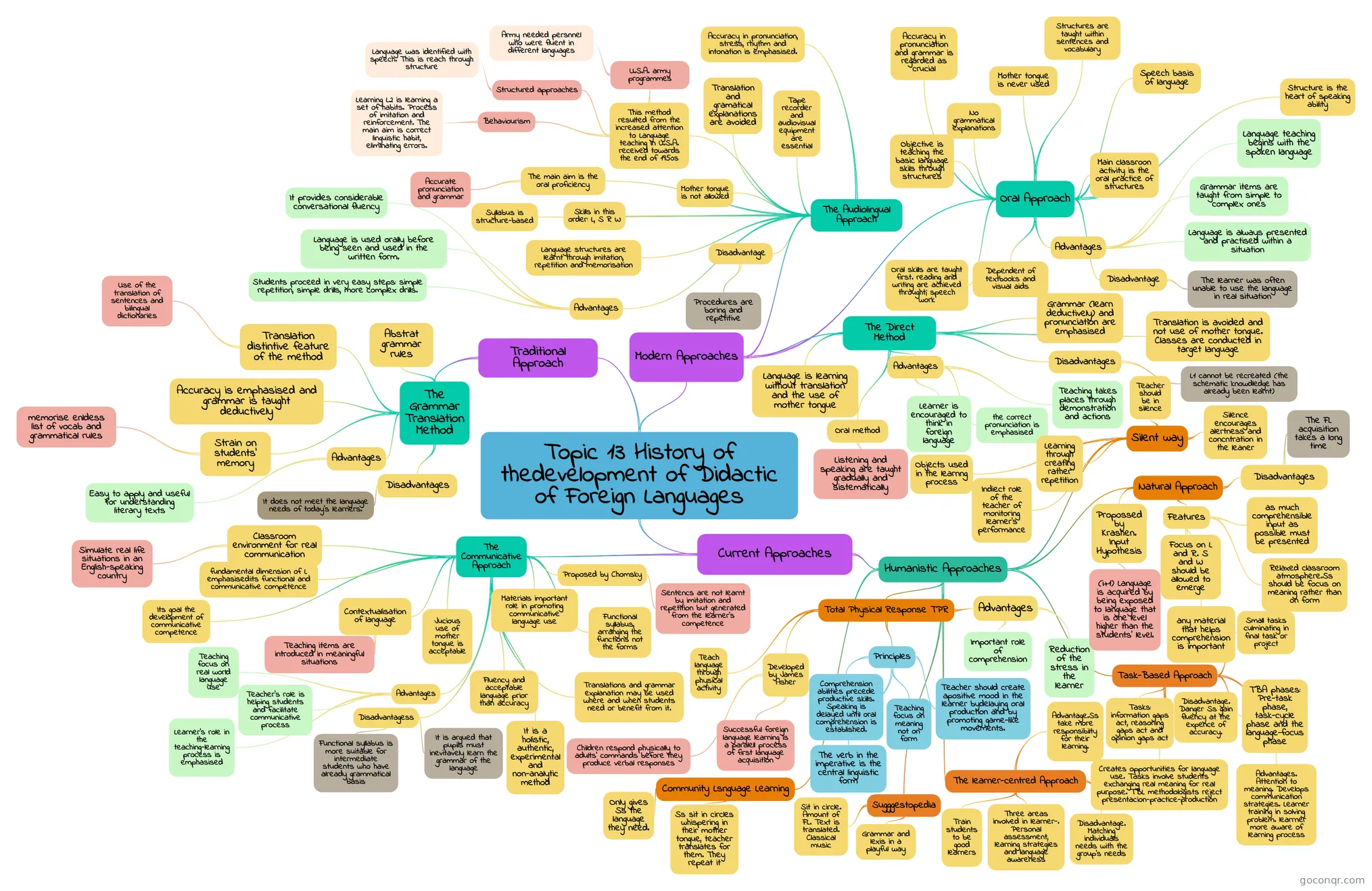
Mind map: History of didactics of foreign languages
Map content
Topic 13 History of thedevelopment of Didactic of Foreign Languages
Traditional Approach
- The Grammar Translation Method
- Abstrat grammar rules
- Translation distintive feature of the method
- Use of the translation of sentences and bilingual dictionaries
- Accuracy is emphasised and grammar is taught deductively
- Strain on students' memory
- memorise enldess list of vocab and grammatical rules
- Advantages
- Easy to apply and useful for understanding literary texts
- Disadvantages
- It does not meet the language needs of today's learners.
- The Grammar Translation Method
Modern Approaches
- The Direct Method
- Language is learning without translation and the use of mother tongue
- Oral method
- Listening and speaking are taught gradually and sistematically
- Grammar (learn deductively) and pronunciation are emphasised
- Translation is avoided and not use of mother tongue. Classes are conducted in target language
- Advantages
- Learner is encouraged to think in foreign language
- the correct pronunciation is emphasised
- Teaching takes places through demonstration and actions
- Disadvantages
- L1 cannot be recreated (the schematic knowdledge has already been learnt)
- Oral Approach
- Speech basis of language
- Structure is the heart of speaking ability
- Main classroon activity is the oral practice of structures
- Structures are taught within sentences and vocabulary
- Objective is teaching the basic language skils through structures
- No grammatical explanations
- Oral skills are taught first. reading and writing are achieved throught¡ speech work
- Dependent of textbooks and visual aids
- Mother tongue is never used
- Accuracy in pronunciation and grammar is regarded as crucial
- Advantages
- Language teaching begins with the spoken language
- Grammar items are taught from simple to complex ones
- Language is always presented and practised within a situation
- Disadvantage
- The learner was often unable to use the language in real situation
- The Audiolingual Approach
- This method resulted from the increased attention to Language teaching in U.S.A. received towards the end of 1950s
- U.S.A. army programmes
- Army needed persnnel who were fluent in different languages
- Structured approaches
- Language was identified with speech. This is reach through structure
- Behaviourism
- Learning L2 is learning a set of habits. Process of imitation and reinforcement. The main aim is correct linguistic habit, eliminating errors.
- U.S.A. army programmes
- The main aim is the oral proficiency
- Accurate pronunciation and grammar
- Skills in this order: L, S R W
- Syllabus is structure-based
- Language structures are learnt through imitation, repetition and memorisation
- Translation and gramatical explanations are avoided
- Mother tongue is not allowed
- Accuracy in pronunciation, stress, rhythm and intonation is emphasised.
- Advantages
- It provides considerable conversational fluency
- Language is used orally before being seen and used in the written form.
- Students proceed in very easy steps: simple repetition, simple drills, more complex drills.
- Disadvantage
- Procedures are boring and repetitive
- Tape recorder and audiovisual equipment are essential
- This method resulted from the increased attention to Language teaching in U.S.A. received towards the end of 1950s
- The Direct Method
Current Approaches
- The Communicative Approach
- Proposed by Chomsky
- Sentencs are not learnt by imitation and repetition but generated from the learner's competence
- Classroom environment for real communication
- Simulate real life situations in an English-speaking country
- fundamental dimension of L emphasised:its functional and communicative competence
- It is a holistic, authentic, experimental and non-analytic method
- Its goal the development of communicative competence
- Contextualisation of language
- Teaching items are introduced in meaningful situations
- Functional syllabus, arranging the functions not the forms
- Translations and grammar explanation may be used where and when students need or benefit from it.
- Fluency and acceptable language prior than accuracy
- Jucious use of mother tongue is acceptable
- Materials important role in promoting communicative language use
- Advantages
- Teaching focus on real world language use
- Learner's role in the teaching-learning process is emphasised
- Teacher's role is helping students and facilitate communicative process
- Disadvantagess
- Functional syllabus is more suitable for intermediate students who have already grammatical basis
- It is argued that pupils must inevitavely learn the grammar of the language
- Proposed by Chomsky
- Humanistic Approaches
- Total Physical Response TPR
- Teach language through physical activity
- Developed by James Asher
- Successful foreign language learning is a paralell process of first language acquisition
- Children respond physically to adults' commands before they produce verbal responses
- Principles
- Comprehension abilities precede productive skills. Speaking is delayed until oral comprehension is established.
- Teaching focus on meaning not on form
- Teacher should create apositive mood in the learner bydelaying oral production and by promoting game-like movements.
- The verb in the imperative is the central linguistic form
- Advantages
- Important role of comprehension
- Reduction of the stress in the learner
- Natural Approach
- Propossed by Krashen. Input Hypothesis
- (i+1) Language is acquired by being exposed to language that is one level higher than the students' level.
- Features
- as much comprehensible input as possible must be presented
- any material that helps comprehension is important
- Focus on L and R. S and W should be allowed to emerge
- Relaxed classroom atmosphere.Ss should be focus on meaning rather than on form
- Disadvantages
- The FL acquisition takes a long time
- Propossed by Krashen. Input Hypothesis
- Silent way
- Teacher should be in silence
- Learning through creating rather repetition
- Objects used in the learnng process
- Silence encourages alertness and concntration in the leaner
- Indiect role of the teacher of monitoring learner's performance
- Community Lsnguage Learning
- Only gives Ss the language they need.
- Ss sit in circles whispering in their mother tongue, teacher translates for them. They repeat it
- Sugggestopedia
- Sit in circle. Amount of FL. Text is translated. Classical music
- Grammar and lexis in a playful way
- The learner-centred Approach
- Train students to be good learners
- Three areas involved in learner-. Personal assessment, learning strategies and language awareness
- Advantage.Ss take more responsibilty for their learning.
- Disadvantage. Matching individuals needs with the group's needs
- Task-Based Approach
- Small tasks culminating in final task or project
- Tasks: information gaps act, reasoning gaps act and opinion gaps act
- TBA phases: Pre-task phase, task-cycle phase and the language-focus phase
- Creates opportunities for language use. Tasks involve students exchanging real meaning for real purpose. TBL methodologists reject presentacion-practice-production
- Advantages. Attention to meaning. Develops communication strategies. Learner training in solving problem. learrner more aware of learning process
- Disadvantage. Danger Ss gain fluency at the expence of accuracy.
- Total Physical Response TPR
- The Communicative Approach
Information
- Description
- Mind map topic 13 falta current approaches
- Created by
- elba vega
- Views
- 263
- Rating