
Mind map
Narrative Theory
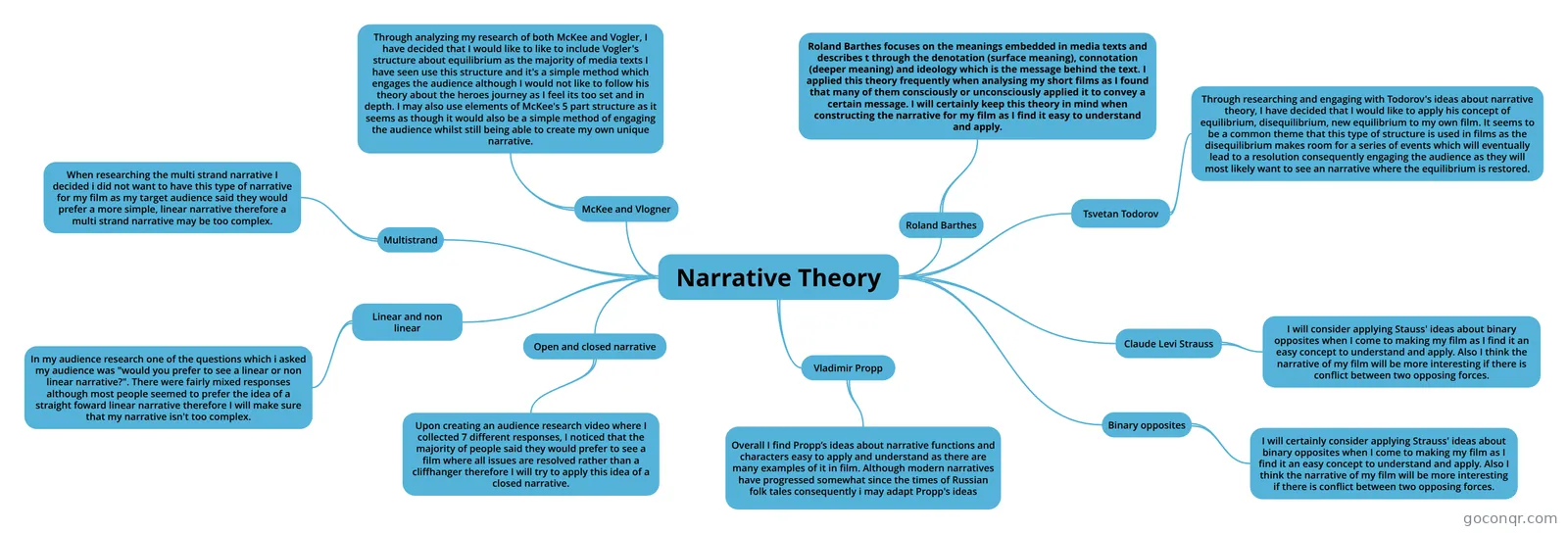
Mind map: Narrative theory
Map content
Narrative Theory
Tsvetan Todorov
- Through researching and engaging with Todorov's ideas about narrative theory, I have decided that I would like to apply his concept of equilibrium, disequilibrium, new equilibrium to my own film. It seems to be a common theme that this type of structure is used in films as the disequilibrium makes room for a series of events which will eventually lead to a resolution consequently engaging the audience as they will most likely want to see an narrative where the equilibrium is restored.
Claude Levi Strauss
- I will consider applying Stauss' ideas about binary opposites when I come to making my film as I find it an easy concept to understand and apply. Also I think the narrative of my film will be more interesting if there is conflict between two opposing forces.
Vladimir Propp
- Overall I find Propp’s ideas about narrative functions and characters easy to apply and understand as there are many examples of it in film. Although modern narratives have progressed somewhat since the times of Russian folk tales consequently i may adapt Propp's ideas
Roland Barthes
- Roland Barthes focuses on the meanings embedded in media texts and describes t through the denotation (surface meaning), connotation (deeper meaning) and ideology which is the message behind the text. I applied this theory frequently when analysing my short films as I found that many of them consciously or unconsciously applied it to convey a certain message. I will certainly keep this theory in mind when constructing the narrative for my film as I find it easy to understand and apply.
McKee and Vlogner
- Through analyzing my research of both McKee and Vogler, I have decided that I would like to like to include Vogler's structure about equilibrium as the majority of media texts I have seen use this structure and it's a simple method which engages the audience although I would not like to follow his theory about the heroes journey as I feel its too set and in depth. I may also use elements of McKee's 5 part structure as it seems as though it would also be a simple method of engaging the audience whilst still being able to create my own unique narrative.
Open and closed narrative
- Upon creating an audience research video where I collected 7 different responses, I noticed that the majority of people said they would prefer to see a film where all issues are resolved rather than a cliffhanger therefore I will try to apply this idea of a closed narrative.
Linear and non linear
- In my audience research one of the questions which i asked my audience was "would you prefer to see a linear or non linear narrative?". There were fairly mixed responses although most people seemed to prefer the idea of a straight foward linear narrative therefore I will make sure that my narrative isn't too complex.
Multistrand
- When researching the multi strand narrative I decided i did not want to have this type of narrative for my film as my target audience said they would prefer a more simple, linear narrative therefore a multi strand narrative may be too complex.
Binary opposites
- I will certainly consider applying Strauss' ideas about binary opposites when I come to making my film as I find it an easy concept to understand and apply. Also I think the narrative of my film will be more interesting if there is conflict between two opposing forces.
Information
- Description
- Mind Map on Narrative Theory, created by Ruth Perry on 15/11/2016.
- Created by
- Ruth Perry
- Views
- 0
- Rating