
Mind map
Cultural Evolution
Map content
Cultural Evolution
EXAMPLES
- Humans: has allowed foragers to occupy a wider ecological range than any other species.
- Dolphins: using puffer fishes to get high. Wear sponges to look nice or fish.
- Chimpanzees: evidence of cultural transmission and social learning.
- BUT: no evidence of CUMULATIVE cultural transmission. Technology remains simple
- Whitnen et.al. 1999
- Whitnen + Schaik 2007: CULTURE PYRAMID.
- Foundation layer: social learning. In most vertebrates and some invertebrates.
- Layer 2: traditions. Only in some whereby social learning is not transitory
- Layer 3: culture. Multiple traditions existing in the same species forming unique local complexes.
- Layer 4: CUMULATIVE culture. Only in humans, whereby more complex traditions arise on elaboration of earlier ones
- Whitnen + Schaik 2007: CULTURE PYRAMID.
- Whitnen et.al. 1999
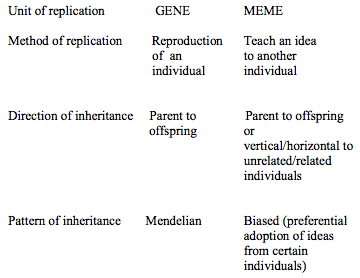
- = Idea transmitted from one indivdiual to another
- BUT: no evidence of CUMULATIVE cultural transmission. Technology remains simple
MEMES
- Dawkins 1976
- “An element of a culture or system of behaviour that may be considered to be passed from one individual to another by non-genetic means, especially imitation.”
- e.g. “tunes, ideas, catch-phrases, clothes fashions, ways of making pots or building arches”
- As replicators
- must have evolutionary interests
- neither nature or nurture - a third way: inherited ideas from others
- CO-EVOLUTION between genes and culture (a cultural trait may affect the evolution of a genetic trait)
CUMULATIVE CULTURAL TRANSMISSION
- = building on earlier culturally transmitted ideas and adding to it
- Neccessary for language, art, technology, complex social institutions
- Sophisticated tools, art etc. emerged in upper Paleolithic - well AFTER modern humans emerged.
- Neccessary for language, art, technology, complex social institutions
- Powell et.al. (2009): POPULATION DENSITY (not just cognitive ability)
- produces enough contact/migratory contact for complex culture to evolve
- Henrich (2004): low population density/ low migratory rates --> inability to learn complex cultural traits.
- e.g. HOLOCENE TASMANIANS. separation from mainland (that had cultural complexity) and decrease in pop size, technology and valuable skills were lost of 8,000 year-period. Probably due to lack of 'cultural parents'.
- Derex et.al. (2013): LAB EXPERIMENT. demonstrated group size maintains and IMPROVES skills in complex tool-making tasks.
- POLITICAL COMPLEXITY
- Is there a regular evolutionary sequence from simple to complex political organisation in human societies?
- Emergence in the PACIFIC
- Studied with the 'AUSTRONESIAN LANGUAGE family' tree
- used 84 LANGUAGES from Austronesian Basic Vocabulary database - and a sample of 1000 trees
- languages matched to 84 SOCIETIES in Ethnographic Atlas
- Used statistical approaches looking for different EVOLUTIONARY PATTERNS. 6 models used.
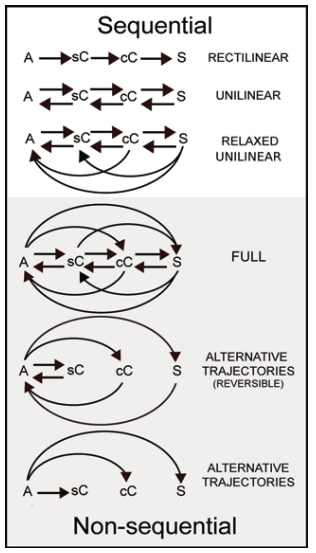
- Models of sequential and non-sequential political evolution
- A = Acephalous (no leader)
- sC = Simple Cheifdom
- cC = Complex Chiefdom
- S = State
- STATISTICAL SUPPORT: Sequential methods had highest BAYES FACTOR (stat method of model selection)
- Societies get more/less complex in a step-wise manner, not all in one go. (decrease in complexity could do this however - a 'collapse in complexity' - relaxed unilinear)
- Models of sequential and non-sequential political evolution
- Currie et.al. 2010
- Studied with the 'AUSTRONESIAN LANGUAGE family' tree
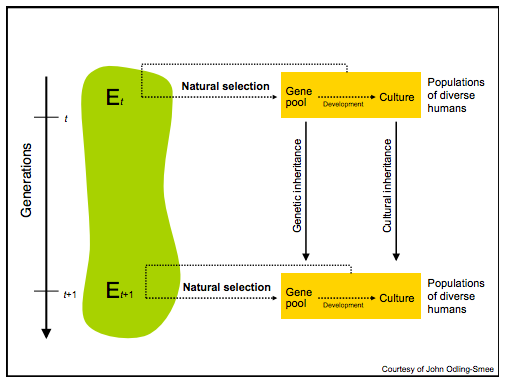
- DUAL INHERITANCE MODEL
- Human behaviour is a product of two evolutionary processes: genetic evolution and cultural evolution
- Culture can be developed within a gene pool de novo, but is also inherited from one gene pool to the next. There is also interaction with natural selection whereby genes and culture co-evolve
- Co-evolution examples
- Lactose-tolerance in Europe and Africa as adaptation to dairying
- Genes against prion brain disease in NewGuinea cannibals
- Alcohol dehydrognease in east Asia as adaptation to rice domestication
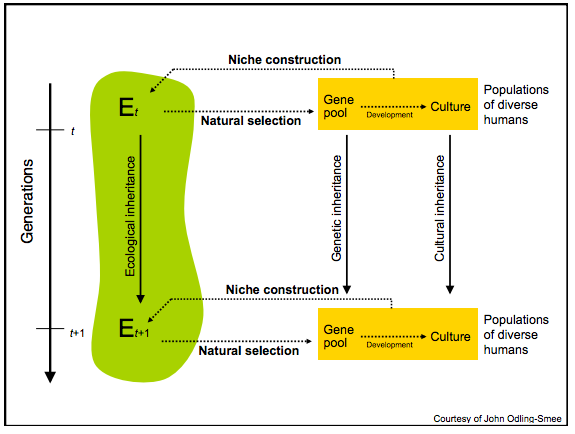
- NICHE CONSTRUCTION
- Dawkins 1982: "extended phenotype". Beavers.
- 3 consequences
- counteract NS
- create novel selection pressures
- another form of inheritance: ecological inheritance (e.g. nest) -> in turn influences genes
- Applications in hominid evolution
- LINEAGE DIVERGENCE
- 1. diff ext environment -> diff selection pressures
- 2. same selection pressure -> one pop niche constructs
- 3. both NS but in different ways
- 4. early NS of one pop due to mutation/discovery -> cause environment to change
- 5. Different kinds of early NS
- RAPID EVOLUTION
- cult transmission homogenises population behaviour + cult traits spread rapidly (via language + non-randomness) -> STRONG SELECTION
- resistant to genetic evolution in response to changing environments?
- BUT: decelerates selection too - counteractive genetic NS
- e.g. improved health care allows the spread of genetic diseases
- cult transmission homogenises population behaviour + cult traits spread rapidly (via language + non-randomness) -> STRONG SELECTION
- LINEAGE DIVERGENCE
- Genes will catch up
- Culture homoginises individuals -> decrease in cultural variant variation -> decrease in cultural evolution rate -> lagging changes in genetic variants increase in importance -> cultural system reaches equilibrium -> gene selection determines shift
- = building on earlier culturally transmitted ideas and adding to it
NATURAL vs. CULTURAL SELECTION
- -Does culture evolve in a Darwinian way? -Does cultural evolution allow us to do unique things? -Why do humans do maladaptive things?
- Perhaps anything to do with cultural evolution is proximate? Hence why some behaviour is evo maladaptive
- Does cultural selection generate behaviour that cannot be explained in a Darwinian framework?
- BIASED CULTURAL TRANSMISSION
- Boyd + Richerson 1985: who we choose to copy matters
- = preferentially copying from certain cultural parents
- DIRECT bias = those with highest returns (i.e.most successful)
- PRESTIGE bias = most respected in society
- MALADAPTIVE BEHAVIOUR
- Cultural variants that aid in attaining influence spread
- Variants can be maladaptive. E.g. famous sportsman takes great risk to health.
- Cultural variants that aid in attaining influence spread
- PRESTIGE MODEL
- People will copy prestigious individuals, even outside their range of expertise
- Skilled individuals have higher prestige
- Prestigious people are memorable
- Prestige associated with different psychology, rather than dominance
- MALADAPTIVE BEHAVIOUR
- CONFORMIST bias = those doing most common strategy
- 'Costly information hypothesis'
- = trade-off between acquiring accurate info at high cost, or less accurate at a lower cost -> NS should select strategies enabling one to extract significant info from others at low cost
- CONTENT BIAS
- acquiring info because seems more appealing
- e.g. learning behaviour that involves resources easily obtainable to you
- acquiring info because seems more appealing
- CONTEXT BIAS
- acquiring info from models
- depends WHO holds ideas and how COMMON they are
- acquiring info from models
- Models: Success + Prestige biases
- Boyd + Richerson
- direct, prestige, conformist bias
- CUES: imitate those who share same ethnic markers -> more likely to fit with own abilities
- kin + trust?
- identifying who to imitate less costly than trial-and-error learning
- GULLIBILITY: believe what previous gen demonstrates because verifying all info too costly
- Conformist Transmission
- allows individuals to aggregate behavioural info of multiple individuals containing effects of own experiences and learning efforts
- good route to adaptation in info-poor environments
- + Cooperation
- cost of alt punishment independent of defector frequency in large pop -> cost of alt punishment decreases as defectors become rare -> alt punishment common -> conformist transmission stabilises punishment -> stabilises cooperation
- stabilised in one group -> cultural group selection -> punishment spread through multi-group pop
- prosocial genes decrease one's risk of punishment -> coop genes spread
- stabilised in one group -> cultural group selection -> punishment spread through multi-group pop
- Guzman et.al.
- cost of alt punishment independent of defector frequency in large pop -> cost of alt punishment decreases as defectors become rare -> alt punishment common -> conformist transmission stabilises punishment -> stabilises cooperation
- allows individuals to aggregate behavioural info of multiple individuals containing effects of own experiences and learning efforts
- CULTURAL GROUP SELECTION
- = heritable variation between groups + intergroup conflict
- genes enabling out competing other groups spread
- MEMES? Not inherited in same way as genes - perhaps group/multi-level selection possible in cultural evolution?
- LINGUISTIC DIVERSITY + SPECIES DIVERSITY
- Language boundaries divide populations culturally, even when genetic distinctions are blurred
- Original ethnoliguistic groups could have begun with as little as 600 individuals
- LINK: same forces causing extinction/diversity cause cultures/languages to die out/diversify
- connection between geographical barriers and language barriers (migration prevented)
- LANGUAGE TREES
- language similarity -> phylogenies of culture
- Why are language trees easier to determine than genetic trees?
- 1. migration -> adopting THEIR language + cultural traits -> offspring will inherit
- Genes will be contributed to the gene pool - own cultural traits will not
- 2. human cultures do not share a habitat (even with diverse and abundant resources) due to intergroup conflict/violence
- e.g. Amazon Rainforest
- 1. migration -> adopting THEIR language + cultural traits -> offspring will inherit
- Language boundaries divide populations culturally, even when genetic distinctions are blurred
- allows evolution of complex group structure
- WARFARE -> GROUP COHESION
- intergroup conflict. e.g. Yanamamo villages with barracades
- MIGRATION: Altruistic group more successful in warfare -> Non-alruistic outsider from other group joins -> their reproductive success increases -> spread in A- -> selection against A+?
- BUT: CONFORMIST BIAS -> immigrants take the form of the majority
- ONLY IF: high rates of group formation + extinction
- Boyd + Richerson
- individual selection FASTER than group selection
- BUT: CONFORMIST BIAS -> immigrants take the form of the majority
- PUNISHMENT -> GROUP COOPERATION
- POLICING + RELIGION -> stable large-scale cooperation between unrelated
- Fehr + Gachter 2003: anonymous public goods game -> cooperation collapses without punishment
- free-riding
- controlled in small populations with low migration
- punishment enables control in larger populations (interdroup migration must still be low)
- Boyd et.al 2003
- altruistic punishment ESS in groups of 600
- Guzman et.al. 2007: CONFORMISM added to model -> also stabilises cooperation in large groups
- larger groups
- reason for xenophobia?
- Boyd et.al 2003
- free-riding
- HUMAN DISTINCTIONS
- = heritable variation between groups + intergroup conflict
- -Does culture evolve in a Darwinian way? -Does cultural evolution allow us to do unique things? -Why do humans do maladaptive things?
Images and files in the map
Information
- Description
- undergraduate Human Behavioural Ecology (Cultural Evolution) Mind Map on Cultural Evolution, created by Janine Brierley on 03/04/2014.
- Created by
- Janine Brierley · Apr 2014
- Updated
- Feb 19, 2016
- Views
- 29
- Tags
- Rating