
Mind map
Cancer 5 (cell cycle & checkpoints)
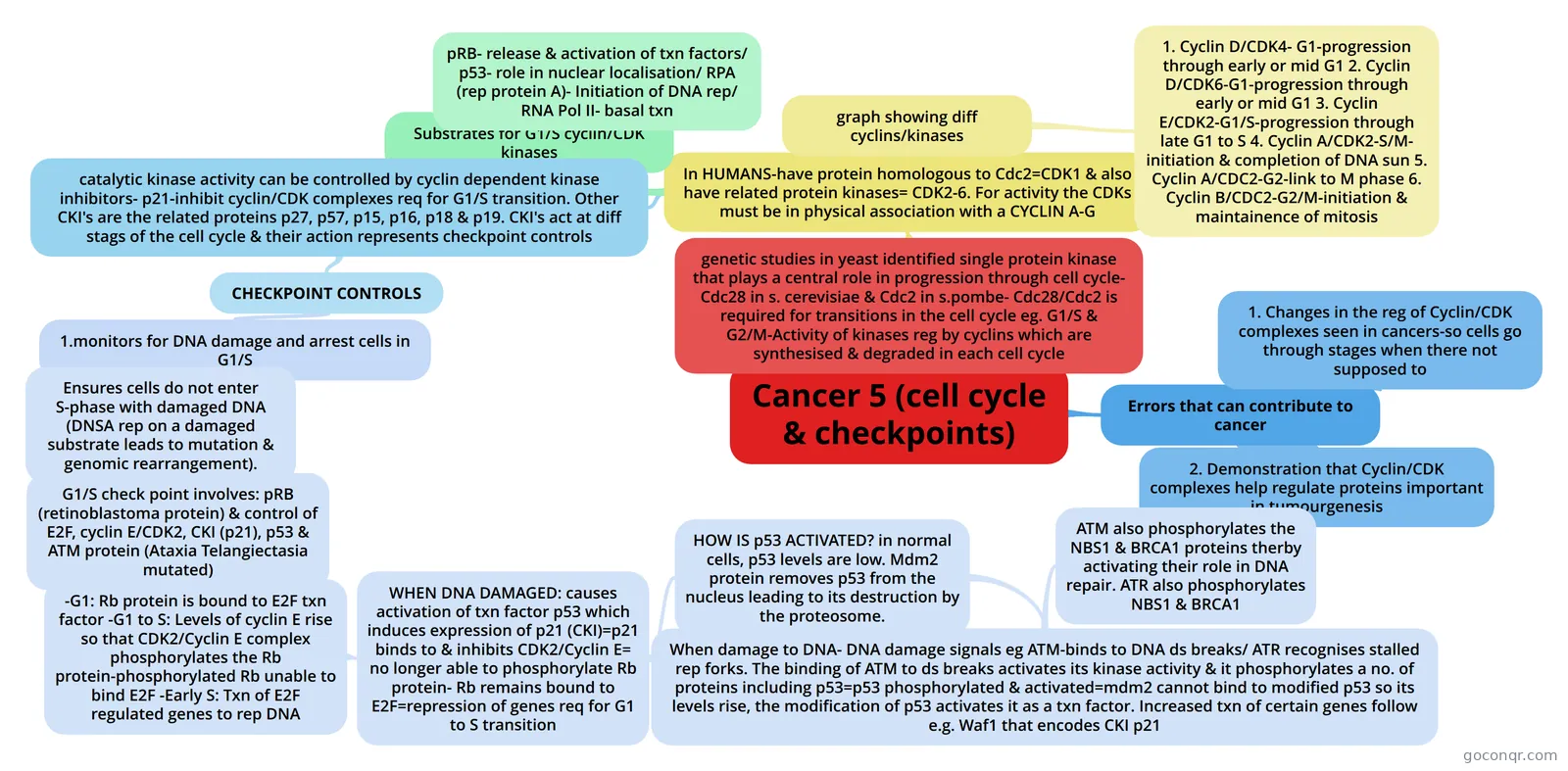
Mind map: cancer cell cycle and checkpoints
Map content
Cancer 5 (cell cycle & checkpoints)
genetic studies in yeast identified single protein kinase that plays a central role in progression through cell cycle- Cdc28 in s. cerevisiae & Cdc2 in s.pombe- Cdc28/Cdc2 is required for transitions in the cell cycle eg. G1/S & G2/M-Activity of kinases reg by cyclins which are synthesised & degraded in each cell cycle
- In HUMANS-have protein homologous to Cdc2=CDK1 & also have related protein kinases= CDK2-6. For activity the CDKs must be in physical association with a CYCLIN A-G
- graph showing diff cyclins/kinases
- 1. Cyclin D/CDK4- G1-progression through early or mid G1 2. Cyclin D/CDK6-G1-progression through early or mid G1 3. Cyclin E/CDK2-G1/S-progression through late G1 to S 4. Cyclin A/CDK2-S/M- initiation & completion of DNA sun 5. Cyclin A/CDC2-G2-link to M phase 6. Cyclin B/CDC2-G2/M-initiation & maintainence of mitosis
- Substrates for G1/S cyclin/CDK kinases
- pRB- release & activation of txn factors/ p53- role in nuclear localisation/ RPA (rep protein A)- Initiation of DNA rep/ RNA Pol II- basal txn
- catalytic kinase activity can be controlled by cyclin dependent kinase inhibitors- p21-inhibit cyclin/CDK complexes req for G1/S transition. Other CKI's are the related proteins p27, p57, p15, p16, p18 & p19. CKI's act at diff stags of the cell cycle & their action represents checkpoint controls
- CHECKPOINT CONTROLS
- 1.monitors for DNA damage and arrest cells in G1/S
- Ensures cells do not enter S-phase with damaged DNA (DNSA rep on a damaged substrate leads to mutation & genomic rearrangement).
- G1/S check point involves: pRB (retinoblastoma protein) & control of E2F, cyclin E/CDK2, CKI (p21), p53 & ATM protein (Ataxia Telangiectasia mutated)
- -G1: Rb protein is bound to E2F txn factor -G1 to S: Levels of cyclin E rise so that CDK2/Cyclin E complex phosphorylates the Rb protein-phosphorylated Rb unable to bind E2F -Early S: Txn of E2F regulated genes to rep DNA
- WHEN DNA DAMAGED: causes activation of txn factor p53 which induces expression of p21 (CKI)=p21 binds to & inhibits CDK2/Cyclin E= no longer able to phosphorylate Rb protein- Rb remains bound to E2F=repression of genes req for G1 to S transition
- HOW IS p53 ACTIVATED? in normal cells, p53 levels are low. Mdm2 protein removes p53 from the nucleus leading to its destruction by the proteosome.
- When damage to DNA- DNA damage signals eg ATM-binds to DNA ds breaks/ ATR recognises stalled rep forks. The binding of ATM to ds breaks activates its kinase activity & it phosphorylates a no. of proteins including p53=p53 phosphorylated & activated=mdm2 cannot bind to modified p53 so its levels rise, the modification of p53 activates it as a txn factor. Increased txn of certain genes follow e.g. Waf1 that encodes CKI p21
- ATM also phosphorylates the NBS1 & BRCA1 proteins therby activating their role in DNA repair. ATR also phosphorylates NBS1 & BRCA1
- When damage to DNA- DNA damage signals eg ATM-binds to DNA ds breaks/ ATR recognises stalled rep forks. The binding of ATM to ds breaks activates its kinase activity & it phosphorylates a no. of proteins including p53=p53 phosphorylated & activated=mdm2 cannot bind to modified p53 so its levels rise, the modification of p53 activates it as a txn factor. Increased txn of certain genes follow e.g. Waf1 that encodes CKI p21
- HOW IS p53 ACTIVATED? in normal cells, p53 levels are low. Mdm2 protein removes p53 from the nucleus leading to its destruction by the proteosome.
- WHEN DNA DAMAGED: causes activation of txn factor p53 which induces expression of p21 (CKI)=p21 binds to & inhibits CDK2/Cyclin E= no longer able to phosphorylate Rb protein- Rb remains bound to E2F=repression of genes req for G1 to S transition
- -G1: Rb protein is bound to E2F txn factor -G1 to S: Levels of cyclin E rise so that CDK2/Cyclin E complex phosphorylates the Rb protein-phosphorylated Rb unable to bind E2F -Early S: Txn of E2F regulated genes to rep DNA
- G1/S check point involves: pRB (retinoblastoma protein) & control of E2F, cyclin E/CDK2, CKI (p21), p53 & ATM protein (Ataxia Telangiectasia mutated)
- Ensures cells do not enter S-phase with damaged DNA (DNSA rep on a damaged substrate leads to mutation & genomic rearrangement).
- 1.monitors for DNA damage and arrest cells in G1/S
- CHECKPOINT CONTROLS
- graph showing diff cyclins/kinases
- In HUMANS-have protein homologous to Cdc2=CDK1 & also have related protein kinases= CDK2-6. For activity the CDKs must be in physical association with a CYCLIN A-G
Errors that can contribute to cancer
- 1. Changes in the reg of Cyclin/CDK complexes seen in cancers-so cells go through stages when there not supposed to
- 2. Demonstration that Cyclin/CDK complexes help regulate proteins important in tumourgenesis
Information
- Description
- Mind Map on Cancer 5 (cell cycle & checkpoints), created by tanitia.dooley on 05/05/2013.
- Created by
- tanitia.dooley
- Views
- 95
- Rating