
Mind map
Elderly and death
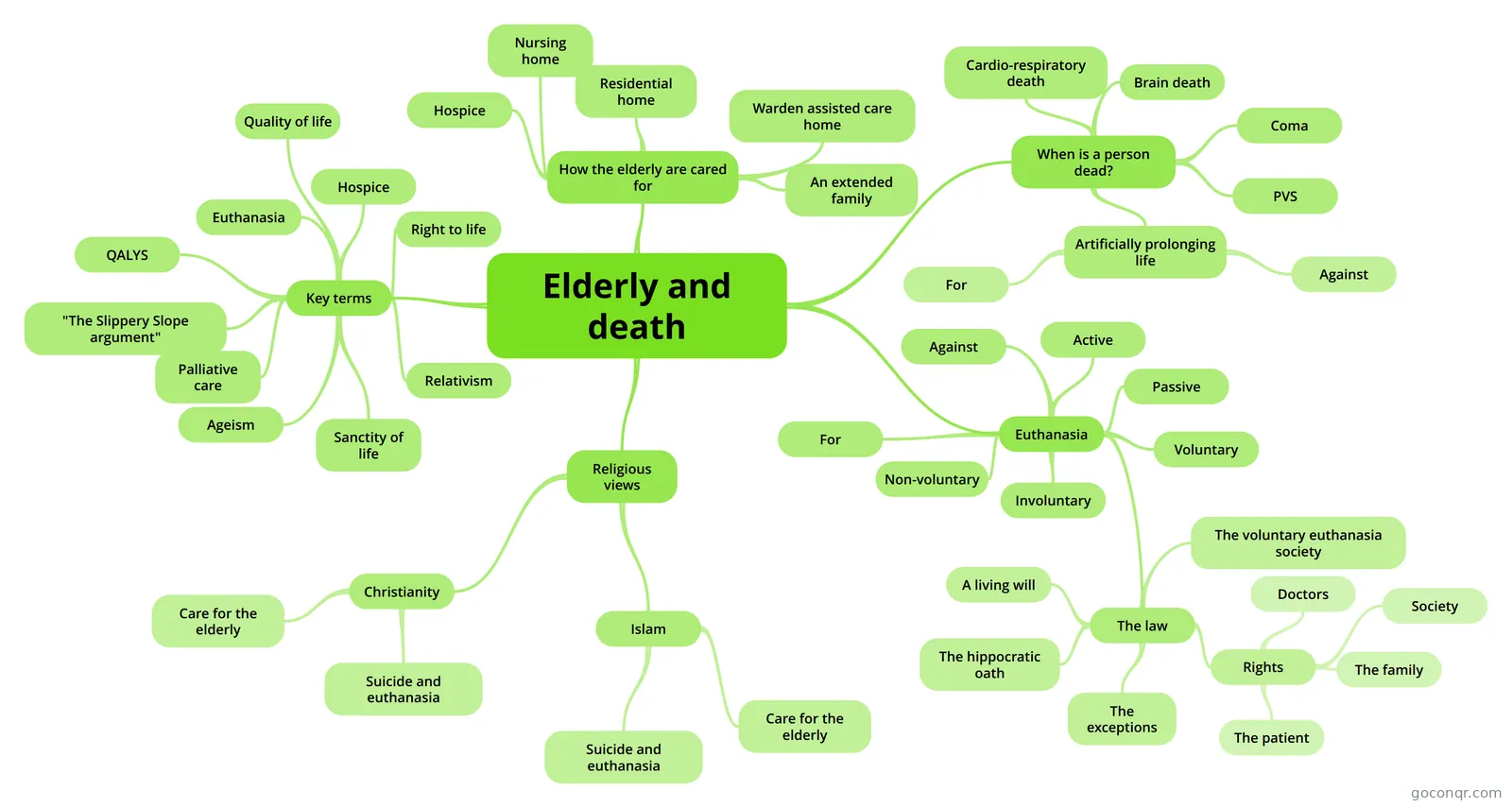
Mind map: Elderly and death
Map content
Elderly and death
Key terms
- Ageism
- Prejudice and discrimination against the elderly
- Palliative care
- Aiming for the best quality of life for the patient and their family
- Euthanasia
- Literally means "good" or "easy" death. Also known as "doctor-assisted suicide"
- Hospice
- A special place to which people go to die with dignity
- Right to life
- The concept that all human life should be protected, no matter what state it is in
- Sanctity of life
- The Christian concept that, as life is a gift from God, it should always be respected. This can be used as a belief from the Catholic church.
- Relativism
- The view that there are no absolute moral rules, so in this case, whether euthanasia is right or wrong depends on the circumstances. This can be used as a belief from the Church of England.
- "The Slippery Slope argument"
- The idea that if we allow some things, (such as killing coma victims), it will lead to further concessions (e.g. ending the lives of demetia patients).
- QALYS
- Quality Adjusted Life Year Schedule, a US score you are given, based on your condition, chance of receovery and life expectancy, used to prioritise care and treatment.
- Quality of life
- A measure of fulfilment in life; this could relate to how much pain and suffering is present
- Ageism
How the elderly are cared for
- Hospice
- A place where the terminally ill are treated. The aim of the hospice is to relieve suffering, not to cure. Several generations live together
- Nursing home
- A place that provides 24 hour care, often for elderly people who are very frail, of have mental/physical disabilities
- Residential home
- A place that provides more care than warden conrolled, often with communal meals and activities
- Warden assisted care home
- A place where residents have some independence, but with help available, 24 hours a day
- An extended family
- When several generations live together
- Hospice
When is a person dead?
- Cardio-respiratory death
- The heart stops beating and/or the lungs stop working
- Brain death
- Refers to someone who has an irreversible loss of all brain function. They cannot breathe without the help of a machine.
- Coma
- A comatose person is someone who cannot be awakened, fails to respond normally to pain or light, does not have sleep-wake cycles, and does not take voluntary actions
- PVS
- Persistent vegetative state- a condition of patients in which the brain stem is still alive and the person still breathes without help. They are, however, completely unaware of themselves and their environment
- Artificially prolonging life
- Against
- Sometimes coma victims may never regain consciousness
- victims may partially recover but have permanent brain damage
- For
- Someone may eb in a coma for weeks and make a full recovery with rehabilitation programmes.
- Against
- Cardio-respiratory death
Euthanasia
- Active
- Occurs in thos instances in which someone takes active means such as lethal injection, to bring about someone's death
- Passive
- Occurs in those instances in which someone simply refuses to intervene in order to prevent someone's death e.g. withdrawing life support machines
- Voluntary
- The patient chooses to be put to death e.g. someone suffering from an incurable illness
- Involuntary
- Someone else makes the decision e.g. doctor, without their permission or against their will
- Non-voluntary
- The patient is unable to make a choice at all
- The law
- The hippocratic oath
- "I will use treatment to help the sick according to my ability and judgement, but never to a view to injury and wrongdoing. Neither will I administer a poison to anybody when asked to do so, nor will I suggest such a course
- The oath make sit impossible for doctors to practice euthanasia, but many doctors support a change in the law and would be prepared to carry it out if the law allowed
- The exceptions
- Consent is sometimes given to turn off life-support machines when a person is already dead
- A doctor may decide to give drugs that ease pain but bring death nearer as a consequence (double effect)
- Rights
- The patient
- Should the patient have the right to self-determination (being able to decide for themselves what happends to them)
- Do they need protection form making a decision, which once acted upon cannot be reversed
- The family
- It is not easy to see a loved one in pain and suffering.
- Would some people act out of self-interest or greed (e.g. inheriting lots of money)
- Doctors
- Should doctors have the right to be able to end a life through treatment by e.g. a legal injection
- Society
- keeping alive thousands of suffering people costs a lot of money. Is it right to expect society to pay when there is no hope of them recovering
- The patient
- The voluntary euthanasia society
- A pressure group who takes the view that people should have the right to make their own decision about their own death
- A living will
- A declaration that a person does not want their life artificially prolonged in the event of terminal illness or a permanent state of unconsciousness
- The hippocratic oath
- For
- Death with dignity is better than a long lingering painful death
- We put down other animals rather than let then suffer, so why refuse the same merciful release to human beings?
- Shouldn't everyone have the right to a good quality of life and to choose how he/she lives and dies?
- Doctors are aware when there is no hope for recovery and when a patient is in great pain
- Despite the law, a survey published in 1994 in the British medical journal showed that some doctors are prepared to help patients to die
- Against
- Every person has the right to live
- The doctors may make an incorrect diagnosis. People have recovered after being "written off" as incurable
- Some people think that euthanasia is a type of murder
- It would be wrong ot expect doctors to kill their patients. The Hippocratic oath expressly forbids it
- What is needed is love and care for the elderly, not an instant end ot their lives
- Active
Religious views
- Islam
- Care for the elderly
- Muslims consider it an honour, blessing and opportunity for great spiritual growth to look after and care for parents
- Serving one's parents is a duty second to prayer
- It is unkind and disrespectful to sed your parents to a home
- Suicide and euthanasia
- "Allah fixes the time span for all things" (Surah 53)
- "When their term expires, they would not be able to delay for a single hour, just as they would not be able to anticipate it. (Surah 16:61)
- Allah created life and it is He alone who should decide whether you live or die. To decide when a person should die is to "play God". Life is a sacred gift from Allah and Allah has decided how long we should live
- Suffering is for a purpose, so if a person is in pain, this is not a reason for euthanasia. If a person suffers it is the will fo Allah who is testing them. As Allah is compassionate, endurance and patience brings reward.
- Care for the elderly
- Christianity
- Care for the elderly
- The bible emphasises the importance of treating the elderly with and Christians are encouraged to provide love and care for their elderly relatives
- Many christian churches provide visitors, senior citizen groups, homes or sheltered accomodation.
- Local christian groups may provide special outings or gift parcels for the elderly and care and support in hospices
- Suicide and euthanasia
- Life is a sacred gift from God and as such should be respected.
- To take a human life is murder and is against the commandment "thou shalt not kill"
- Acts 17:26 say that God has fixed our life span. God gives life and so he alone has the right to take it away. Suicide is therefore regarded as wrong
- Quakers will biry those who take their own life and do not hold the view that it is a sin and thus they should not be buried.
- Some Christians believe that it is extremely important to show compassion to those who are suffering, in extreme cases of suffering no further active treatment to prolong life should be given
- Care for the elderly
- Islam
Information
- Description
- T.E (Elderly and death) Mind Map on Elderly and death, created by sammyjaygleek on 09/05/2013.
- Created by
- sammyjaygleek
- Views
- 69
- Tags
- Rating