
Mind map
Arctic
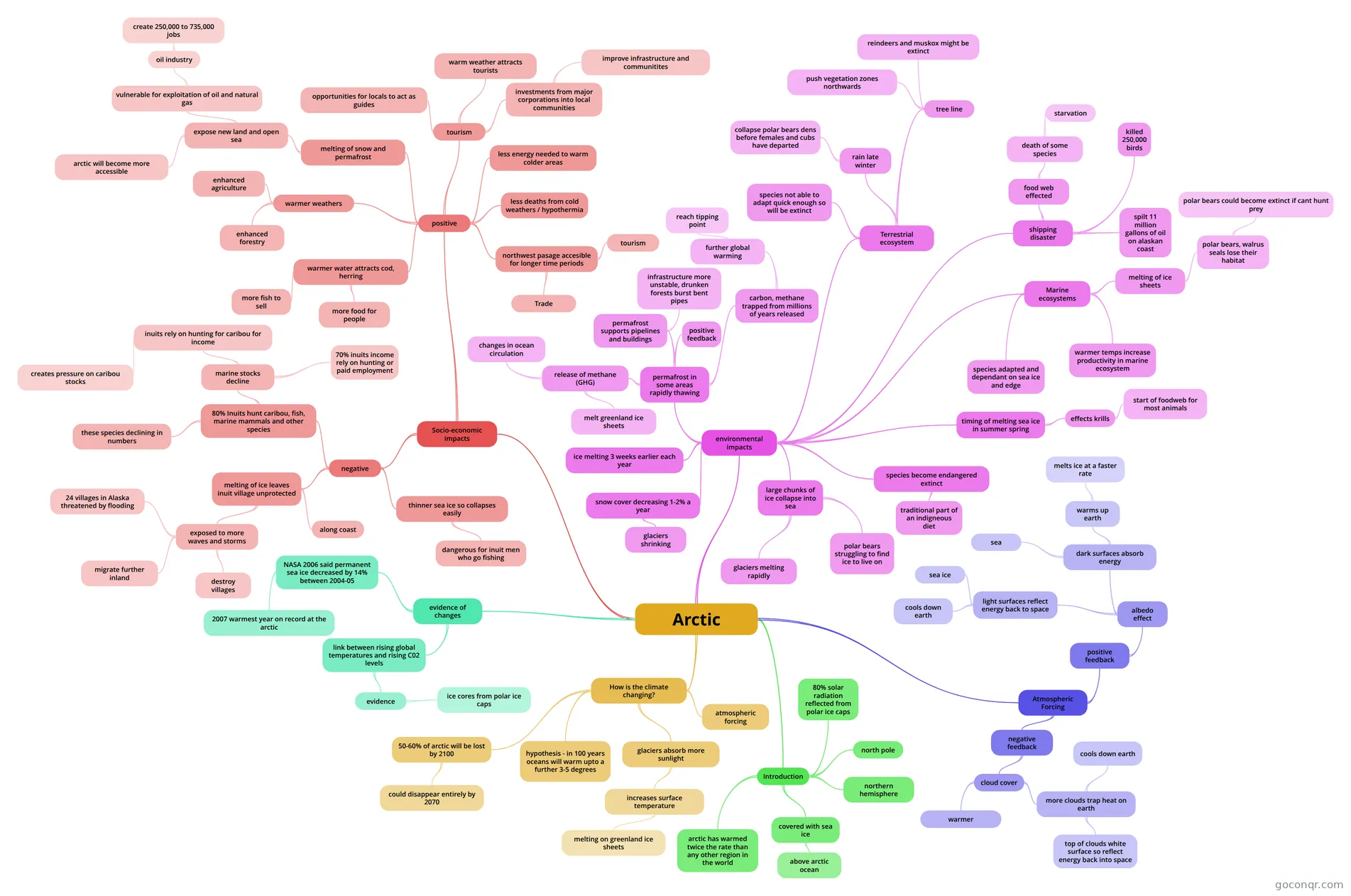
Mind map: Arctic climate change
Map content
Arctic
Atmospheric Forcing
- positive feedback
- albedo effect
- light surfaces reflect energy back to space
- sea ice
- cools down earth
- dark surfaces absorb energy
- sea
- warms up earth
- melts ice at a faster rate
- light surfaces reflect energy back to space
- albedo effect
- negative feedback
- cloud cover
- more clouds trap heat on earth
- cools down earth
- top of clouds white surface so reflect energy back into space
- warmer
- more clouds trap heat on earth
- cloud cover
- positive feedback
Introduction
- north pole
- northern hemisphere
- covered with sea ice
- above arctic ocean
- arctic has warmed twice the rate than any other region in the world
- 80% solar radiation reflected from polar ice caps
How is the climate changing?
- atmospheric forcing
- glaciers absorb more sunlight
- increases surface temperature
- melting on greenland ice sheets
- increases surface temperature
- hypothesis - in 100 years oceans will warm upto a further 3-5 degrees
- 50-60% of arctic will be lost by 2100
- could disappear entirely by 2070
evidence of changes
- link between rising global temperatures and rising C02 levels
- evidence
- ice cores from polar ice caps
- evidence
- NASA 2006 said permanent sea ice decreased by 14% between 2004-05
- 2007 warmest year on record at the arctic
- link between rising global temperatures and rising C02 levels
Socio-economic impacts
- negative
- thinner sea ice so collapses easily
- dangerous for inuit men who go fishing
- melting of ice leaves inuit village unprotected
- along coast
- exposed to more waves and storms
- destroy villages
- migrate further inland
- 24 villages in Alaska threatened by flooding
- 80% Inuits hunt caribou, fish, marine mammals and other species
- these species declining in numbers
- marine stocks decline
- inuits rely on hunting for caribou for income
- creates pressure on caribou stocks
- 70% inuits income rely on hunting or paid employment
- inuits rely on hunting for caribou for income
- thinner sea ice so collapses easily
- positive
- warmer water attracts cod, herring
- more food for people
- more fish to sell
- warmer weathers
- enhanced forestry
- enhanced agriculture
- melting of snow and permafrost
- expose new land and open sea
- arctic will become more accessible
- vulnerable for exploitation of oil and natural gas
- oil industry
- create 250,000 to 735,000 jobs
- oil industry
- expose new land and open sea
- tourism
- opportunities for locals to act as guides
- warm weather attracts tourists
- investments from major corporations into local communities
- improve infrastructure and communitites
- less energy needed to warm colder areas
- less deaths from cold weathers / hypothermia
- northwest pasage accesible for longer time periods
- tourism
- Trade
- warmer water attracts cod, herring
- negative
environmental impacts
- large chunks of ice collapse into sea
- glaciers melting rapidly
- polar bears struggling to find ice to live on
- species become endangered extinct
- traditional part of an indigneous diet
- timing of melting sea ice in summer spring
- effects krills
- start of foodweb for most animals
- effects krills
- permafrost in some areas rapidly thawing
- release of methane (GHG)
- melt greenland ice sheets
- changes in ocean circulation
- permafrost supports pipelines and buildings
- infrastructure more unstable, drunken forests burst bent pipes
- carbon, methane trapped from millions of years released
- further global warming
- reach tipping point
- further global warming
- positive feedback
- release of methane (GHG)
- snow cover decreasing 1-2% a year
- glaciers shrinking
- ice melting 3 weeks earlier each year
- Marine ecosystems
- species adapted and dependant on sea ice and edge
- warmer temps increase productivity in marine ecosystem
- melting of ice sheets
- polar bears, walrus seals lose their habitat
- polar bears could become extinct if cant hunt prey
- polar bears, walrus seals lose their habitat
- Terrestrial ecosystem
- species not able to adapt quick enough so will be extinct
- rain late winter
- collapse polar bears dens before females and cubs have departed
- tree line
- push vegetation zones northwards
- reindeers and muskox might be extinct
- shipping disaster
- spilt 11 million gallons of oil on alaskan coast
- killed 250,000 birds
- food web effected
- death of some species
- starvation
- death of some species
- large chunks of ice collapse into sea
Information
- Description
- Mind Map on Arctic, created by tahseen_365 on 11/05/2013.
- Created by
- tahseen_365
- Views
- 46
- Rating