
Mind map
Edgar Degas
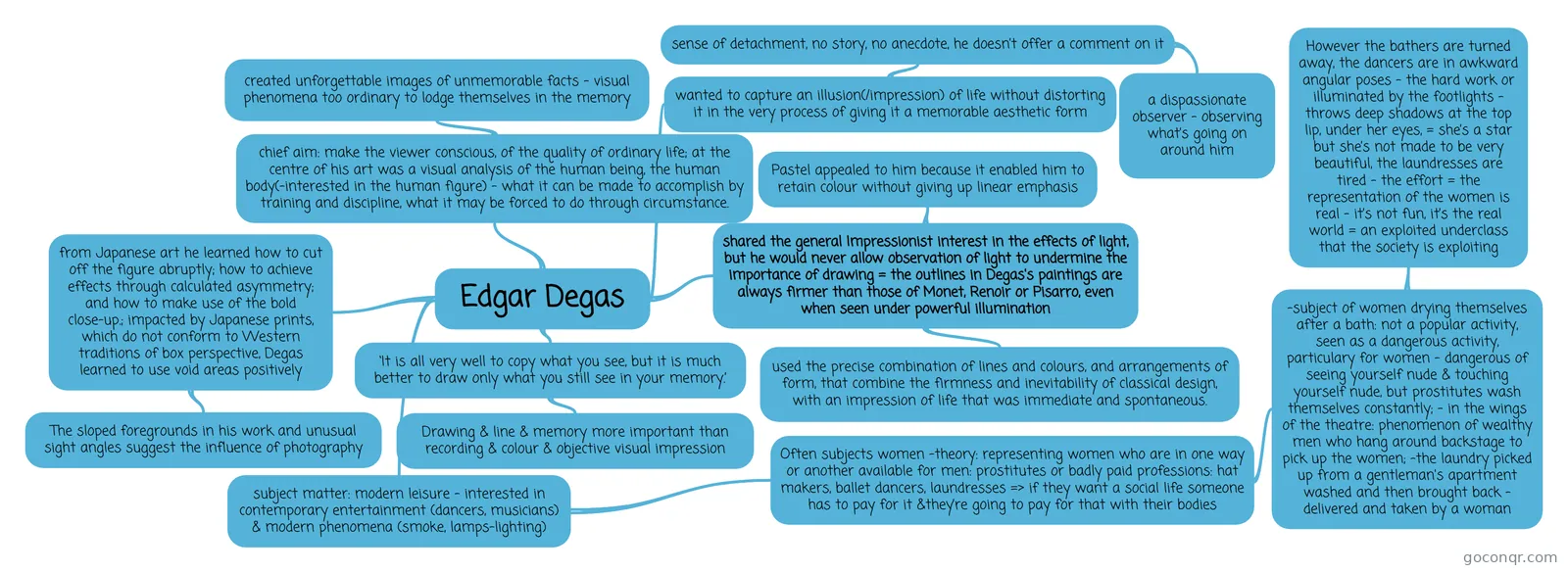
Mind map: Edgar Degas
Map content
Edgar Degas
‘It is all very well to copy what you see, but it is much better to draw only what you still see in your memory.’
- Drawing & line & memory more important than recording & colour & objective visual impression
shared the general Impressionist interest in the effects of light, but he would never allow observation of light to undermine the importance of drawing = the outlines in Degas's paintings are always firmer than those of Monet, Renoir or Pisarro, even when seen under powerful illumination
- Pastel appealed to him because it enabled him to retain colour without giving up linear emphasis
- used the precise combination of lines and colours, and arrangements of form, that combine the firmness and inevitability of classical design, with an impression of life that was immediate and spontaneous.
chief aim: make the viewer conscious, of the quality of ordinary life; at the centre of his art was a visual analysis of the human being, the human body(-interested in the human figure) - what it can be made to accomplish by training and discipline, what it may be forced to do through circumstance.
- created unforgettable images of unmemorable facts – visual phenomena too ordinary to lodge themselves in the memory
wanted to capture an illusion(/impression) of life without distorting it in the very process of giving it a memorable aesthetic form
- sense of detachment, no story, no anecdote, he doesn’t offer a comment on it
- a dispassionate observer - observing what’s going on around him
- sense of detachment, no story, no anecdote, he doesn’t offer a comment on it
from Japanese art he learned how to cut off the figure abruptly; how to achieve effects through calculated asymmetry; and how to make use of the bold close-up.; impacted by Japanese prints, which do not conform to Western traditions of box perspective, Degas learned to use void areas positively
- The sloped foregrounds in his work and unusual sight angles suggest the influence of photography
subject matter: modern leisure - interested in contemporary entertainment (dancers, musicians) & modern phenomena (smoke, lamps-lighting)
- Often subjects women –theory: representing women who are in one way or another available for men: prostitutes or badly paid professions: hat makers, ballet dancers, laundresses => if they want a social life someone has to pay for it &they’re going to pay for that with their bodies
- -subject of women drying themselves after a bath: not a popular activity, seen as a dangerous activity, particulary for women – dangerous of seeing yourself nude & touching yourself nude, but prostitutes wash themselves constantly; - in the wings of the theatre: phenomenon of wealthy men who hang around backstage to pick up the women; -the laundry picked up from a gentleman's apartment washed and then brought back – delivered and taken by a woman
- However the bathers are turned away, the dancers are in awkward angular poses – the hard work or illuminated by the footlights - throws deep shadows at the top lip, under her eyes, = she’s a star but she’s not made to be very beautiful, the laundresses are tired - the effort = the representation of the women is real – it’s not fun, it’s the real world = an exploited underclass that the society is exploiting
- -subject of women drying themselves after a bath: not a popular activity, seen as a dangerous activity, particulary for women – dangerous of seeing yourself nude & touching yourself nude, but prostitutes wash themselves constantly; - in the wings of the theatre: phenomenon of wealthy men who hang around backstage to pick up the women; -the laundry picked up from a gentleman's apartment washed and then brought back – delivered and taken by a woman
- Often subjects women –theory: representing women who are in one way or another available for men: prostitutes or badly paid professions: hat makers, ballet dancers, laundresses => if they want a social life someone has to pay for it &they’re going to pay for that with their bodies
Information
- Description
- Mind Map on Edgar Degas, created by Sandra Porenta on 24/04/2017.
- Created by
- Sandra Porenta
- Views
- 0
- Rating