
Mind map
Van Gogh (Post Impressionism)
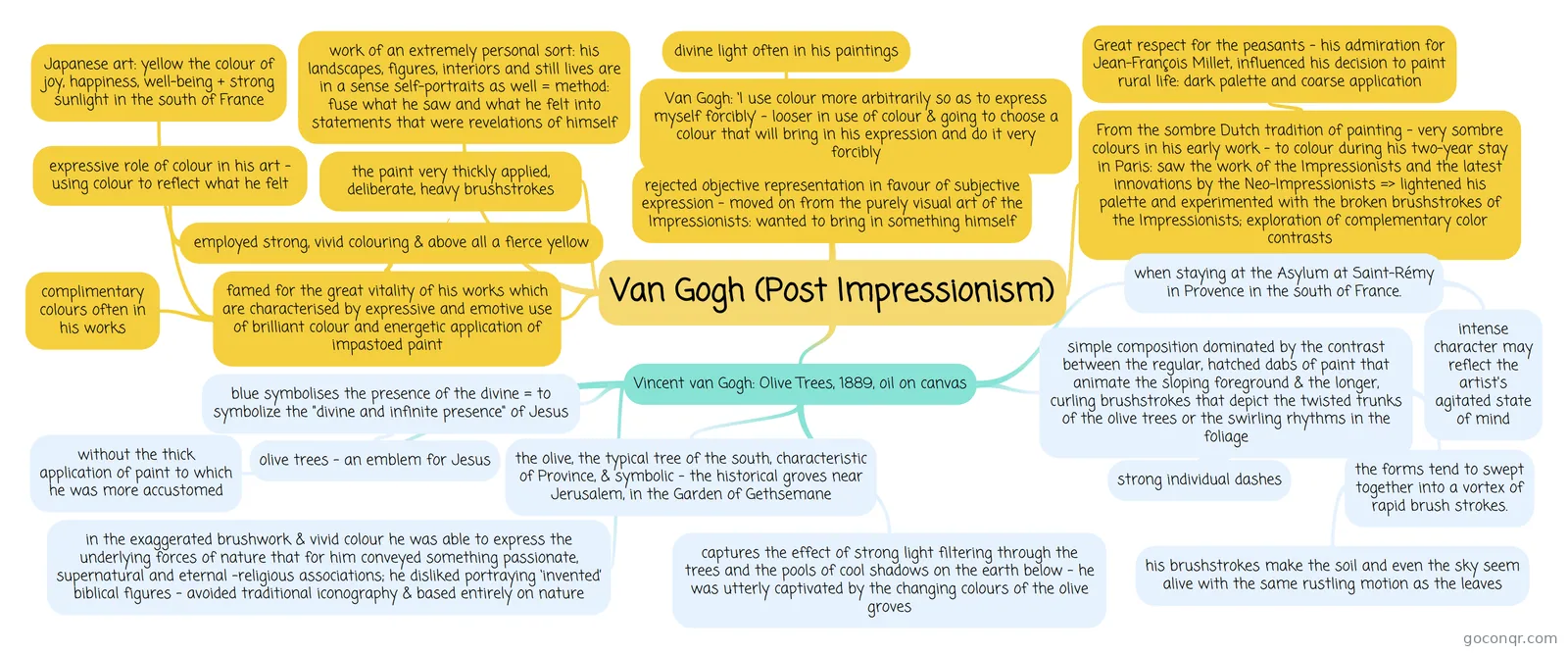
Mind map: Van Gogh (Post Impressionism)
Map content
Van Gogh (Post Impressionism)
the paint very thickly applied, deliberate, heavy brushstrokes
rejected objective representation in favour of subjective expression - moved on from the purely visual art of the Impressionists: wanted to bring in something himself
- Van Gogh: ‘I use colour more arbitrarily so as to express myself forcibly’ – looser in use of colour & going to choose a colour that will bring in his expression and do it very forcibly
famed for the great vitality of his works which are characterised by expressive and emotive use of brilliant colour and energetic application of impastoed paint
- employed strong, vivid colouring & above all a fierce yellow
- Japanese art: yellow the colour of joy, happiness, well-being + strong sunlight in the south of France
- expressive role of colour in his art - using colour to reflect what he felt
- complimentary colours often in his works
- employed strong, vivid colouring & above all a fierce yellow
work of an extremely personal sort: his landscapes, figures, interiors and still lives are in a sense self-portraits as well = method: fuse what he saw and what he felt into statements that were revelations of himself
From the sombre Dutch tradition of painting - very sombre colours in his early work - to colour during his two-year stay in Paris: saw the work of the Impressionists and the latest innovations by the Neo-Impressionists => lightened his palette and experimented with the broken brushstrokes of the Impressionists; exploration of complementary color contrasts
- Great respect for the peasants - his admiration for Jean-François Millet, influenced his decision to paint rural life: dark palette and coarse application
divine light often in his paintings
Vincent van Gogh: Olive Trees, 1889, oil on canvas
- when staying at the Asylum at Saint-Rémy in Provence in the south of France.
- intense character may reflect the artist's agitated state of mind
- simple composition dominated by the contrast between the regular, hatched dabs of paint that animate the sloping foreground & the longer, curling brushstrokes that depict the twisted trunks of the olive trees or the swirling rhythms in the foliage
- the forms tend to swept together into a vortex of rapid brush strokes.
- his brushstrokes make the soil and even the sky seem alive with the same rustling motion as the leaves
- strong individual dashes
- the forms tend to swept together into a vortex of rapid brush strokes.
- captures the effect of strong light filtering through the trees and the pools of cool shadows on the earth below - he was utterly captivated by the changing colours of the olive groves
- in the exaggerated brushwork & vivid colour he was able to express the underlying forces of nature that for him conveyed something passionate, supernatural and eternal -religious associations; he disliked portraying ‘invented’ biblical figures - avoided traditional iconography & based entirely on nature
- the olive, the typical tree of the south, characteristic of Province, & symbolic – the historical groves near Jerusalem, in the Garden of Gethsemane
- blue symbolises the presence of the divine = to symbolize the "divine and infinite presence" of Jesus
- olive trees - an emblem for Jesus
- without the thick application of paint to which he was more accustomed
- when staying at the Asylum at Saint-Rémy in Provence in the south of France.
Information
- Description
- Mind Map on Van Gogh (Post Impressionism), created by Sandra Porenta on 27/04/2017.
- Created by
- Sandra Porenta
- Views
- 3
- Rating