
Mind map
Chapter 9- Managerial Decision Making
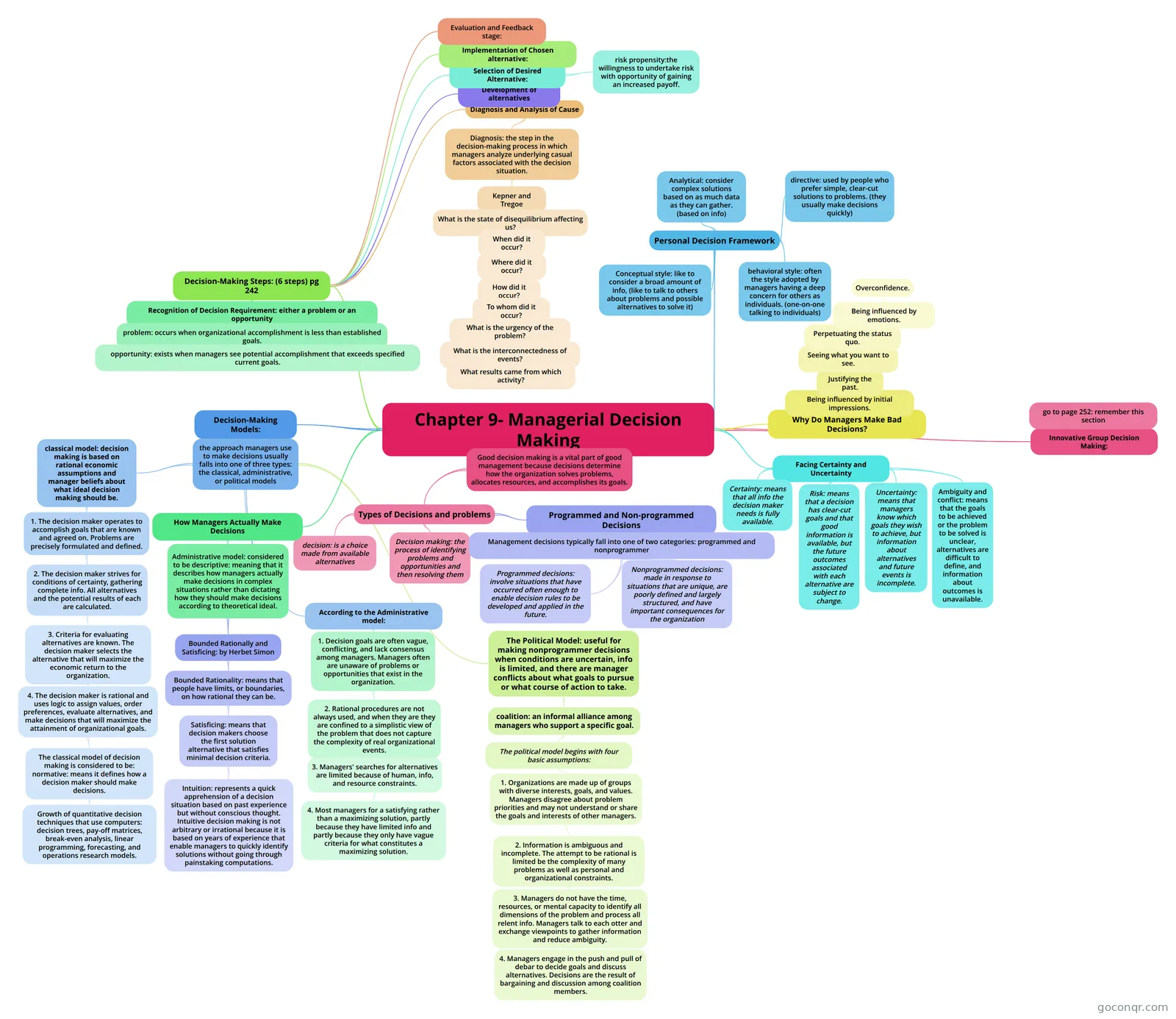
Mind map: managerial decision making
Map content
Chapter 9- Managerial Decision Making
Good decision making is a vital part of good management because decisions determine how the organization solves problems, allocates resources, and accomplishes its goals.
- Types of Decisions and problems
- decision: is a choice made from available alternatives
- Decision making: the process of identifying problems and opportunities and then resolving them
- Programmed and Non-programmed Decisions
- Management decisions typically fall into one of two categories: programmed and nonprogrammer
- Programmed decisions: involve situations that have occurred often enough to enable decision rules to be developed and applied in the future.
- Nonprogrammed decisions: made in response to situations that are unique, are poorly defined and largely structured, and have important consequences for the organization
- Management decisions typically fall into one of two categories: programmed and nonprogrammer
- Types of Decisions and problems
Facing Certainty and Uncertainty
- Certainty: means that all info the decision maker needs is fully available.
- Risk: means that a decision has clear-cut goals and that good information is available, but the future outcomes associated with each alternative are subject to change.
- Uncertainty: means that managers know which goals they wish to achieve, but information about alternatives and future events is incomplete.
- Ambiguity and conflict: means that the goals to be achieved or the problem to be solved is unclear, alternatives are difficult to define, and information about outcomes is unavailable.
Decision-Making Models:
- the approach managers use to make decisions usually falls into one of three types: the classical, administrative, or political models
- classical model: decision making is based on rational economic assumptions and manager beliefs about what ideal decision making should be.
- 1. The decision maker operates to accomplish goals that are known and agreed on. Problems are precisely formulated and defined.
- 2. The decision maker strives for conditions of certainty, gathering complete info. All alternatives and the potential results of each are calculated.
- 3. Criteria for evaluating alternatives are known. The decision maker selects the alternative that will maximize the economic return to the organization.
- 4. The decision maker is rational and uses logic to assign values, order preferences, evaluate alternatives, and make decisions that will maximize the attainment of organizational goals.
- The classical model of decision making is considered to be: normative: means it defines how a decision maker should make decisions.
- Growth of quantitative decision techniques that use computers: decision trees, pay-off matrices, break-even analysis, linear programming, forecasting, and operations research models.
- The classical model of decision making is considered to be: normative: means it defines how a decision maker should make decisions.
- 4. The decision maker is rational and uses logic to assign values, order preferences, evaluate alternatives, and make decisions that will maximize the attainment of organizational goals.
- 3. Criteria for evaluating alternatives are known. The decision maker selects the alternative that will maximize the economic return to the organization.
- 2. The decision maker strives for conditions of certainty, gathering complete info. All alternatives and the potential results of each are calculated.
- 1. The decision maker operates to accomplish goals that are known and agreed on. Problems are precisely formulated and defined.
- According to the Administrative model:
- 1. Decision goals are often vague, conflicting, and lack consensus among managers. Managers often are unaware of problems or opportunities that exist in the organization.
- 2. Rational procedures are not always used, and when they are they are confined to a simplistic view of the problem that does not capture the complexity of real organizational events.
- 3. Managers' searches for alternatives are limited because of human, info, and resource constraints.
- 4. Most managers for a satisfying rather than a maximizing solution, partly because they have limited info and partly because they only have vague criteria for what constitutes a maximizing solution.
- 3. Managers' searches for alternatives are limited because of human, info, and resource constraints.
- 2. Rational procedures are not always used, and when they are they are confined to a simplistic view of the problem that does not capture the complexity of real organizational events.
- 1. Decision goals are often vague, conflicting, and lack consensus among managers. Managers often are unaware of problems or opportunities that exist in the organization.
- The Political Model: useful for making nonprogrammer decisions when conditions are uncertain, info is limited, and there are manager conflicts about what goals to pursue or what course of action to take.
- coalition: an informal alliance among managers who support a specific goal.
- The political model begins with four basic assumptions:
- 1. Organizations are made up of groups with diverse interests, goals, and values. Managers disagree about problem priorities and may not understand or share the goals and interests of other managers.
- 2. Information is ambiguous and incomplete. The attempt to be rational is limited be the complexity of many problems as well as personal and organizational constraints.
- 3. Managers do not have the time, resources, or mental capacity to identify all dimensions of the problem and process all relent info. Managers talk to each otter and exchange viewpoints to gather information and reduce ambiguity.
- 4. Managers engage in the push and pull of debar to decide goals and discuss alternatives. Decisions are the result of bargaining and discussion among coalition members.
- 3. Managers do not have the time, resources, or mental capacity to identify all dimensions of the problem and process all relent info. Managers talk to each otter and exchange viewpoints to gather information and reduce ambiguity.
- 2. Information is ambiguous and incomplete. The attempt to be rational is limited be the complexity of many problems as well as personal and organizational constraints.
- 1. Organizations are made up of groups with diverse interests, goals, and values. Managers disagree about problem priorities and may not understand or share the goals and interests of other managers.
- The political model begins with four basic assumptions:
- coalition: an informal alliance among managers who support a specific goal.
- classical model: decision making is based on rational economic assumptions and manager beliefs about what ideal decision making should be.
- the approach managers use to make decisions usually falls into one of three types: the classical, administrative, or political models
How Managers Actually Make Decisions
- Administrative model: considered to be descriptive: meaning that it describes how managers actually make decisions in complex situations rather than dictating how they should make decisions according to theoretical ideal.
- Bounded Rationally and Satisficing: by Herbet Simon
- Bounded Rationality: means that people have limits, or boundaries, on how rational they can be.
- Satisficing: means that decision makers choose the first solution alternative that satisfies minimal decision criteria.
- Intuition: represents a quick apprehension of a decision situation based on past experience but without conscious thought. Intuitive decision making is not arbitrary or irrational because it is based on years of experience that enable managers to quickly identify solutions without going through painstaking computations.
- Satisficing: means that decision makers choose the first solution alternative that satisfies minimal decision criteria.
- Bounded Rationality: means that people have limits, or boundaries, on how rational they can be.
- Bounded Rationally and Satisficing: by Herbet Simon
- Administrative model: considered to be descriptive: meaning that it describes how managers actually make decisions in complex situations rather than dictating how they should make decisions according to theoretical ideal.
Decision-Making Steps: (6 steps) pg 242
- Recognition of Decision Requirement: either a problem or an opportunity
- problem: occurs when organizational accomplishment is less than established goals.
- opportunity: exists when managers see potential accomplishment that exceeds specified current goals.
- problem: occurs when organizational accomplishment is less than established goals.
- Diagnosis and Analysis of Cause
- Diagnosis: the step in the decision-making process in which managers analyze underlying casual factors associated with the decision situation.
- Kepner and Tregoe
- What is the state of disequilibrium affecting us?
- When did it occur?
- Where did it occur?
- How did it occur?
- To whom did it occur?
- What is the urgency of the problem?
- What is the interconnectedness of events?
- What results came from which activity?
- What is the interconnectedness of events?
- What is the urgency of the problem?
- To whom did it occur?
- How did it occur?
- Where did it occur?
- When did it occur?
- What is the state of disequilibrium affecting us?
- Kepner and Tregoe
- Diagnosis: the step in the decision-making process in which managers analyze underlying casual factors associated with the decision situation.
- Development of alternatives
- Selection of Desired Alternative:
- risk propensity:the willingness to undertake risk with opportunity of gaining an increased payoff.
- Implementation of Chosen alternative:
- Evaluation and Feedback stage:
- Recognition of Decision Requirement: either a problem or an opportunity
Personal Decision Framework
- directive: used by people who prefer simple, clear-cut solutions to problems. (they usually make decisions quickly)
- Analytical: consider complex solutions based on as much data as they can gather. (based on info)
- Conceptual style: like to consider a broad amount of info, (like to talk to others about problems and possible alternatives to solve it)
- behavioral style: often the style adopted by managers having a deep concern for others as individuals. (one-on-one talking to individuals)
Why Do Managers Make Bad Decisions?
- Being influenced by initial impressions.
- Justifying the past.
- Seeing what you want to see.
- Perpetuating the status quo.
- Being influenced by emotions.
- Overconfidence.
- Being influenced by emotions.
- Perpetuating the status quo.
- Seeing what you want to see.
- Justifying the past.
- Being influenced by initial impressions.
Innovative Group Decision Making:
- go to page 252: remember this section
Information
- Description
- Mind Map on Chapter 9- Managerial Decision Making, created by suttona4 on 18/05/2014.
- Created by
- suttona4
- Views
- 45
- Rating