
Mind map
Palestine Question, 1919-39
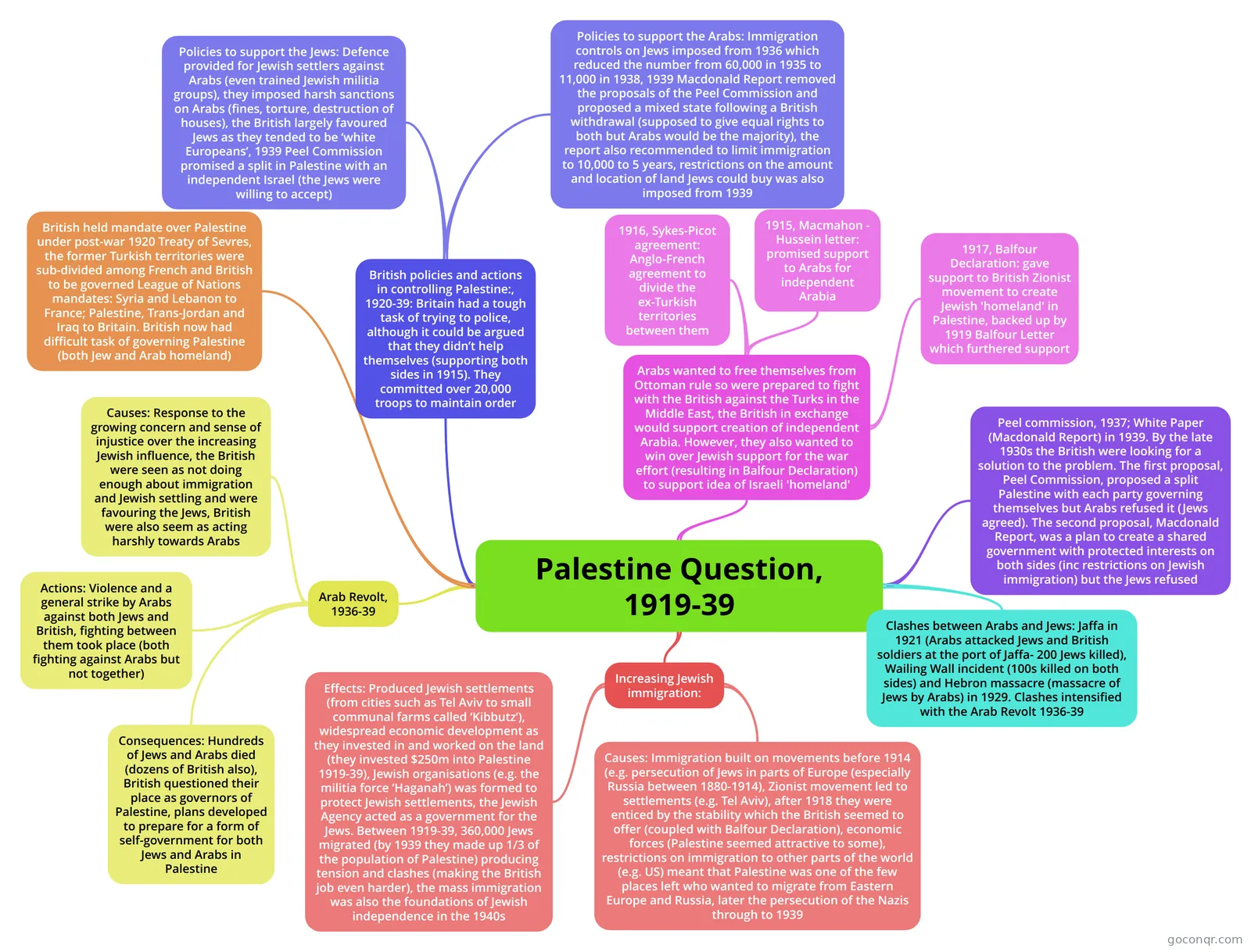
Mind map: Palestine Question, 1919-39
Map content
Palestine Question, 1919-39
Arabs wanted to free themselves from Ottoman rule so were prepared to fight with the British against the Turks in the Middle East, the British in exchange would support creation of independent Arabia. However, they also wanted to win over Jewish support for the war effort (resulting in Balfour Declaration) to support idea of Israeli 'homeland'
- 1917, Balfour Declaration: gave support to British Zionist movement to create Jewish 'homeland' in Palestine, backed up by 1919 Balfour Letter which furthered support
- 1916, Sykes-Picot agreement: Anglo-French agreement to divide the ex-Turkish territories between them
- 1915, Macmahon - Hussein letter: promised support to Arabs for independent Arabia
British held mandate over Palestine under post-war 1920 Treaty of Sevres, the former Turkish territories were sub-divided among French and British to be governed League of Nations mandates: Syria and Lebanon to France; Palestine, Trans-Jordan and Iraq to Britain. British now had difficult task of governing Palestine (both Jew and Arab homeland)
Increasing Jewish immigration:
- Causes: Immigration built on movements before 1914 (e.g. persecution of Jews in parts of Europe (especially Russia between 1880-1914), Zionist movement led to settlements (e.g. Tel Aviv), after 1918 they were enticed by the stability which the British seemed to offer (coupled with Balfour Declaration), economic forces (Palestine seemed attractive to some), restrictions on immigration to other parts of the world (e.g. US) meant that Palestine was one of the few places left who wanted to migrate from Eastern Europe and Russia, later the persecution of the Nazis through to 1939
- Effects: Produced Jewish settlements (from cities such as Tel Aviv to small communal farms called ‘Kibbutz’), widespread economic development as they invested in and worked on the land (they invested $250m into Palestine 1919-39), Jewish organisations (e.g. the militia force ‘Haganah’) was formed to protect Jewish settlements, the Jewish Agency acted as a government for the Jews. Between 1919-39, 360,000 Jews migrated (by 1939 they made up 1/3 of the population of Palestine) producing tension and clashes (making the British job even harder), the mass immigration was also the foundations of Jewish independence in the 1940s
Clashes between Arabs and Jews: Jaffa in 1921 (Arabs attacked Jews and British soldiers at the port of Jaffa- 200 Jews killed), Wailing Wall incident (100s killed on both sides) and Hebron massacre (massacre of Jews by Arabs) in 1929. Clashes intensified with the Arab Revolt 1936-39
British policies and actions in controlling Palestine:, 1920-39: Britain had a tough task of trying to police, although it could be argued that they didn’t help themselves (supporting both sides in 1915). They committed over 20,000 troops to maintain order
- Policies to support the Arabs: Immigration controls on Jews imposed from 1936 which reduced the number from 60,000 in 1935 to 11,000 in 1938, 1939 Macdonald Report removed the proposals of the Peel Commission and proposed a mixed state following a British withdrawal (supposed to give equal rights to both but Arabs would be the majority), the report also recommended to limit immigration to 10,000 to 5 years, restrictions on the amount and location of land Jews could buy was also imposed from 1939
- Policies to support the Jews: Defence provided for Jewish settlers against Arabs (even trained Jewish militia groups), they imposed harsh sanctions on Arabs (fines, torture, destruction of houses), the British largely favoured Jews as they tended to be ‘white Europeans’, 1939 Peel Commission promised a split in Palestine with an independent Israel (the Jews were willing to accept)
Arab Revolt, 1936-39
- Actions: Violence and a general strike by Arabs against both Jews and British, fighting between them took place (both fighting against Arabs but not together)
- Consequences: Hundreds of Jews and Arabs died (dozens of British also), British questioned their place as governors of Palestine, plans developed to prepare for a form of self-government for both Jews and Arabs in Palestine
- Causes: Response to the growing concern and sense of injustice over the increasing Jewish influence, the British were seen as not doing enough about immigration and Jewish settling and were favouring the Jews, British were also seem as acting harshly towards Arabs
Peel commission, 1937; White Paper (Macdonald Report) in 1939. By the late 1930s the British were looking for a solution to the problem. The first proposal, Peel Commission, proposed a split Palestine with each party governing themselves but Arabs refused it (Jews agreed). The second proposal, Macdonald Report, was a plan to create a shared government with protected interests on both sides (inc restrictions on Jewish immigration) but the Jews refused
Information
- Description
- Mind Map on Palestine Question, 1919-39, created by Monty Kirk on 20/05/2014.
- Created by
- Monty Kirk
- Views
- 38
- Rating
More on British Mandate and Partition of Palestine