
Mind map
Human Endocrine System
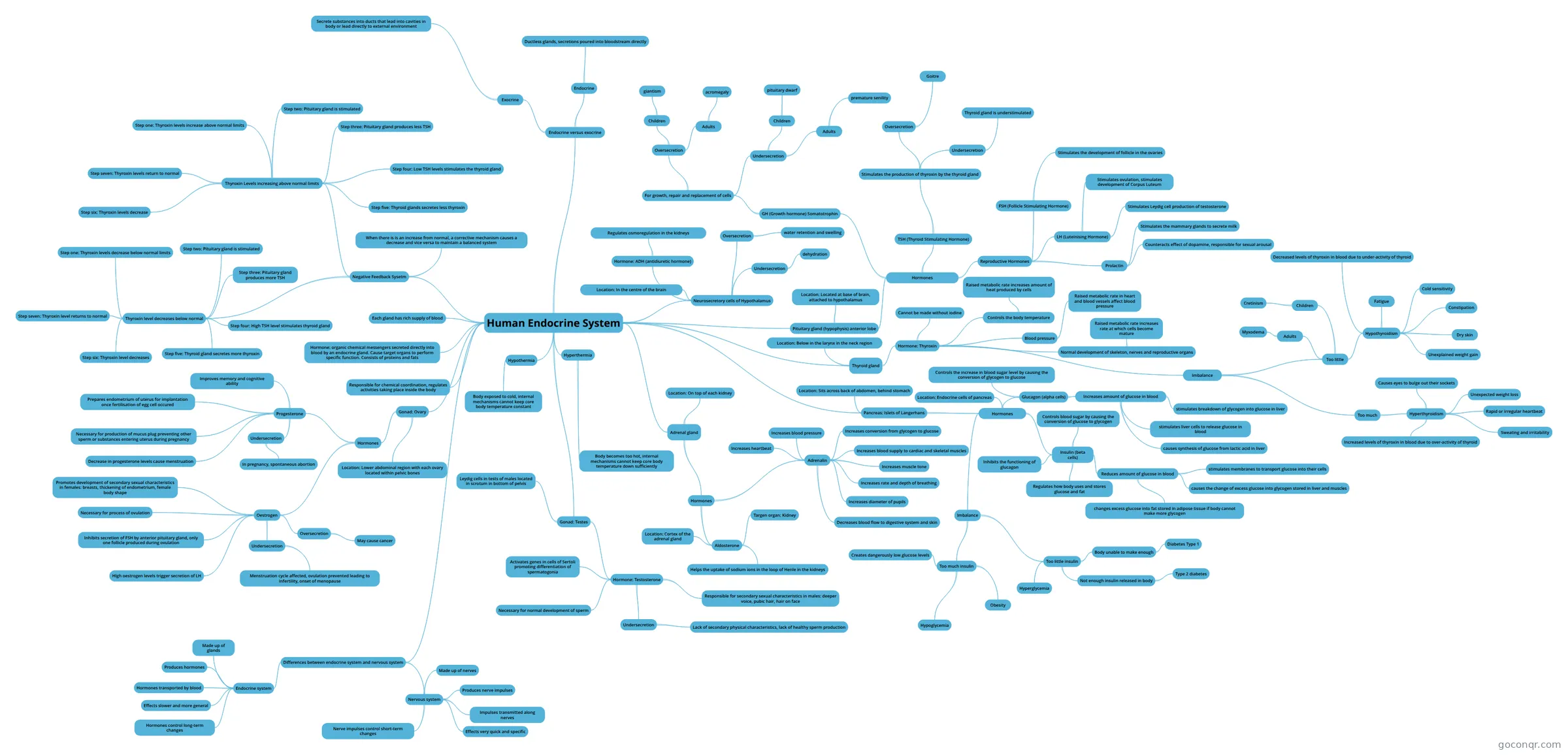
Mind map: Human Endocrine System
Map content
Human Endocrine System
Responsible for chemical coordination, regulates activities taking place inside the body
Each gland has rich supply of blood
Neurosecretory cells of Hypothalamus
- Location: In the centre of the brain
- Hormone: ADH (antidiuretic hormone)
- Regulates osmoregulation in the kidneys
- Oversecretion
- water retention and swelling
- Undersecretion
- dehydration
Pituitary gland (hypophysis) anterior lobe
- Location: Located at base of brain, attached to hypothalamus
- Hormones
- GH (Growth hormone) Somatotrophin
- For growth, repair and replacement of cells
- Oversecretion
- Children
- giantism
- Adults
- acromegaly
- Children
- Undersecretion
- Children
- pituitary dwarf
- Adults
- premature senility
- Children
- Oversecretion
- For growth, repair and replacement of cells
- TSH (Thyroid Stimulating Hormone)
- Stimulates the production of thyroxin by the thyroid gland
- Oversecretion
- Goitre
- Undersecretion
- Thyroid gland is understimulated
- Oversecretion
- Stimulates the production of thyroxin by the thyroid gland
- Reproductive Hormones
- FSH (Follicle Stimulating Hormone)
- Stimulates the development of follicle in the ovaries
- LH (Luteinising Hormone)
- Stimulates ovulation, stimulates development of Corpus Luteum
- Stimulates Leydig cell production of testosterone
- Prolactin
- Stimulates the mammary glands to secrete milk
- Counteracts effect of dopamine, responsible for sexual arousal
- FSH (Follicle Stimulating Hormone)
- GH (Growth hormone) Somatotrophin
Thyroid gland
- Location: Below in the larynx in the neck region
- Hormone: Thyroxin
- Controls the body temperature
- Raised metabolic rate increases amount of heat produced by cells
- Blood pressure
- Raised metabolic rate in heart and blood vessels affect blood pressure
- Normal development of skeleton, nerves and reproductive organs
- Raised metabolic rate increases rate at which cells become mature
- Cannot be made without iodine
- Imbalance
- Too little
- Hypothyroidism
- Fatigue
- Cold sensitivity
- Constipation
- Dry skin
- Unexplained weight gain
- Decreased levels of thyroxin in blood due to under-activity of thyroid
- Children
- Cretinism
- Adults
- Myxodema
- Hypothyroidism
- Too much
- Hyperthyroidism
- Causes eyes to bulge out their sockets
- Unexpected weight loss
- Rapid or irregular heartbeat
- Sweating and irritability
- Increased levels of thyroxin in blood due to over-activity of thyroid
- Hyperthyroidism
- Too little
- Controls the body temperature
Pancreas: Islets of Langerhans
- Location: Sits across back of abdomen, behind stomach
- Hormones
- Glucagon (alpha cells)
- Increases amount of glucose in blood
- stimulates breakdown of glycogen into glucose in liver
- stimulates liver cells to release glucose in blood
- causes synthesis of glucose from lactic acid in liver
- Controls the increase in blood sugar level by causing the conversion of glycogen to glucose
- Increases amount of glucose in blood
- Insulin (beta cells)
- Reduces amount of glucose in blood
- stimulates membranes to transport glucose into their cells
- causes the change of excess glucose into glycogen stored in liver and muscles
- changes excess glucose into fat stored in adipose tissue if body cannot make more glycogen
- Regulates how body uses and stores glucose and fat
- Controls blood sugar by causing the conversion of glucose to glycogen
- Inhibits the functioning of glucagon
- Reduces amount of glucose in blood
- Imbalance
- Too much insulin
- Creates dangerously low glucose levels
- Hypoglycemia
- Obesity
- Too little insulin
- Body unable to make enough
- Diabetes Type 1
- Not enough insulin released in body
- Type 2 diabetes
- Hyperglycemia
- Body unable to make enough
- Too much insulin
- Location: Endocrine cells of pancreas
- Glucagon (alpha cells)
Adrenal gland
- Location: On top of each kidney
- Hormones
- Adrenalin
- Increases heartbeat
- Increases blood pressure
- Increases conversion from glycogen to glucose
- Increases blood supply to cardiac and skeletal muscles
- Increases muscle tone
- Increases rate and depth of breathing
- Increases diameter of pupils
- Decreases blood flow to digestive system and skin
- Aldosterone
- Targen organ: Kidney
- Helps the uptake of sodium ions in the loop of Henle in the kidneys
- Location: Cortex of the adrenal gland
- Adrenalin
Gonad: Ovary
- Location: Lower abdominal region with each ovary located within pelvic bones
- Hormones
- Oestrogen
- Promotes development of secondary sexual characteristics in females: breasts, thickening of endometrium, female body shape
- Necessary for process of ovulation
- Inhibits secretion of FSH by anterior pituitary gland, only one follicle produced during ovulation
- HIgh oestrogen levels trigger secretion of LH
- Oversecretion
- May cause cancer
- Undersecretion
- Menstruation cycle affected, ovulation prevented leading to infertility, onset of menopause
- Progesterone
- Prepares endometrium of uterus for implantation once fertilisation of egg cell occured
- Necessary for production of mucus plug preventing other sperm or substances entering uterus during pregnancy
- Decrease in progesterone levels cause menstruation
- Improves memory and cognitive ability
- Undersecretion
- In pregnancy, spontaneous abortion
- Oestrogen
Gonad: Testes
- Hormone: Testosterone
- Responsible for secondary sexual characteristics in males: deeper voice, pubic hair, hair on face
- Necessary for normal development of sperm
- Activates genes in cells of Sertoli promoting differentiation of spermatogonia
- Undersecretion
- Lack of secondary physical characteristics, lack of healthy sperm production
- Leydig cells in tests of males located in scrotum in bottom of pelvis
- Hormone: Testosterone
Negative Feedback Sysetm
- Thyroxin Levels increasing above normal limits
- Step one: Thyroxin levels increase above normal limits
- Step two: Pituitary gland is stimulated
- Step three: Pituitary gland produces less TSH
- Step four: Low TSH levels stimulates the thyroid gland
- Step five: Thyroid glands secretes less thyroxin
- Step six: Thyroxin levels decrease
- Step seven: Thyroxin levels return to normal
- Thyroxin level decreases below normal
- Step one: Thyroxin levels decrease below normal limits
- Step two: Pituitary gland is stimulated
- Step three: Pituitary gland produces more TSH
- Step four: High TSH level stimulates thyroid gland
- Step five: Thyroid gland secretes more thyroxin
- Step six: Thyroxin level decreases
- Step seven: Thyroxin level returns to normal
- When there is is an increase from normal, a corrective mechanism causes a decrease and vice versa to maintain a balanced system
- Thyroxin Levels increasing above normal limits
Endocrine versus exocrine
- Exocrine
- Secrete substances into ducts that lead into cavities in body or lead directly to external environment
- Endocrine
- Ductless glands, secretions poured into bloodstream directly
- Exocrine
Hormone: organic chemical messengers secreted directly into blood by an endocrine gland. Cause target organs to perform specific function. Consists of proteins and fats
Differences between endocrine system and nervous system
- Nervous system
- Made up of nerves
- Produces nerve impulses
- Impulses transmitted along nerves
- Effects very quick and specific
- Nerve impulses control short-term changes
- Endocrine system
- Made up of glands
- Produces hormones
- Hormones transported by blood
- Effects slower and more general
- Hormones control long-term changes
- Nervous system
Hypothermia
- Body exposed to cold, internal mechanisms cannot keep core body temperature constant
Hyperthermia
- Body becomes too hot, internal mechanisms cannot keep core body temperature down sufficiently
Information
- Description
- Life Sciences Mind Map on Human Endocrine System, created by Sharni Knight on 23/08/2017.
- Created by
- Sharni Knight
- Views
- 1
- Rating