
Notes
Chemistry Regents Review - Molecular Compounds and Covalent Bonding
Content of the notes (1)
Page 1
Molecules and Molecular Compounds
Molecular Formulas
A molecular formula is the chemical formula of a molecular compound.
A molecular formula shows how many atoms of each element a molecule contains
The Octet Rule in Covalent Bonding
In
forming covalent bonds, electron sharing usually occurs so that atoms attain
the electron configurations of noble gases
Single Covalent Bonds
Double and Triple Covalent Bonds
Coordinate Covalent Bonds
Bond Dissociation Energies
The energy required to break the bond between
two covalently bonded atoms is known as the bond dissociation energy
A large
bond dissociation energy corresponds to a strong covalent bond
Exceptions to the Octet Rule
Atoms held together by sharing electrons are joined by a covalent bond
A molecule is a neutral group of atoms joined together by covalent bonds
A diatomic molecule is a molecule consisting of two atoms
A compound composed of molecules is called a molecular compound
Molecular compounds tend to have relatively low melting and boiling points
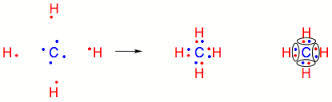
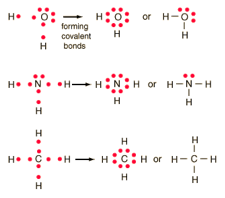
Two atoms held together by sharing a pair of electrons are joined by a single covalent bond.
An electron dot structure such as H:H represents the shared pair of electrons of the covalent bond by two dots
A structural formula represents the covalent bonds by dashes and shows the arrangement of covalently bonded atoms
A pair of valence electrons that is not shared between atoms is called an unshared pair, also known as a lone pair or a nonbonding pair
Examples of Covalent bonding:
Atoms form double or triple covalent bonds if they can attain a noble gas structure by sharing two pairs or three pairs of electrons
A bond that involves two shared pairs of electrons is a double covalent bond
A bond that is formed by sharing three pairs of electrons is a triple covalent bond
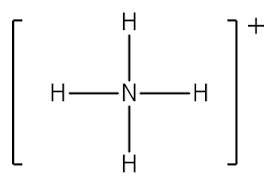
A coordinate covalent bond is a covalent bond in which one atom contributes both bonding electrons
In a coordinate covalent bond, the shared electron pair comes from one of the bonding atoms
A polyatomic ion, such as NH4+ is a tightly bound group of atoms that has a positive or negative charge and behaves as a unit
The octet rule cannot be satisfied in molecules whose total number of valence electrons is an odd number
There are also molecules in which an atom has fewer, or no more, than a complete octet of valence electrons
Molecular Compounds and Covalent bonding
Information
- Description
- Molecular Compounding and Covalent Bondingreview notes for the Chemistry Regents
- Created by
- Ali Kane · May 2014
- Updated
- Jan 17, 2017
- Views
- 710
- Tags
- Rating