
Notes
Newton's Three Laws of Motion
Content of the notes (1)
Page 1
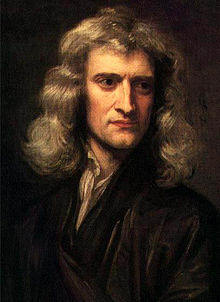
Isaac Newton
First law:
An object at rest remains at rest unless acted upon by a force. An object in motion remains in motion, and at a constant velocity, unless acted upon by a force.
Second law:
The acceleration of a body is directly proportional to, and in the same direction as, the net force acting on the body, and inversely proportional to its mass. Thus, F = ma, where F is the net force acting on the object, m is the mass of the object and a is the acceleration of the object.
Third law:
When one body exerts a force on a second body, the second body simultaneously exerts a force equal in magnitude and opposite in direction to that of the first body.
http://www.youtube.com/watch?v=CQYELiTtUs8 (Embed)
http://www.youtube.com/watch?v=ou9YMWlJgkE (Embed)
http://www.youtube.com/watch?v=By-ggTfeuJU (Embed)
Newtons first law is a re-statement of Galileo's law of inertia.
In simple terms, all objects are stationary until something/someone applies force on it. In a vacuum the object will travel forever but on Earth due to factors such as friction, art resistance etc objects slow down over time
Force = Mass x Acceleration
F= ma
Don't confuse Mass with Weight
Mass ≠ Weight
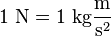
Force is measure in Newtons.
To every action there is an equal and opposite reaction
Newton's Three Laws of Motion
Newton's laws of motion are three physical laws that together laid the foundation for classical mechanics. They describe the relationship between a body and the forces acting upon it, and its motion in response to said forces.
First law:
An object at rest remains at rest unless acted upon by a force. An object in motion remains in motion, and at a constant velocity, unless acted upon by a force.
Second law:
The acceleration of a body is directly proportional to, and in the same direction as, the net force acting on the body, and inversely proportional to its mass. Thus, F = ma, where F is the net force acting on the object, m is the mass of the object and a is the acceleration of the object.
Third law:
When one body exerts a force on a second body, the second body simultaneously exerts a force equal in magnitude and opposite in direction to that of the first body.
Intro
1st Law
2nd Law
3rd Law
Information
- Description
- Newton's 3 Laws of Motion. These vital for any studying physics.
- Created by
- PatrickNoonan
- Views
- 7,549
- Tags
- Rating