
Notes
Untitled

Content of the notes (1)
Page 1
(i) Using NB from above we have that
(2x^2+6x-9)^1/2 = (1/2(4x^2+12x-18))^1/2 = (1/2((2x+3)^2 -27))^1/2
METHOD: taking out 1/a where a is the coefficient of a in this case it is 2, then complete the sq this is (ax+b)^2 - b^2. From this next form we can use standard substitutions.
(ii) 3+2x-x^2 = 3 - (x^2 - 2x) = 3 - ((1-x)^2 - 1) = 4 - (1-x)^2
When you have a quadratic that has -x^2, take out the -1 for the terms with x. Then factorise the terms with x so that when you complete the sq you have (-x + some number)^2, and subtract the const squared. This for can be solved using standard substitutions. Remember that it has a square root.
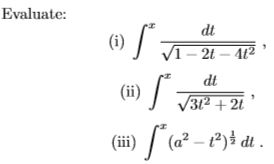
(i) Consider the denominator and the quadratic in the sq root, first take out 1/a where a is the coefficient of t^2. Take out -1 from the terms with t, Factorise the terms with t using completing the square (ax+b)^2 and subtracting the constant squared. Now use a substitution.
(1- 2t - 4t^2) = (1/4(4-8t-16t^2)) = (1/4(4 - (8t + 16t^2))) = (1/4(4 - ((4t+1)^2 -1))) = (1/4(5 - (4t+1)^2))
(ii) Consider the quadratic eq and proceed using NB: 3t^2+2t = 1/3(9t^2+6t) = 1/3((3t+1)^2 -1)
Trigonometric Substitution:
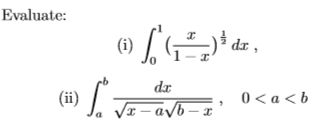
(i) We use trigonometric substitution: let x = sin^2@ we can also use x = cos^2@
This is because the trig formula appears in the denominator, cos^2 + sin^2 can be rearranged in two ways, so x can be either sin or cos.
(ii) If you write out the denominator you have ((x-a)(b-x))^1/2 now you can use NB, the completing the sq method. Alternatively you can use trig substitution.
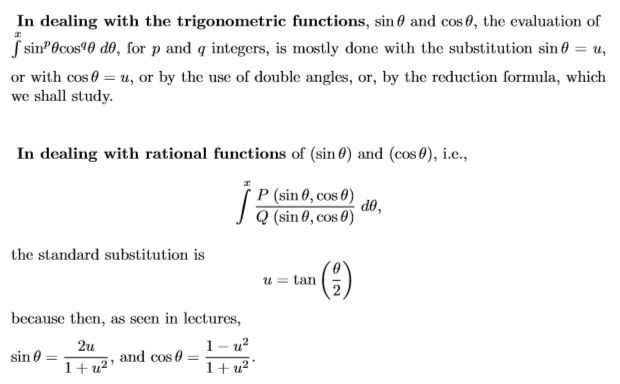
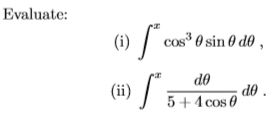
(i) let u = cos@ then differentiate the substitution. For integrals similar to these ones, let u be one of the trig functions in the entire funct.
(ii) Use the substitution of u = tan(@/2), can differentiate this and use a trig function.
Now use the definition from tan(@/2) for cos@ so that you can rewrite the integral. Remember to change the limits and now this becomes an easier integral to solve.
INTEGRATION BY PARTS
uv = integral of u(dv/dt) + v(du/dt) absorbing the constant into the integral

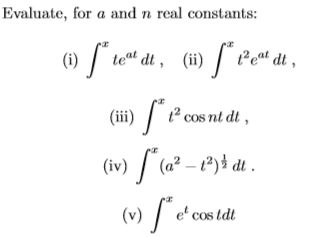
Solve these by integration by parts
(i) let u = t and v' = e^at so u' = 1 and v = 1/a(e^at)
Now use the formula to get (xe^ax)/a - (e^ax)/a^2 + c a const of int.
(ii)The functions here when differentiated do not have an infinite number of terms.
Let u = t^2, v' = e^at now we have that u' = 2t and v = (e^at)/a
Using the integration by parts formula we have: x^2(e^ax)/a - integral of 2t(e^at/a)
We've solved the previous integral before so we can use the result for before.
In this case we have to use integration by parts twice.
(iii)The functions here when differentiated do not have an infinite number of terms.
So here we let u = t^2 and v' = cos(nt) then u' = 2t and v = sin(nt)/n
In this case also have to use integration by parts twice.
(iv) Here you have only one term so the trick is let u = (a^2-t^2)^1/2 and v' = 1 finding u' and v.
By integration by parts we have
x (a^2 - x^2)^1/2 + int of t^2(a^2 - t^2)^1/2
This integral we solve as follows: in the numerator of the next integral write +a^2 - a^2 and so we can divide the integral into one that is easier to solve.
(v) Can use integration by parts or alternative method, Re of the int e^t * e^it
For integration of rational fractions, revise partial fractions. Assume that p(x) is of a lower degree than q(x) otherwise divide out.
Factor of Q(x)
a) unrepeated linear factor (x-@) then the corresponding partial fraction is a / (x-@)
b) repeated linear factor (x-@)^k implies a1/(x-@) + a2/(x-@)^2 +...+ak/(x-@)^k
c) unrepeated quadratic factor x^+ax+b implies (Bx+c)/(x^+ax+b)
d)repeated quadratic factor (x^+ax+b)^j implies (b1x+c1)/(x^+ax+b) +.. + (bjx+cj)/(x^+ax+b)^j
Where a, b, c are all real coeffs.
To determine the coefficients in the partial fractions the technique is to mulitply through by Q(x) and then either:
a) equate coefficients of similar powers of x
b) evaluate for special values of x
c) comination of (a) and (b)
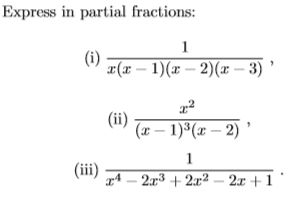
(i) all terms are linear so multiply through by the denominator and then let each factor equal 0 for a special and different value of x each time. Solve to find constants a,b,c and d.
(ii) there is a repeated linear factor. Multiply by the denominator, we have that for x = 2, we find the value of one of the constants, for the others equate the constants of the coeffecients.
(iii) There is a repeated linear and a quadratic, for x = 1 we find a value of one of the constants. To find the others compare the constants of the coefficients.
The rational function (x-@)^-n :
1. If n = 1 then the integral is ln(x-@)
2. If n>1 then the integral is ((x-@)^(1-n))/(1-n)
Reduction Formula
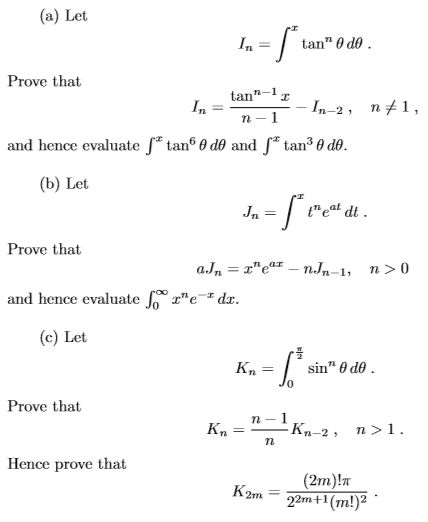
Chapter 3 Integration part 2
Information
- Description
- Note on Untitled, created by ewawanda on 01/01/2015.
- Created by
- ewawanda
- Views
- 5
- Rating