
Notes
Two Masses Connected Example Problem
Content of the notes (1)
Page 1
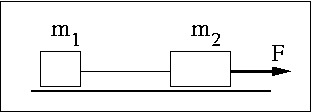
Two masses,
m1 = 2.26 kg and
m2 = 6.03 kg are
on a horizontal frictionless surface and they are
connected together with a rope as shown in the figure.
1. The rope will snap if the tension in it exceeds
75.0 N.
What is the maximum value of the force F which can be applied?
Given:
- m1 = 2.26 kg
- m2 = 6.03 kg
- T = 75.0 N
Need:
- max force in (N)
Equations:
- to find max force
max force = tension + (acceleration*m2)
- BUT we do not know acceleration so to find that, we use the equation:
acceleration = tension/m1
Work:
acceleration = tension/m1
a = 75.0N/2.26kg
a = 33.1858 m/s^2
Now plug the acceleration into the max force equation:
max force = T + a(m2)
F(max) = 75.0N + (33.1858*6.03kg)
F(max) = 275.2 N
2. What is the acceleration of the whole system, when this maximum
force is applied?
Equation:
acceleration = F(max)/(m1+m2)
a = 275.2N/(2.26kg+6.03kg)
a = 33.2 m/s^2
Information
- Description
- Two masses, m1 = 2.26 kg and m2 = 6.03 kg are on a horizontal frictionless surface and they are connected together with a rope. The rope will snap if the tension in it exceeds 75.0 N. What is the maximum value of the force F which can be applied? What is the acceleration of the whole system, when this maximum force is applied?
- Created by
- cclynm1
- Views
- 331
- Tags
- Rating