
Notes
Introduction to Vectors
Content of the notes (5)
Page 1
What is a vector?
A scalar is a quantity that has magnitude only.
Examples: Mass, time, electric charge, speed, distance
A vector is a quantity that has both magnitude and direction.
Examples: Force, displacement, velocity
Speed vs Velocity
You may have heard these two terms used interchangeably in everyday life. However, they have two very different meanings. Speed is a scalar and velocity is a direction. If you describe a car as moving at 60km/hr, you describe its speed. If you say it is moving 60km/hr in the south east direction, you are describing its velocity
Displacement vs Distance
The difference between speed and velocity comes from their respective definitions.
Speed: Change in distance per unit time
Velocity: Change in displacement per unit time
Distance is a scalar, while displacement is a vector.
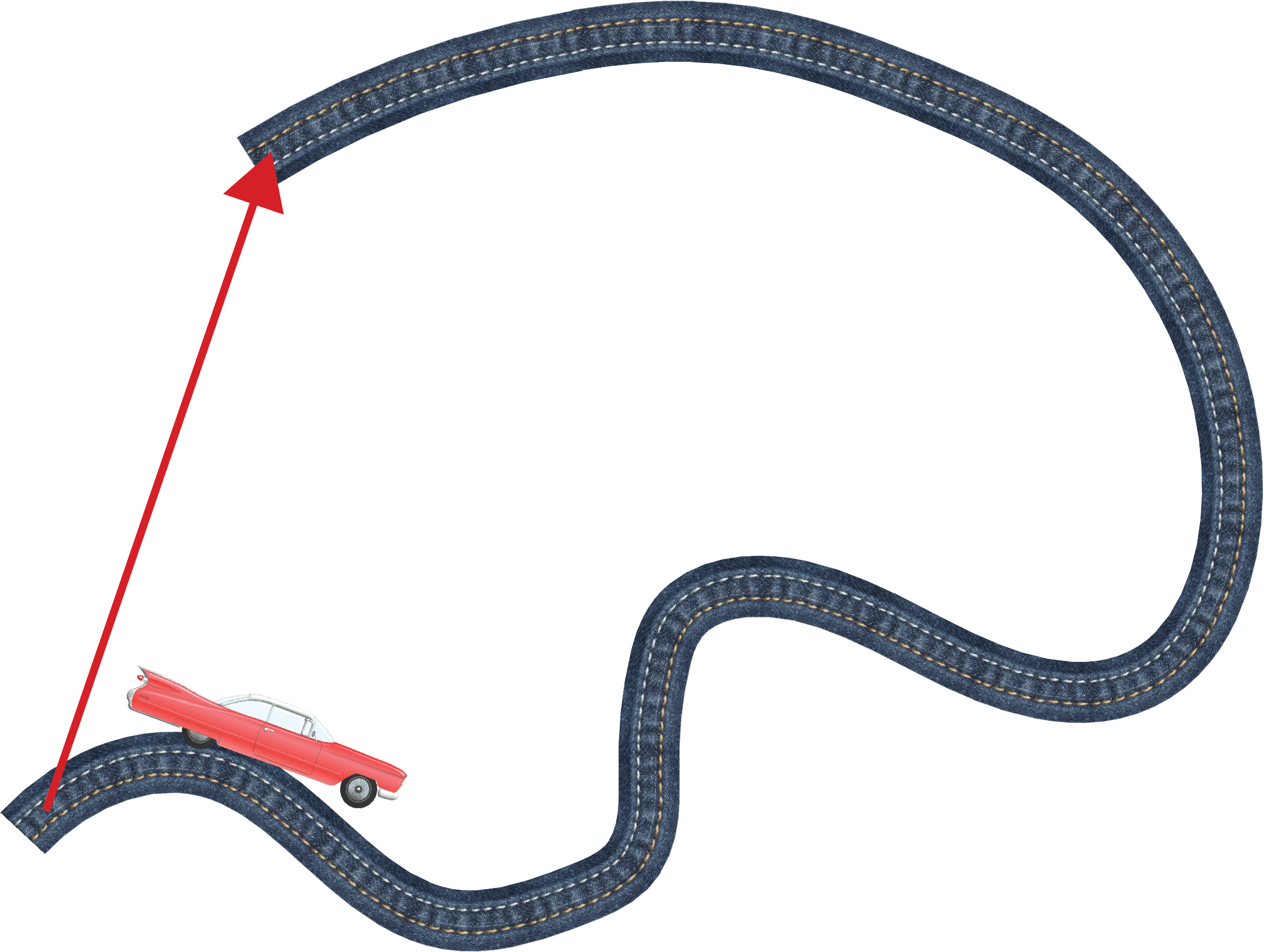
Consider the diagram shown below. The distance travelled by the car is the length of the road. However, the displacement of the car is the red line - it is the difference in the start and end position of the car - in the direction that the arrow is pointing.
Page 2
Vector terms and notation
Vectors can be described and written in a number of ways.
Vectors are often printed in bold E.g.: a
Sometimes they are printed with an arrowhead above them: E.g: \(\vec v\)
Sometimes they are described by the point where they begin and end. E.g.: \(\vec{AB}\) Joins point A to B
Vectors can be expressed in terms of the Cartesian system. \(\vec{\imath}\) and \(\vec{\jmath}\) are unit vectors that point in the direction of the x and y axes respectively. A vector can be expressed as a sum of \(\vec{\imath}\) and \(\vec{\jmath}\) components.
This can also be converted to bracketed form:\(\vec v=\) \(x \vec{\imath} + y \vec{\jmath}\) can also be written as \(\vec v= \begin{bmatrix}x\\y \\\end{bmatrix}\)
The magnitude or modulus of a vector is its length. This is written as \(|\vec v |\) and is calculated by \( |\vec v | = \sqrt{x^2+y^2}\).
The direction of a vector can be found by \( \theta = Tan^{-1} \frac yx\).
Therefore, a vector can also be expressed in terms of its magnitude in a given direction Eg: 60km 20° North of East.
A unit vector has a magnitude of 1.
Equal vectors: Vectors that have the same magnitude and direction. They may start at different positions.
Parallel vectors: Two vectors are parallel if one is a scalar multiple of the other
Collinear: Two vectors are collinear, if they lie on the same line or parallel lines
Page 3
Multiplication by a scalar
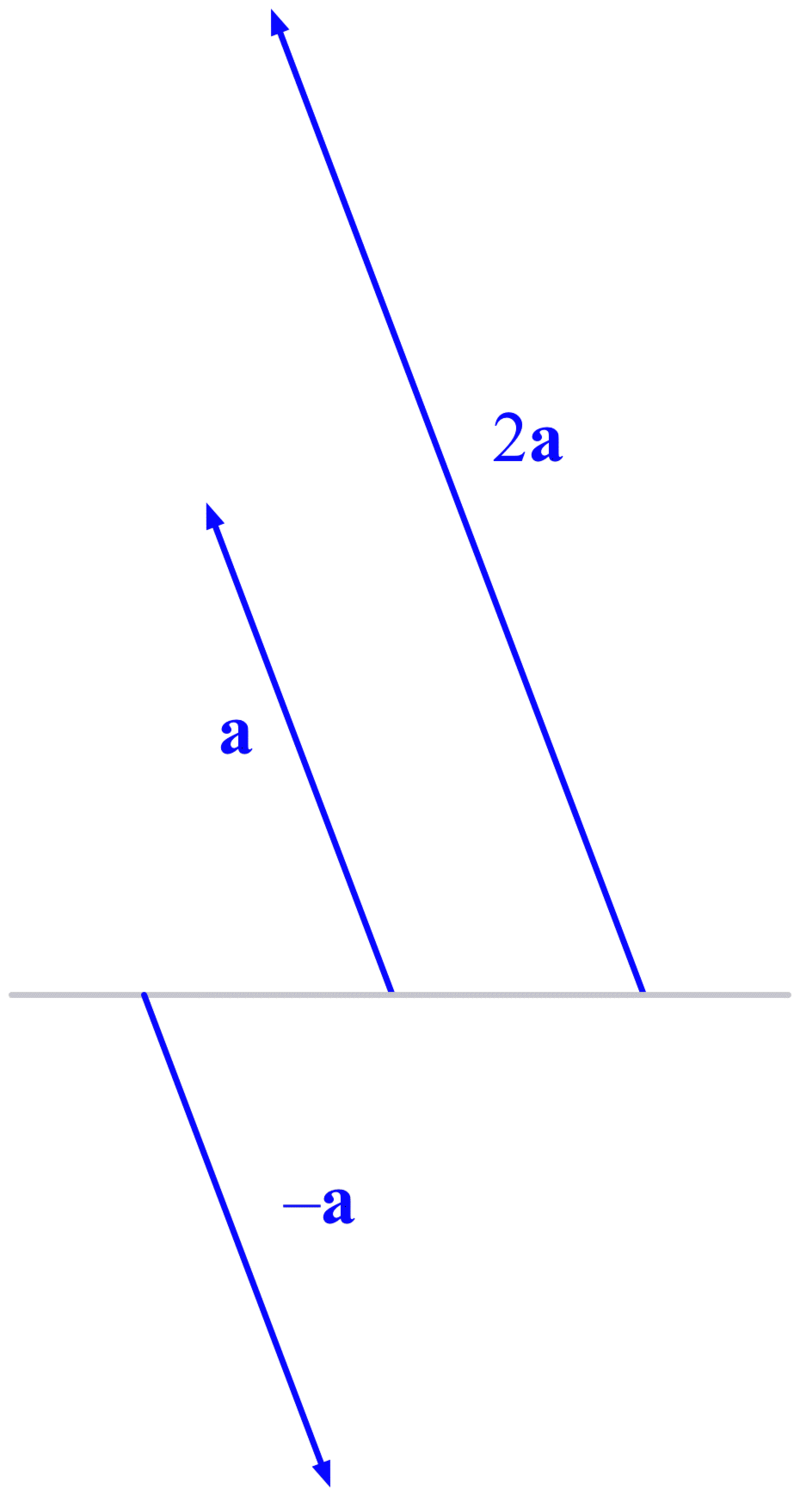
Multiplying a vector by a scalar scales the vector.
Multiplying a vector by 2 will produce a vector of the same direction that is the twice the length.
Multiplying by a negative scalar will change the sense of the vector (it will point in the opposite direction)
To perform the multiplication algebraically, multiply all the components of the vector by the scalar.
Example:
If \( \vec v =\begin{bmatrix}{4 }\\{ 5}\\\end{bmatrix}\)
Then \(3\vec v= 3\begin{bmatrix}4\\5 \\\end{bmatrix}=\begin{bmatrix}{3 \times 4}\\{3 \times 5} \\\end{bmatrix}=\begin{bmatrix}{12}\\{15}\\\end{bmatrix}\)
Page 4
Addition and Subtraction by graphical methods
Vectors can be added or subtracted to other vectors if they have the same dimensions.
Vectors cannot be added or subtracted to scalars.
This operation can be performed both graphically and algebraically.
The resultant vector is the term used to describe the vector that the addition/subtraction operation generates.
Graphical Methods
Vectors can be added using the triangle rule or the parallelogram rule.
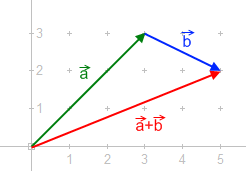
Triangle rule
This is used to add vectors that join head to tail. The resultant vector is the vector obtained when the tail of the first vector is joined to the head of the other.
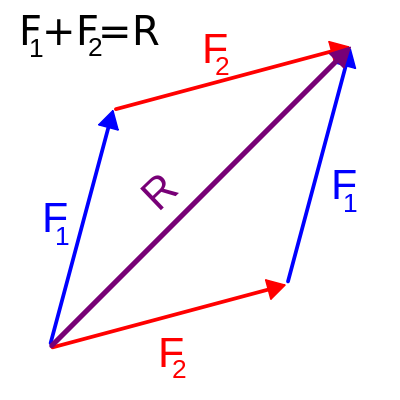
Parallelogram rule
This is used to add vectors that join tail to tail. The resultant vector is obtained by constructing a parallelogram with the two sides having the same magnitude and direction as the vectors in question. The resultant is the diagonal through the point of intersection of the vectors.
Subtraction of vectors
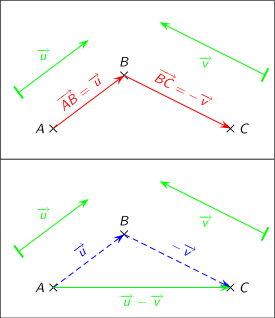
Subtracting two vectors is the same as multiplying one of the vectors by -1 and then adding this vector to the other. Therefore, to perform the subtraction graphically, we reverse the direction of one of the vectors and then add them using the triangle or parallelogram rule.
Page 5
Addition and subtraction by algebraic methods
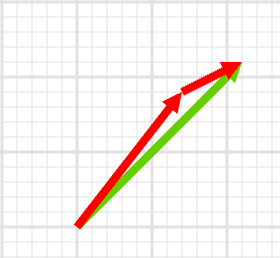
In order to add two vectors algebraically, simply add their components.
Example:
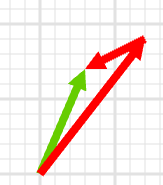
Let \(\vec a = \begin{bmatrix} 7\\9\\\end{bmatrix}\) and let \(\vec b = \begin{bmatrix} 4\\2\\\end{bmatrix}\)
\( \vec a +\vec b = \begin{bmatrix} 7\\9\\\end{bmatrix}+\begin{bmatrix} 4\\2\\\end{bmatrix}=\begin{bmatrix} {7+4}\\{9+2}\\\end{bmatrix}=\begin{bmatrix} {11}\\{11}\\\end{bmatrix}\)
\( \vec a -\vec b = \begin{bmatrix} 7\\9\\\end{bmatrix}-\begin{bmatrix} 4\\2\\\end{bmatrix}=\begin{bmatrix} {7-4}\\{9-2}\\\end{bmatrix}=\begin{bmatrix} {3}\\{7}\\\end{bmatrix}\)
Information
- Description
- User has deleted their subject information Note on Introduction to Vectors, created by Deleted user on 29/08/2017.
- Created by
- Deleted user · Aug 2017
- Updated
- Aug 29, 2017
- Views
- 192
- History
-
- Created by Niamh Ryan · Aug 17, 2017
- Copied by Niamh Ryan · Aug 29, 2017
- Rating