
Notes
Problems using Vectors
Content of the notes (4)
Page 1
One dimensional forces
The resultant force is the vector sum of all the forces acting on an object.
Remember that at the beginning of a question you must determine what is the positive direction. Always indicate this direction on any diagrams you draw.
Example:
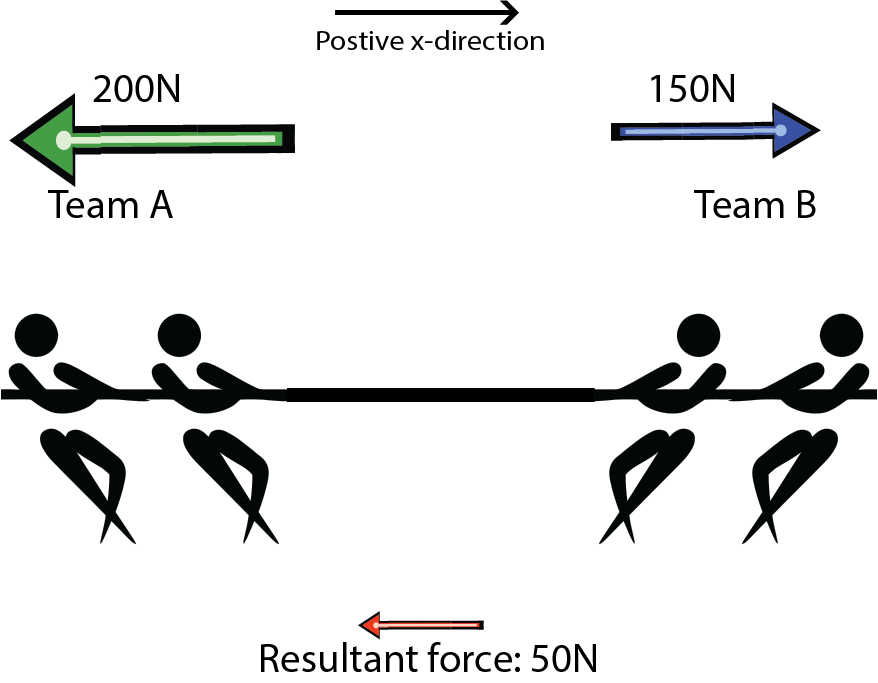
Two teams are engaged in a tug of war. Team A exerts a force of 200N to the left, while Team B exerts a force of 150N to the right.
What is the resultant force and which direction will the rope move?
Answer:
Team A exerts a force of \( \vec a = -200 \vec{\imath}\) and Team B exerts a force of \( \vec a = +150 \vec{\imath}\).
The resultant force is the vector sum of these two forces: \[F = -200+150 \vec{\imath}= -50\vec{\imath} Newtons.\]
Therefore, the resultant force is in the negative x direction and the rope moves to the left.
Page 2
Two dimensional forces
Example:
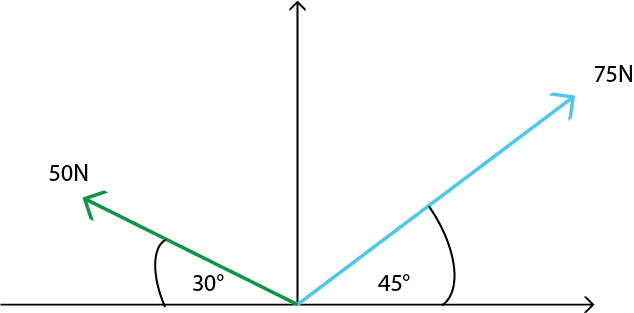
What is the resultant force in the below case?
Answer:
In general, the directions of the arrows on the axes indicate the positive directions.
We are given the directions and magnitudes of the vectors but they are much easier to add if you change them into component form.
This can be done by treating each vector as a right-angled triangle and then using your knowledge of trigonometric ratios, as shown in the diagram below
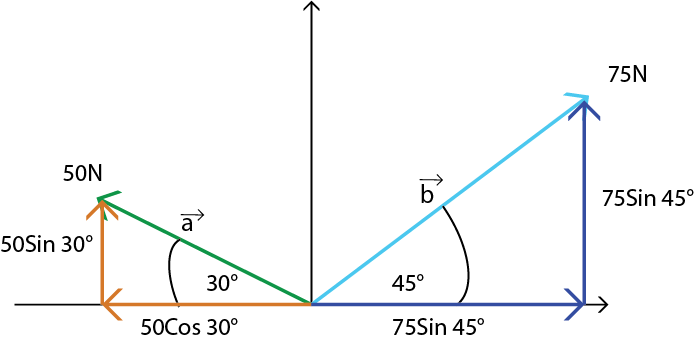
Bear in mind that \(\vec a\) points in the positive y-direction, but the negative x-direction.
Therefore, it can be written as\[ \vec a = \begin{bmatrix}-50\times \frac{ \sqrt 3}2\\50\times \frac 12 \\\end{bmatrix}= \begin{bmatrix}-25 \sqrt 3\\25\\\end{bmatrix}\]
While the other vector, which points in the positive x- and y-directions can be written as \[ \vec b = \begin{bmatrix}75\times \frac{1}{ \sqrt 2}\\75\times \frac{1}{ \sqrt 2} \\\end{bmatrix}=\begin{bmatrix} \frac{75}{ \sqrt 2}\\ \frac{75}{ \sqrt 2} \\\end{bmatrix}\]
The resultant force is found by adding these two vectors.
\[\begin{bmatrix}-25 \sqrt 3\\25\\\end{bmatrix}+\begin{bmatrix} \frac{75}{ \sqrt 2}\\ \frac{75}{ \sqrt 2} \\\end{bmatrix}=\begin{bmatrix} \frac{75}{ \sqrt 2}-25 \sqrt 3\\ \frac{75}{ \sqrt 2}+ 25\\\end{bmatrix}\]
Page 3
Dividing a line in a given ratio
Vectors can be used to find a point which divides a point which divides a line in a given ratio.
Example:
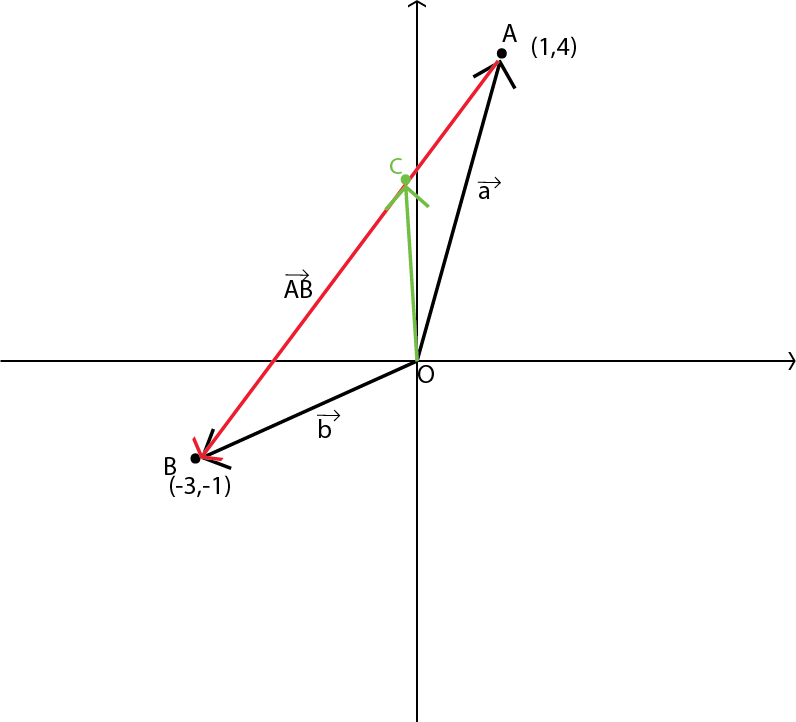
Find the position vector of a point \(C\) on a line through A and B dividing \(\vec{AB}\) in a the ratio 1:2.
Solution:
\(2+1=3\), so we are dividing the line into thirds.
Earlier we calculated the vector \(\vec{AB}\) to be \(4 \vec{\imath}-5 \vec{\jmath}\)
Because of the way in which vectors can be added, \( \vec{OC} = \vec{OA} + \vec{AC} = \vec{OA} + \frac 13 \vec{AB} \)
(In other words, going from \(O\) to \(C\) is the same as going from \(O\) to \(A\) and then going from \(A\) to \(C\).)
This means that \[\vec{OC}=\begin{bmatrix}1\\4 \\\end{bmatrix}+ \frac 13 \begin{bmatrix}-4\\-5 \\\end{bmatrix} = \begin{bmatrix}1- \frac 43\\4- \frac 53\\\end{bmatrix}\]
\[= \begin{bmatrix} -\frac 13 \\ \frac 73 \\\end{bmatrix}\]
You can use the diagram to check that this answer makes sense - the green arrow is just a little bit to the left of the x-axis, corresponding to the negative x-coordinate and more than halfway up to \(A\) corresponding to the positive y-coordinate.
Page 4
Finding the fourth corner of a parallelogram
Example:
Find the position vector for \(D\), the fourth corner of the parallelogram \(ABCD\)
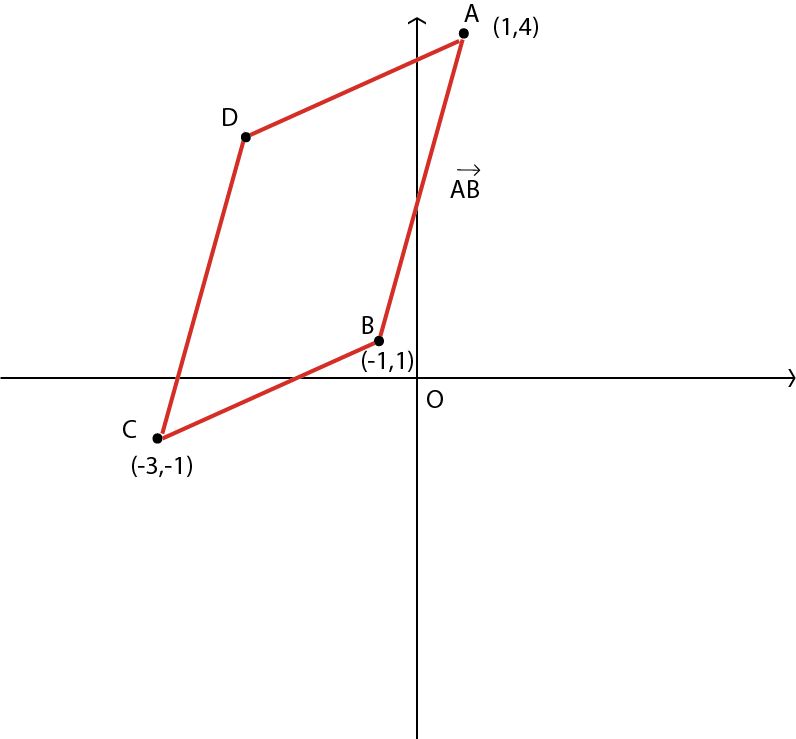
Answer:
Remember that opposite sides in a parallelogram have the same direction and equal lengths - they are equal vectors. Therefore, adding \(\vec {BA} \) to a point is the same as adding \(\vec {CD}\).
From previous examples, we know that \[ \vec{OD}= \vec{OC} + \vec{CD} \] and given the statement above about parallelograms, \[ \vec{OD}= \vec{OC} + \vec{BA} \]
We know that \( \vec{BA} = \vec a - \vec b\) so \[ \vec {CD} = \begin{pmatrix} 1\\4\\\end{pmatrix} - \begin{pmatrix} -1 \\1\\\end{pmatrix} = \begin{pmatrix}2\\3\\\end{pmatrix}\]
This means that \[ \vec{OD}= \begin{pmatrix} -3 \\-1\\\end{pmatrix}+\begin{pmatrix}2\\3\\\end{pmatrix}= \begin{pmatrix} -1\\2\\\end{pmatrix}\]
Information
- Description
- User has deleted their subject information Note on Problems using Vectors, created by Deleted user on 29/08/2017.
- Created by
- Deleted user · Aug 2017
- Updated
- Aug 29, 2017
- Views
- 143
- History
-
- Created by Niamh Ryan · Aug 21, 2017
- Copied by Niamh Ryan · Aug 29, 2017
- Rating