
Flashcards
SC Concepts

Cards in this deck (29)
- 1Regard X as Y OR Regard X to be YRegard X as Y
- 2Compare to vs. Compare withCompare to - Unlike things
AND
Compare with - Like / similar things - 3Phrase AND ClausePhrase - It is a collection of words that make some sense, but not complete sense. It does not have a subject doing a verb.
Clause - A group of words that contains both a subject & a predicate but which may NOT be able to stand on its own. It is a smallest grammatical unit that can express a complete idea. - 4Sentence FragmentA sentence that does not have one or more of the necessary components of a sentence such as the subject and the main action verb. It cannot stand on its own.
- 5Run-On Sentence AND Comma SpliceRun-On Sentence:
It connects >= 2 ICs without proper connectors (commas, semi-colons and/or conjunctions)
Comma Splice:
Type of run-on sentence in which 2 ICs are incorrectly connected by a comma. Either part can stand by itself. - 6Verbals 1. Gerunds 2. Participles 3. Infinitives1. GERUND
ends in -ing
Functions as a NOUN
2. PARTICIPLE
Functions as an ADJECTIVES.
i. Present Participle
Expresses 'what a thing does'
Usually, ends in -ing
ii. Past Participle
Expresses 'what was done to a thing'
Usually, ends in -ed, -en, -d, -t, or -n
3. INFINITIVE
{to + verb} form
Functions as a NOUN, ADJECTIVE or ADVERB - 7S-V AGREEMENT (Subject Obfuscation) 1. Each / EveryEach / Every ALWAYS requires a SINGULAR verb
- 8S-V AGREEMENT (Subject Obfuscation) 2. Either.....or.....Y / Neither.....or.....Yi. Both S - singular --> V - singular
ii. Both S - plural --> V - plural
iii. One S singular & other plural --> V agrees with closest S - 9S-V AGREEMENT (Subject Obfuscation) 3. The number / A number ofThe number --> Singular verb
A number of --> Plural verb - 10S-V AGREEMENT (Subject Obfuscation) 4. Countable / Uncountable NounCountable Noun --> Plural Verb
Uncountable Noun --> Singular Verb - 11S-V AGREEMENT (Subject Obfuscation) 5. Collective & Plural NounsCollective Noun --> Singular Verb
Plural Noun --> Plural Verb - 12S-V AGREEMENT (Additive Phrases) along with in addition to as well as accompanied by together with including and, etc.Except 'and', all other additive phrases keep the subject singular. Hence, the verb should also be singular.
- 13S-V AGREEMENT One of Structure

- 14Relative Pronouns
- 15INDEFINITE PRONOUNS (IP) - 1 of n (Singular IP) WHATEVER SOMETHING each every everyone anyone someone no one nobody anybody whoeverSingular IP --> Singular Verb
- 16INDEFINITE PRONOUNS (IP) - 2 of n (Plural IP) Both FewPlural IP --> Plural Verb
- 17INDEFINITE PRONOUNS (IP) - n of n (Exceptions) MANASmost, any, none, all & some
MANAS may be singular or plural depending on what they refer to.
Examine the "of" phrase following the pronoun to determine whether the pronoun is singular or plural. - 18it vs. soExample: Alex has tried to fix the error several times but so far he has failed to do IT.
The pronoun 'it' cannot refer to the act of 'failing to fix the error'. Hence, 'SO' is required. - 19MODIFIERS which vs. that'which' is used in a NON-RESTRICTIVE clause - CAN be left out.
'that' is used in a RESTRICTIVE clause - CANNOT be left out. - 20MODIFIERS Exception to the 'which' test
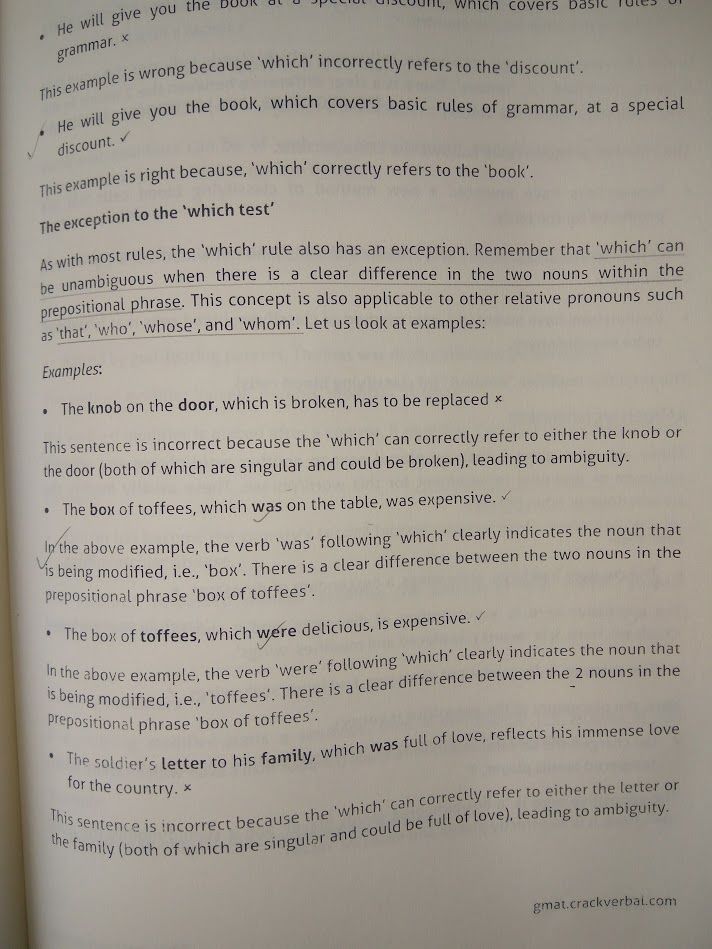
- 21MODIFIERS (Participial Modifiers) Verb-ed ModifierSTARTS
Modifies the SUBJECT of the SUBSEQUENT CLAUSE
AFTER COMMA
Modifies the PRECEDING NOUN or NOUN PHRASE - 22MODIFIERS (Participial Modifiers) Verb-ing ModifierSTARTS
Modifies the:
i. SUBJECT of the SUBSEQUENT CLAUSE, or
ii. ENTIRE CLAUSE itself depending on the context
AFTER COMMA
Modifies the ENTIRE PRECEDING CLAUSE - 23MODIFIERS (Participial Modifiers) Sequence of EventsActions must be in sequential.
Participial Modifier (PM) should be placed:
1. BEFORE the main clause:
When PM has an action that has ALREADY TAKEN PLACE before the action in the main clause
2. AFTER the main clause:
When PM has an action that is the CONSEQUENCE of the action in the main clause
3. BEFORE OR AFTER:
When PM has an action that is subordinate to / description of the action in the main clause - 24MODIFIERS Difference between: Participle Infinitive Past Tense
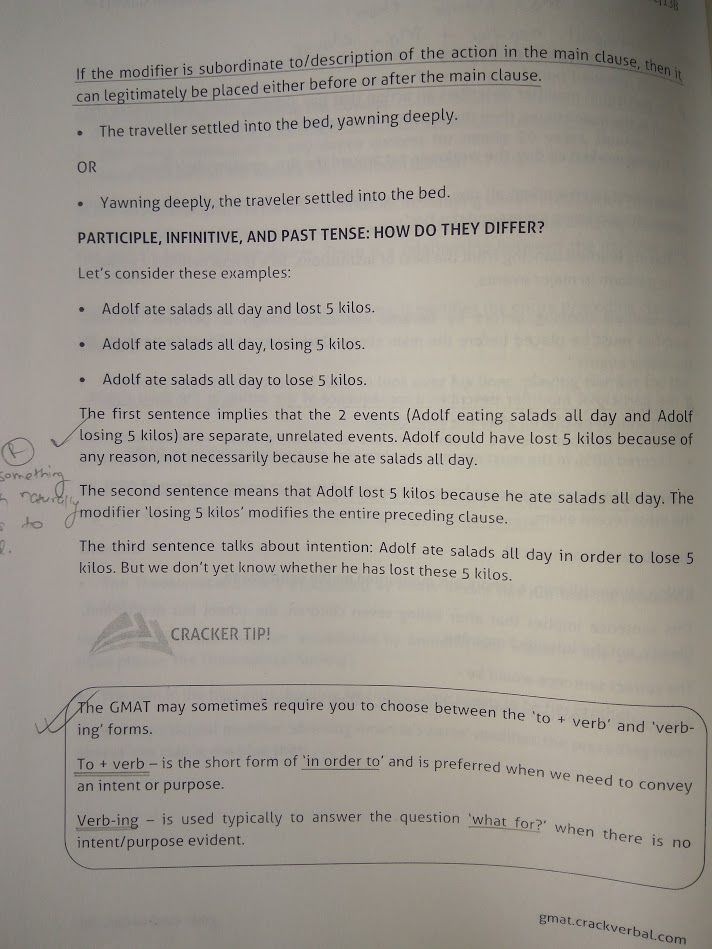
- 25Absolute Modifiers vs. AppositivesABSOLUTE MODIFIERS
A (noun + noun modifier) that modifies the entire preceding clause.
APPOSITIVE
Modifies only the nearest noun phrase - 26COMPARISON Like / As / Such AsLike --> Signifies Similarity
As --> Means 'the same'
- 27Modal VerbsCould - Possibility, Suggestions
Should - Strong suggestions, Instructions
Must - Obligations
Will - Future Certainty
Would - Hypothetical Situation
Might - Mild Probability
- 28Subjunctive MoodUsed to express uncertainty or wishful thinking.
Always use 'WERE' and 'WOULD', irrespective of the subject / tense.
Examples:
i. If I WERE rich, I WOULD institute a scholarship at my alma mater.
ii. If the restaurant WERE TO LIMIT its membership, it WOULD have to raise its membership fees. - 29Command SubjunctiveUsed to express a command for another person / entity to take a specific action.
STRUCTURE:
i. subject + command verb (any tense) + that + subject + verb in SIMPLE form
ii. it + be (any tense) + command adjective + that + subject + verb in SIMPLE tense
https://gmatclub.com/forum/subjunctive-and-use-of-that-with-simple-verb-form-79606.html
Information
- Description
- User has deleted their subject information Flashcards on SC Concepts, created by Deleted user on 30/10/2017.
- Created by
- Deleted user · Oct 2017
- Updated
- Oct 30, 2017
- Views
- 12
- History
-
- Created by Nishant Jain · Oct 30, 2017
- Copied by Nishant Jain · Oct 30, 2017
- Rating